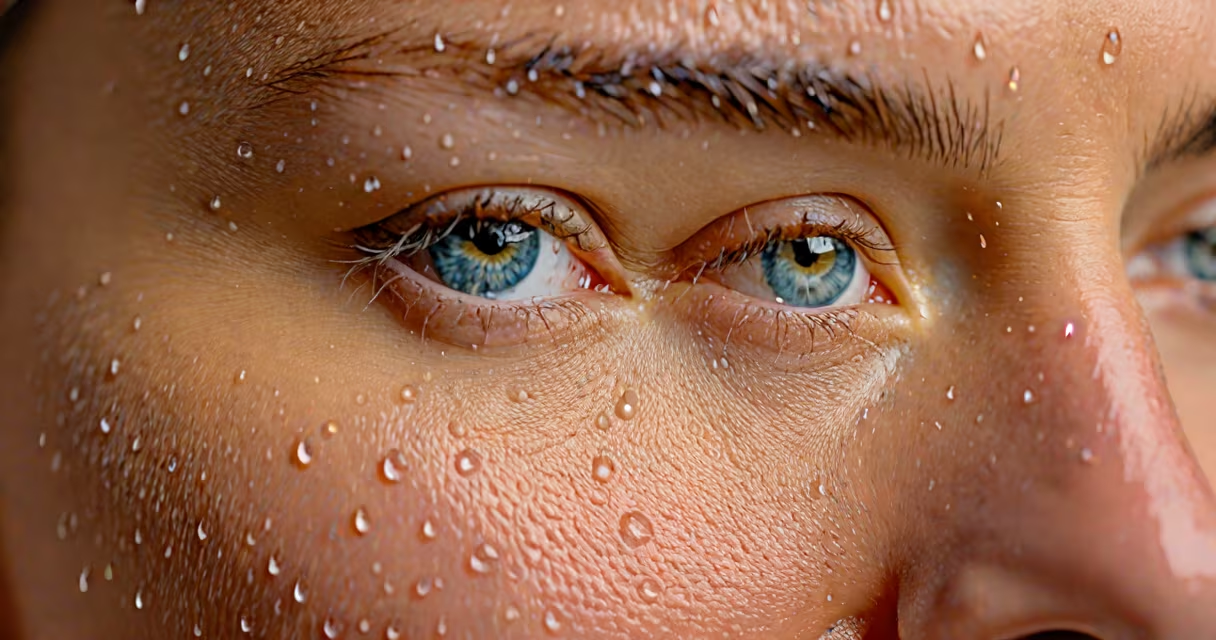
Sweat feels cold because evaporation removes heat from your skin, lowering surface temperature. This process is a core part of how your body maintains internal balance during exertion or high ambient temperatures.
When your body heats up-whether from exercise, fever, or hot weather-your hypothalamus triggers sweat glands to release fluid onto your skin. As this liquid evaporates, it absorbs thermal energy from your skin's surface. The loss of heat makes the area feel cool, even though the sweat itself is at body temperature (around 37°C or 98.6°F).
This mechanism is not unique to humans. Mammals rely on evaporative cooling through sweat, panting, or fur dampening. But human sweat is especially effective due to our high density of eccrine sweat glands-over 2 million across the body-and our ability to sustain prolonged physical activity without overheating.
Evaporation is a phase change: liquid water turns into vapor. This transformation requires energy-specifically, the latent heat of vaporization. For water, that's about 2,260 joules per gram. When sweat evaporates, it pulls that energy from your skin, reducing local temperature.
The rate of cooling depends on environmental conditions. In dry air, sweat evaporates quickly, producing strong cooling. In humid environments, the air is already saturated with moisture, so evaporation slows. That's why high humidity makes you feel hotter-even if the air temperature is the same.
A study published in Journal of Applied Physiology found that under 30% relative humidity, sweat evaporation can lower skin temperature by up to 3°C (5.4°F) within five minutes of onset. At 80% humidity, the same sweat may reduce temperature by less than 1°C (1.8°F).
Humans produce two main types of sweat: eccrine and apocrine. Eccrine sweat is clear, odorless, and responsible for thermoregulation. Apocrine sweat is thicker, produced in areas like the armpits and groin, and contributes to body odor when broken down by bacteria.
Eccrine sweat accounts for nearly all cooling-related perspiration. It's mostly water, sodium chloride, and trace electrolytes. The concentration of salt in sweat varies-average sweat contains about 0.9% sodium chloride-but can rise in people who sweat heavily or have certain medical conditions.
| Type | Location | Function | Composition |
|---|---|---|---|
| Eccrine | Throughout the body, especially palms and soles | Thermoregulation | Water, NaCl, K+, lactate |
| Apocrine | Armpits, groin, around nipples | Emotional signaling, pheromone release | Proteins, lipids, steroids |
Only eccrine sweat contributes to the sensation of coldness. Apocrine sweat doesn't evaporate effectively and remains on the skin longer, increasing bacterial breakdown and odor. That's why underarm sweat doesn't feel cool-it's not meant to cool you down.
Many assume sweat is cold because it comes from the body. But sweat is always near body temperature-about 37°C (98.6°F)-when it leaves the gland. The cooling effect happens only after evaporation begins.
Another myth is that "cold sweat" means the sweat is actually low-temperature. In reality, "cold sweat" is a medical term for excessive sweating triggered by stress, fear, or illness. It's not colder than normal sweat-it's just a physiological response to sympathetic nervous system activation. The chill you feel comes from blood flow redirection and reduced skin perfusion, not from the sweat's temperature.
For example, during a panic attack, people often report clammy hands and a cold sweat. The sweat is still warm-around 36-37°C-but the skin feels icy due to vasoconstriction and reduced blood flow. This is distinct from evaporative cooling, which relies on moisture removal.
During a 10K run on a 30°C (86°F) day with 40% humidity, your core temperature rises. Your hypothalamus activates eccrine glands across your torso, arms, and legs. Sweat appears on your skin and begins to evaporate.
Within two minutes, evaporation lowers your skin temperature by 1.5°C (2.7°F). You feel cooler despite the hot air. But if humidity jumps to 80%, evaporation slows. Sweat pools on your skin, and you feel sticky and overheated-even though your body is still producing sweat.
This is why marathon runners wear moisture-wicking fabrics. These materials draw sweat away from the skin and increase surface area for evaporation. A 2018 study in Textile Research Journal showed that athletes wearing such fabrics maintained 0.8°C lower skin temperature compared to those in cotton during endurance trials.
I once ran a 5K in 35°C heat with 60% humidity. My shirt was soaked within the first mile. Despite feeling wet and uncomfortable, my core temperature stayed stable. After the race, I noticed that the areas where sweat had evaporated-like my back and shoulders-felt noticeably cooler than the parts still covered in damp fabric. The difference wasn't in the sweat itself, but in how much evaporation occurred.
Evaporative cooling fails when sweat cannot evaporate. This happens in high humidity, dense clothing, or stagnant air. In these cases, sweat accumulates on the skin, offering no cooling benefit and potentially increasing risk of heat exhaustion.
Dehydration also impairs the process. With low fluid volume, sweat production drops. A 2020 review in Frontiers in Physiology found that losing just 2% of body weight in fluid reduces sweat rate by 30%. This reduces evaporative capacity and raises core temperature faster during sustained activity.
If you're sweating but not cooling, check your environment and hydration. Wear loose, breathable clothes. Stay hydrated. And avoid exercising during peak afternoon heat unless acclimated.
Understanding why sweat feels cold clarifies how your body manages heat. It's not magic-it's physics. Evaporation is a useful natural mechanism, but it only works when conditions allow.