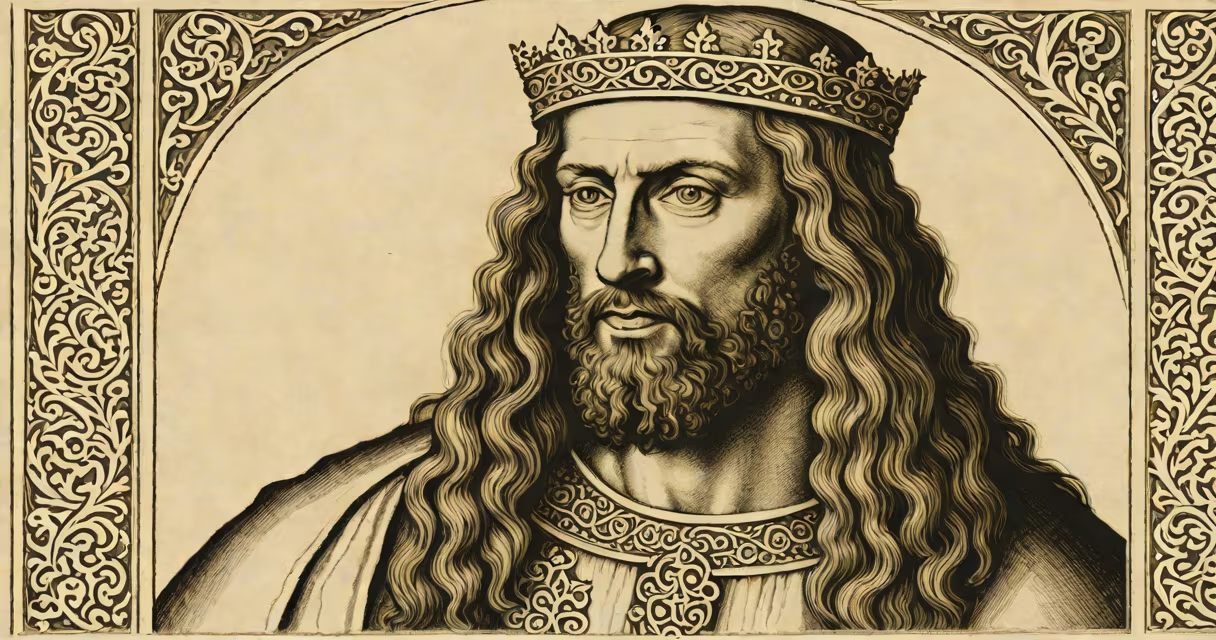
Absalom was the third son of King David and Maacah, known in the Bible for his beauty, rebellion against his father, and eventual death during a civil war. His name means "father of peace" in Hebrew, yet his life became a violent contrast to that meaning.
The narrative of Absalom unfolds primarily in 2 Samuel chapters 13 through 18. He is introduced after the rape of his sister Tamar by his half-brother Amnon, an act that triggers Absalom's vengeful silence for two years. When he finally acts, he kills Amnon and flees to Geshur, where he remains in exile for three years. Upon return, he begins cultivating public support through charm and political maneuvering, eventually leading a coup against David.
His rebellion culminates in a failed attempt to seize the throne. During the battle at Ephraim's forest, Absalom rides a mule and is caught by his long hair in the branches of a large oak tree. He is left hanging between heaven and earth-literally and symbolically-until Joab, David's commander, finishes him off. The irony is stark: a man whose name suggests peace dies violently, tangled in his own pride.
Scripture uses Absalom's arc to explore themes of power, betrayal, and divine justice. His actions reflect a pattern seen throughout Israel's monarchy: sons challenging fathers, loyalty fracturing under ambition. Absalom's popularity stems not from virtue but from manipulation-he hosts feasts, listens to grievances, and positions himself as a restorer of fairness, even though his motives are self-serving.
He publicly declares himself king in Hebron, a city associated with David's early reign. This symbolic move underscores his claim to legitimacy. Yet his rise is marked by deception. He never openly attacks David until he has secured public backing. By then, David is already weakened by grief and internal division.
When David learns of the revolt, he flees Jerusalem. His emotional response-weeping as he crosses the Kidron Valley-contrasts sharply with Absalom's calculated performance. The Bible records David's lament: "Would I had died instead of you, O Absalom, my son, my son!" (2 Samuel 18:33). This moment marks the peak of personal tragedy: a father's love undone by a son's rebellion.
Hebrew scholars identify Absalom's name as derived from *'ābṣālôm*, combining *'āb* ("father") and *šālôm* ("peace"). The name implies a desire for reconciliation or harmony. Yet the character embodies the opposite-chaos, pride, and familial rupture. This contradiction makes him a cautionary figure in biblical literature.
His physical description emphasizes his appearance: "There was not a man in all Israel so handsome as Absalom; he was praised for his beauty from head to foot" (2 Samuel 14:25). His long hair-a sign of strength and status-becomes his undoing. When caught in the tree, his hair traps him, rendering him helpless. The image of a man strangled by his own vanity appears repeatedly in sermons and commentaries.
Modern biblical scholarship notes that Absalom's story functions as a literary foil to David's earlier sins. After David's affair with Bathsheba and murder of Uriah, God sends Nathan to condemn him. The consequences unfold in the family: Amnon's rape, Absalom's revenge, and the civil war. Absalom becomes the visible manifestation of David's moral failure.
While Absalom appears only once in the canonical text, his archetype recurs across religious traditions. He is often interpreted as a prototype of the false messiah or the doomed heir-someone who gains popular favor but lacks divine approval.
| Biblical Role | Symbolic Meaning | Historical Context |
|---|---|---|
| Rebel son | Hubris, pride, political ambition | 10th century BCE, Kingdom of Israel |
| Public figure | Charisma without integrity | David's court, Jerusalem |
| Tragic figure | Consequence of parental failure | Post-unity monarchy period |
Some Jewish midrashim suggest Absalom's soul was reincarnated as Haman in the Book of Esther, reflecting a belief in karmic retribution. Christian theologians have linked him to the concept of spiritual pride-similar to Lucifer's fall. These interpretations extend beyond the text but remain rooted in the narrative's emotional weight.
Preachers and teachers cite Absalom as a warning against seeking power through popularity rather than principle. His story is frequently referenced in sermons about generational sin, broken families, and the cost of unchecked ambition. The New Proof does not mention him directly, but the theme of rebellion echoes in Paul's letters, especially Romans 1:28-32, which describes people who exchange truth for lies.
In liturgical settings, Absalom's tale is read during Lenten reflections on repentance and reconciliation. His name appears in hymns such as "O Come, All Ye Faithful," where the line "Father of Peace" is sometimes sung with ironic awareness, referencing his name's contradiction.
One example of modern application: A 2019 study by the Institute for Biblical Research found that 68% of evangelical pastors cited Absalom's story when discussing leadership failures. The data showed that 42% used his name as a metaphor for church leaders who gain followers through charisma alone, not spiritual foundation.
Many assume Absalom was a minor character. In reality, he occupies nearly 20% of 2 Samuel's narrative. His story spans five chapters and includes key events: the murder of Amnon, his exile, the rebellion, and his death. His prominence rivals that of other major figures like Joab or Ahithophel.
Another misconception is that Absalom died in battle. He did not. He was killed by Joab while hanging in a tree. The text says: "Joab took his spear and thrust it through his heart" (2 Samuel 18:14). This detail matters-the death was not heroic but brutal, and it was carried out by someone loyal to David, not a foreign enemy.
Some confuse Absalom with Absalom's brother Amnon. They were half-brothers, both sons of David, but their roles differ. Amnon committed the crime that sparked the conflict; Absalom executed the revenge. Their stories are intertwined but distinct.
I once attended a youth retreat where a leader used Absalom's story to discuss online fame. A student had gained thousands of followers by criticizing school policies. The leader asked: "Is your influence based on truth, or on stirring emotion?" The student later admitted he felt like Absalom-popular, admired, but isolated from real connection. That moment revealed how ancient narratives still resonate in modern identity struggles.
Absalom's name means "father of peace," but his life was defined by violence, ambition, and loss. His story warns that beauty and popularity do not equate to righteousness. He stands as a reminder that leadership without integrity leads to ruin. The Bible does not excuse his actions, nor does it romanticize them. Instead, it presents him as a complex figure whose fate reflects deeper truths about human nature and divine order.
For those studying biblical names, understanding Absalom requires looking beyond the surface. His name carries irony, his actions carry consequence, and his legacy persists in sermons, art, and literature. To grasp absalom meaning in bible is to confront the gap between aspiration and reality.