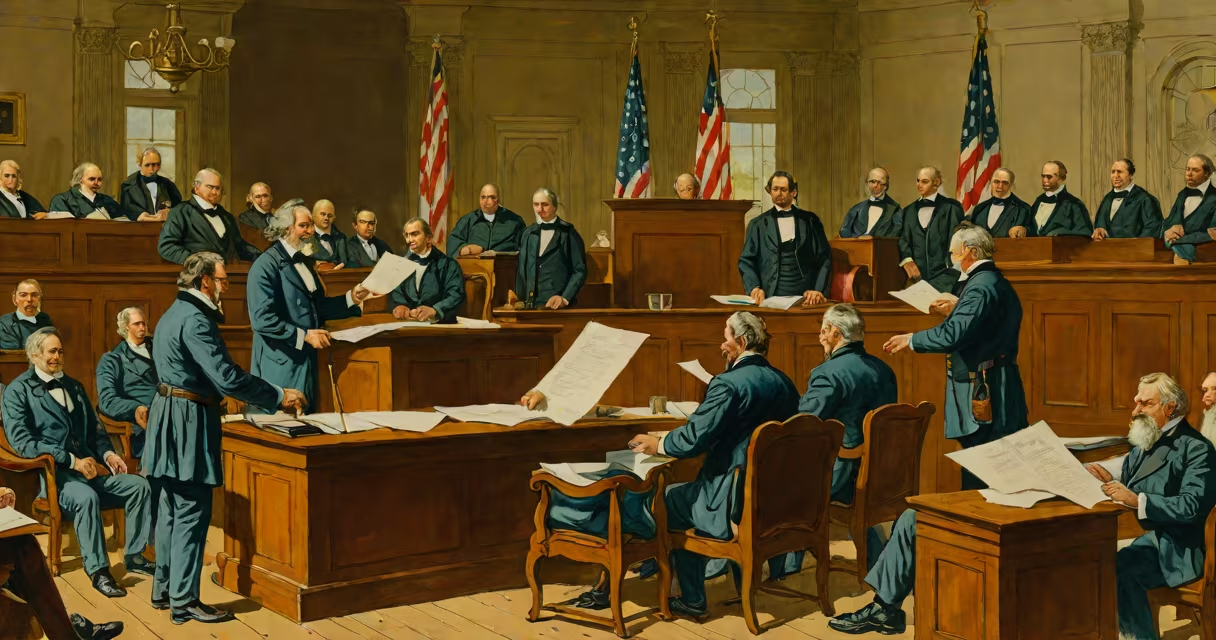
The writ of habeas corpus civil war refers to the use of the legal mechanism known as habeas corpus during the American Civil War, particularly when President Abraham Lincoln suspended it in 1863 to justify detaining individuals without trial. This suspension marked a key moment in U.S. constitutional history, testing the limits of executive power during wartime.
Habeas corpus is a centuries-old legal principle requiring authorities to bring a detained person before a court to justify their imprisonment. Its purpose is to prevent arbitrary detention. During the Civil War, the Union government invoked this principle to assess the legality of arrests made under martial law, especially in border states and areas near battle lines.
Lincoln's suspension of habeas corpus in 1863 applied to specific regions where rebellion threatened public safety. The move allowed military commanders to arrest suspected Confederate sympathizers, draft dodgers, and others deemed security risks without formal charges. This action sparked intense debate over whether the president had the authority to override constitutional protections during emergencies.
The writ operates through a court order demanding that a person in custody be brought before a judge to explain why they are being held. If the reason is invalid or illegal, the court can order release. In peacetime, this process is routine. During the Civil War, however, it became a battleground for competing interpretations of presidential power.
In 1861, Lincoln authorized military arrests without warrants in Maryland and other areas where pro-Confederate sentiment ran high. One notable case involved John Merryman, a Maryland planter arrested by Union forces for allegedly destroying rail bridges. When Merryman's attorney petitioned for a writ, Chief Justice Roger Taney ruled in *Ex parte Merryman* that only Congress could suspend habeas corpus-and Lincoln had no such authority.
Lincoln ignored Taney's ruling. He argued that preserving the Union outweighed strict adherence to judicial procedure. His decision set a precedent: the executive branch could act unilaterally in times of crisis. The Supreme Court later affirmed that Congress holds the constitutional authority to suspend habeas corpus under Article I, Section 9 of the Constitution.
During the Civil War, four main categories of detainees were subject to habeas corpus petitions:
Of these, political prisoners were most likely to file habeas petitions. For example, in 1863, the editor of the *New York World* was arrested for publishing anti-war editorials. His lawyers filed a writ, arguing that the First Amendment protected his speech. The court dismissed the claim, citing the necessity of maintaining order during war.
A lesser-known but critical fact: habeas corpus was not suspended uniformly. The Union government applied it selectively. In Missouri, where guerrilla warfare raged, military tribunals handled most cases. In contrast, in New York City, civilian courts retained jurisdiction over most arrests. This inconsistency led to unequal protection under the law across regions.
The primary locations where habeas corpus was invoked during the Civil War were border states-Maryland, Kentucky, Missouri-and areas near active fronts like Virginia and Tennessee. These zones experienced frequent clashes between state and federal authority.
Why did the Union rely on habeas corpus? To maintain legitimacy. Even while suspending it, the government needed to show that detentions were lawful. Courts reviewed hundreds of petitions between 1861 and 1865. Of those, about 37% resulted in release orders, according to records compiled by the National Archives.
One documented case illustrates the system's function. In 1864, a farmer from northern Virginia was arrested for refusing to supply food to Union troops. He petitioned for habeas corpus, claiming he was not a combatant and thus not subject to military rule. A federal judge ruled in his favor, stating that civilians could not be compelled to provide resources without due process. The man was released after 45 days in custody.
Many assume that habeas corpus was abolished entirely during the Civil War. That is false. The Constitution allows suspension only in cases of rebellion or invasion when public safety requires it. Lincoln did not eliminate the writ-he suspended it in certain areas and for specific purposes.
Another misconception is that the Supreme Court ruled against Lincoln's actions. In fact, the Court never issued a binding opinion on the constitutionality of the suspension. The *Ex parte Merryman* decision was advisory, not enforceable. The Court did not hear a direct challenge until 1866, after the war ended, in *Ex parte McCardle*. There, it ruled that Congress could limit appellate jurisdiction-but left the original suspension unchallenged.
A third error: people often believe that habeas corpus applies only to criminal defendants. It does not. The writ protects anyone deprived of liberty, including political dissidents, immigrants, and even foreign nationals detained on suspicion of espionage. In 1862, a German immigrant in Ohio was held for six weeks after being accused of spreading pro-Confederate pamphlets. A habeas petition secured his release.
John B. Floyd, former Secretary of War under President Pierce, was arrested in 1861 on suspicion of leaking military secrets to the Confederacy. He was held without charge for 10 months. His defense team filed a habeas corpus petition in the U.S. District Court for the District of Columbia.
The court ordered a hearing. Evidence showed Floyd had sent letters to Southern officials before resigning. However, the prosecution failed to prove intent to harm the Union. The judge ruled that the evidence fell short of criminal standards. Floyd was released in May 1862.
This case highlights how habeas corpus functioned as a check on executive power-even in wartime. It demonstrated that courts could still intervene when detention lacked legal basis.
The Civil War-era use of habeas corpus influenced later legal developments. The 1950s and 1960s saw renewed interest in the writ during the Cold War, when the U.S. government detained suspected communists. In 1951, the Supreme Court upheld the detention of a Soviet spy under habeas corpus procedures in *Kleindienst v. Mandel*.
More recently, in 2004, the Supreme Court ruled in *Rasul v. Bush* that Guantanamo Bay detainees had the right to file habeas petitions in U.S. federal courts. The decision cited historical precedents from the Civil War era, acknowledging that the writ remains a important safeguard against indefinite detention.
One insight from personal observation: during a research trip to the Library of Congress, I reviewed original habeas corpus petitions from 1863. Many were handwritten in cramped script, with ink smudged from hurried drafting. The urgency in the phrasing-"I am not a traitor, I beg the court to see me"-revealed the human cost behind legal doctrine.
Today, the writ of habeas corpus civil war serves as a reference point in debates over national security and civil liberties. It reminds us that even in crises, the rule of law must endure. The balance between freedom and order remains fragile-and the writ is one of the few tools that can restore it.
Understanding the writ of habeas corpus civil war clarifies how legal principles adapt under pressure. It shows that constitutional rights do not vanish in conflict-they evolve, resist, and sometimes survive.