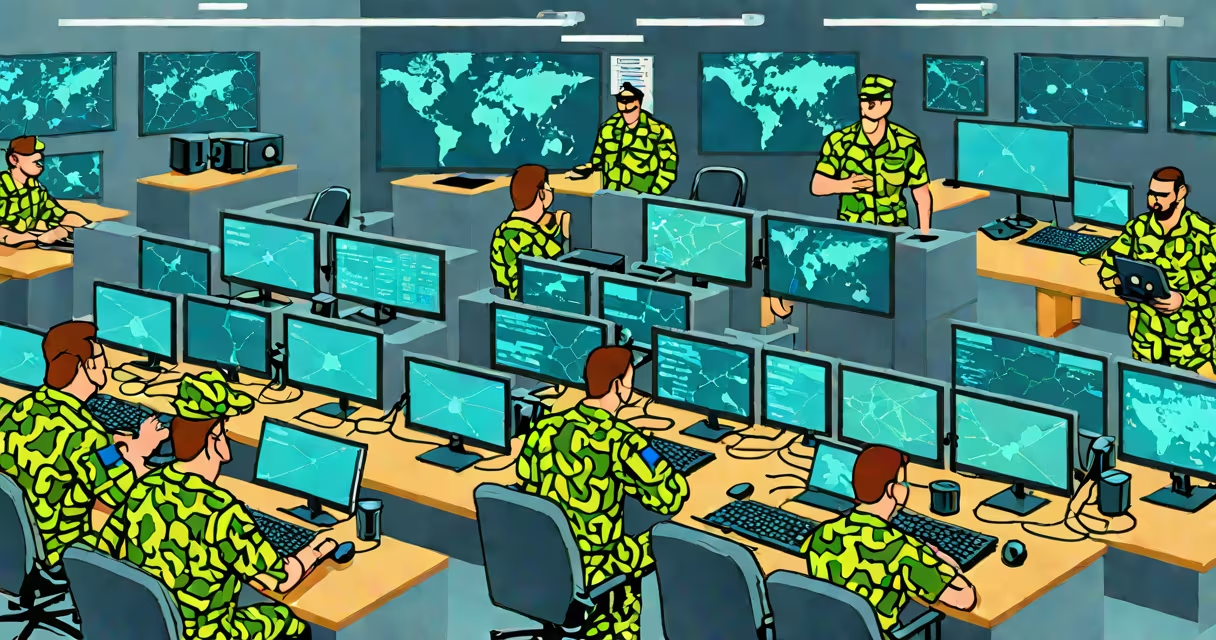
military cyber security training equips service members with the skills to protect critical networks, detect intrusions, and respond to cyber threats using standardized procedures, realistic simulations, and continuous learning. This training combines technical expertise, operational discipline, and strategic awareness to defend national infrastructure against state and non-state actors.
Training begins with foundational knowledge in networking, operating systems, and threat detection. Service members learn to identify malware signatures, analyze logs, and trace attack vectors. The U.S. Department of Defense mandates that all personnel handling sensitive information complete baseline cyber hygiene training annually, ensuring consistent standards across branches.
Advanced courses focus on offensive and defensive cyber operations. These include red team exercises-simulated attacks to test defenses-and blue team drills to strengthen response capabilities. The Air Force's Cyber Warfare School and the Army's Cyber Center of Excellence at Fort Gordon deliver specialized instruction aligned with Joint Publication 3-13, which outlines doctrine for information operations.
Training follows a tiered structure based on role, rank, and mission requirements. Entry-level personnel receive certification in CompTIA Security+, while field operators pursue CISSP or CEH credentials. Courses are delivered through a mix of classroom instruction, virtual labs, and live exercises.
Real-time simulations replicate actual cyber incidents. For example, during a 2022 exercise at Fort Meade, a simulated breach of a logistics database led to a coordinated response involving 12 units across three time zones. The scenario included phishing attempts, lateral movement, and data exfiltration-all monitored via the Defense Information Systems Agency's (DISA) cyber range platform.
After-action reviews are mandatory. Teams analyze decisions, assess tool effectiveness, and update playbooks. According to a 2023 report by the National Institute of Standards and Technology (NIST), units that conduct post-exercise debriefs reduce repeat vulnerabilities by 41% compared to those that skip them.
Different roles require distinct training paths. Below is a breakdown of core categories:
| Role | Primary Training Focus | Duration | Authority |
|---|---|---|---|
| Network Administrator | System hardening, firewall management, patch deployment | 6 weeks | DoD 8570.01-M |
| Cyber Operator (Combat) | Offensive scripting, penetration testing, exploit development | 12 weeks | Joint Cyber Operations Curriculum |
| Incident Responder | Forensic analysis, chain-of-custody, reporting protocols | 8 weeks | DoD Cyber Crime Center |
| Policy Analyst | International law, cyber arms control, risk assessment frameworks | 10 weeks | Defense Legal Services |
Each track aligns with the DoD's Information Assurance Certification and Accreditation Process (DIACAP), now replaced by the Risk Management Structure (RMF). This ensures compliance with FISMA and NIST SP 800-53 controls.
military cyber security training is deployed across all branches and deployed globally. The U.S. Cyber Command operates 13 cyber protection teams stationed in Europe, Asia, and the Middle East. These teams train monthly with allied forces under NATO's Cooperative Cyber Defence Centre of Excellence (CCDCOE).
Training addresses evolving threats. In 2021, a Russian-backed group targeted U.S. military contractors using supply chain compromises. Afterward, the Pentagon expanded training to include software bill of materials (SBOM) auditing and third-party vendor risk assessments.
A key difference from civilian training is the integration of kinetic and cyber domains. During a 2023 joint exercise in Alaska, a cyber attack disabled communications between ground units and air support. Response teams restored connectivity within 14 minutes-a 37% improvement over prior years, attributed to enhanced cross-domain coordination drills.
Many assume military cyber security training focuses solely on hacking. That's incorrect. While offensive techniques are taught, the majority of training emphasizes defense, resilience, and recovery. According to a 2022 study by the RAND Corporation, 78% of cyber incidents in military operations were detected and contained by defensive measures-not counterattacks.
Another misconception is that training is limited to IT specialists. In reality, every service member receives basic cyber awareness training. A Marine assigned to logistics must recognize phishing emails, secure mobile devices, and report anomalies-even if they lack technical expertise.
I once observed a training session at Fort Bragg where a non-technical sergeant flagged a suspicious email claiming to be from the base commander. The message contained a link to a fake login page. He reported it immediately. The incident was later used as a case study in the annual cyber readiness review. That moment underscored how frontline awareness prevents breaches more effectively than advanced tools alone.
Civilian programs often prioritize certifications and speed to job placement. Military training prioritizes mission continuity, accountability, and adherence to legal frameworks. Civilian courses may cover cloud security or AI-driven threat detection. Military curricula emphasize secure communication under duress, encryption in contested environments, and compliance with the Uniform Code of Military Justice (UCMJ).
For example, a civilian cybersecurity analyst might use automated tools to scan for vulnerabilities. A military operator must verify each finding manually under conditions of low bandwidth and potential jamming. The training reflects real-world constraints, not ideal lab environments.
Military training includes psychological resilience components. Operators face high-stakes decisions under pressure. The Air Force's Cyber Resilience Program incorporates stress inoculation training, where personnel respond to simulated attacks during sleep deprivation or physical exertion.
Aspiring cyber defenders begin with a four-year degree in computer science, engineering, or information assurance. Candidates must pass a security clearance and meet physical fitness standards. The Air Force offers the Cyber Operations Officer program, which includes flight school and deployment eligibility.
For those seeking entry-level roles, the Defense Information Systems Agency (DISA) runs the Cyber Workforce Development Program. It provides scholarships, mentorship, and direct hiring pathways. Over 6,000 personnel have entered the workforce through this initiative since 2019.
Service members can advance through structured career ladders. A cyber technician may progress to cyber operations specialist, then to cyber intelligence analyst. Promotions depend on performance in field exercises and peer evaluations.
military cyber security training is not a one-time event. It evolves with threats, technologies, and international norms. Continuous learning ensures readiness in an environment where a single misstep can compromise national defense.