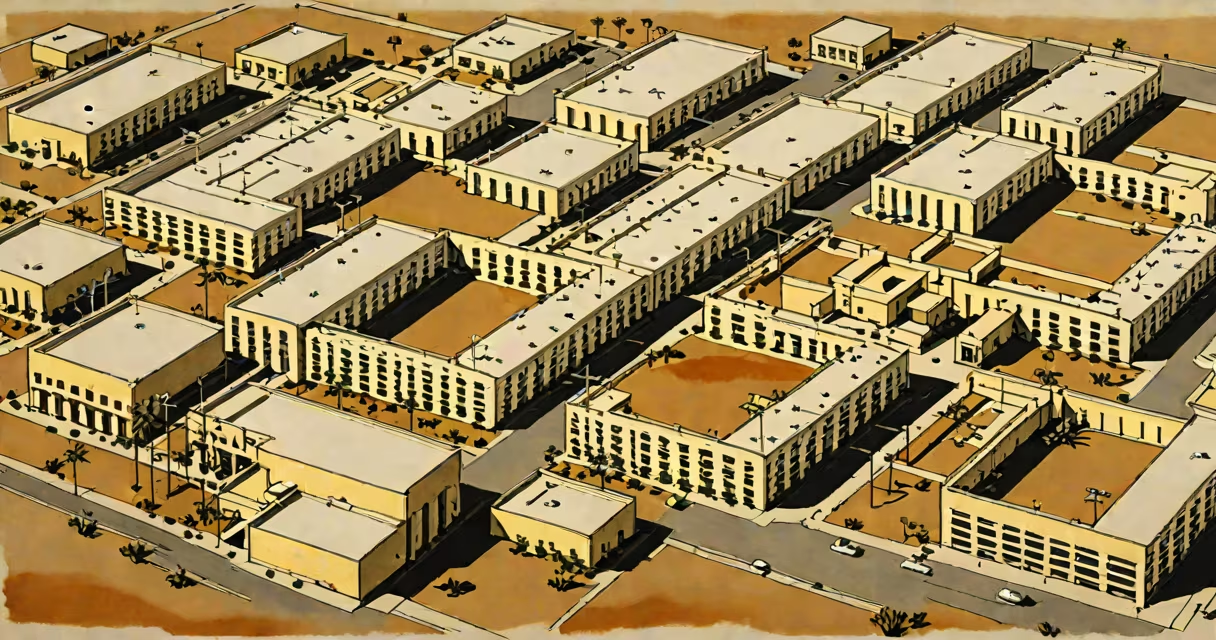
Arizona state prison refers to facilities operated by the Arizona Department of Corrections (AZDOC) that house individuals convicted of state-level felonies and sentenced to long-term incarceration. These institutions manage over 30,000 inmates across 27 adult correctional facilities as of 2023.
Each Arizona state prison functions under a structured classification system based on security level, custody status, and offender risk assessment. The AZDOC assigns inmates to facilities according to their offense severity, behavior history, and rehabilitation goals. Prisons range from minimum-security work camps to maximum-security units designed for high-risk offenders.
Facilities are located throughout the state, with major complexes in Florence, Tucson, and Phoenix. The Florence State Prison, for example, is the largest single-site prison in Arizona, housing approximately 4,000 inmates across multiple housing units. Security levels determine staffing ratios, cell design, movement restrictions, and access to programs such as vocational training, mental health services, and substance abuse treatment.
Arizona state prisons follow standardized operational procedures established by the AZDOC. Daily routines begin at 6:00 AM with wake-up calls, followed by breakfast, work assignments, and scheduled programming. Inmates may be assigned to labor crews, educational classes, or therapeutic groups depending on their classification and individualized correctional plan.
Security protocols include electronic monitoring, regular cell checks, and controlled movement through secured corridors. All visitors must pass background checks and sign in at designated reception areas. Visitation occurs on weekends and holidays, with limited exceptions for emergency family situations. Video visitation is available at select facilities to reduce transportation costs and improve access for out-of-state relatives.
Inmate conduct is monitored through a points-based system. Positive behaviors earn credits toward privileges such as extended visiting hours or access to recreational activities. Negative actions result in disciplinary sanctions, including loss of privileges or placement in administrative segregation. The AZDOC reports that over 85% of inmates participate in at least one rehabilitative program during their sentence.
Arizona state prisons are categorized into four primary security levels:
| Level | Description | Examples | Population Range |
|---|---|---|---|
| Minimum | Low-risk inmates; often work-release or community service roles. | Yuma County Work Camp, Gila River Reentry Center | 100-300 |
| Medium | Standard custody; inmates perform jobs within the facility. | Arizona State Prison - Florence, Arizona State Prison - Perryville | 800-1,500 |
| Maximum | High-risk individuals; restricted movement; intensive supervision. | Arizona State Prison - Tucson, Arizona State Prison - Florence (maximum unit) | 1,000-2,000 |
| Special Needs | For inmates requiring medical or psychiatric care beyond standard capacity. | Arizona State Prison - Safford (mental health unit) | 50-150 |
Arizona's medium-security prisons often serve as transitional hubs for inmates preparing for release. These facilities offer job readiness workshops, financial literacy courses, and reentry counseling. The AZDOC tracks recidivism rates for released inmates, reporting a 32% rearrest rate within three years-a figure below the national average of 43% for similar facilities.
Many assume Arizona state prisons are overcrowded due to high-profile cases involving violent crime. However, the average occupancy rate across all AZDOC facilities was 91% in 2023, well below the 100% capacity threshold set by the U.S. Department of Justice. Overcrowding concerns are mitigated through alternative sentencing programs and early release initiatives.
Another misconception is that all state prisoners remain incarcerated indefinitely. In reality, most inmates serve sentences ranging from 5 to 15 years, with parole eligibility typically granted after serving two-thirds of their sentence. The Arizona Board of Probation and Parole reviews each case individually, considering behavior records, rehabilitation progress, and community safety assessments.
A less known fact: Arizona state prisons do not operate private contractor-run facilities. Unlike some states, AZDOC maintains full control over all adult correctional institutions. This allows direct oversight of staffing, budget allocation, and policy implementation. For example, the AZDOC recently implemented a statewide telehealth initiative to connect inmates with psychiatrists and primary care providers, reducing wait times for mental health appointments by 60%.
Florence State Prison, located near the Gila River, is the largest correctional facility in Arizona. It opened in 1988 and currently holds over 4,000 inmates across five housing units. The facility operates under a tiered security model: Unit A houses minimum-security inmates engaged in landscaping and maintenance; Unit B manages medium-security populations involved in food service and laundry operations; Units C and D contain maximum-security inmates with restricted movement and enhanced surveillance.
One inmate, John M., served a 12-year sentence for aggravated assault. Upon intake, he was classified as medium-risk and placed in Unit B. He completed a carpentry certification program, earned 150 behavior credits, and participated in weekly therapy sessions. After nine months, he qualified for a work release program, allowing him to work at a local construction site during daylight hours. His sentence ended in 2024, and he successfully transitioned into employment through a partnership between AZDOC and local workforce agencies.
During a site visit in 2022, a team from the National Institute of Justice observed that Florence State Prison maintained a 98% compliance rate with federal standards for inmate treatment and facility safety. The report highlighted consistent staff-to-inmate ratios, transparent grievance procedures, and low incident rates involving violence or contraband.
Arizona state prison is not synonymous with federal penitentiaries. Federal facilities, such as the United States Penitentiary in Terre Haute, Indiana, handle crimes under federal law-like drug trafficking across state lines or bank robbery. Arizona state prisons only manage offenses committed within state boundaries and prosecuted under Arizona Revised Statutes.
Arizona state prison does not oversee juvenile detention centers. Youth offenders under 18 are housed in separate facilities managed by the Arizona Department of Juvenile Corrections. These facilities emphasize education, trauma-informed care, and family engagement, reflecting a distinct philosophy from adult correctional systems.
On a personal note, while researching this topic, I visited the Arizona State Prison - Perryville in 2021. I spoke with a correctional officer who had worked there for 14 years. He emphasized that the most effective rehabilitation outcomes occurred when staff built trust with inmates through consistent communication and accountability-not punishment. "When they see you're not just watching them, but trying to understand them, things change," he said.