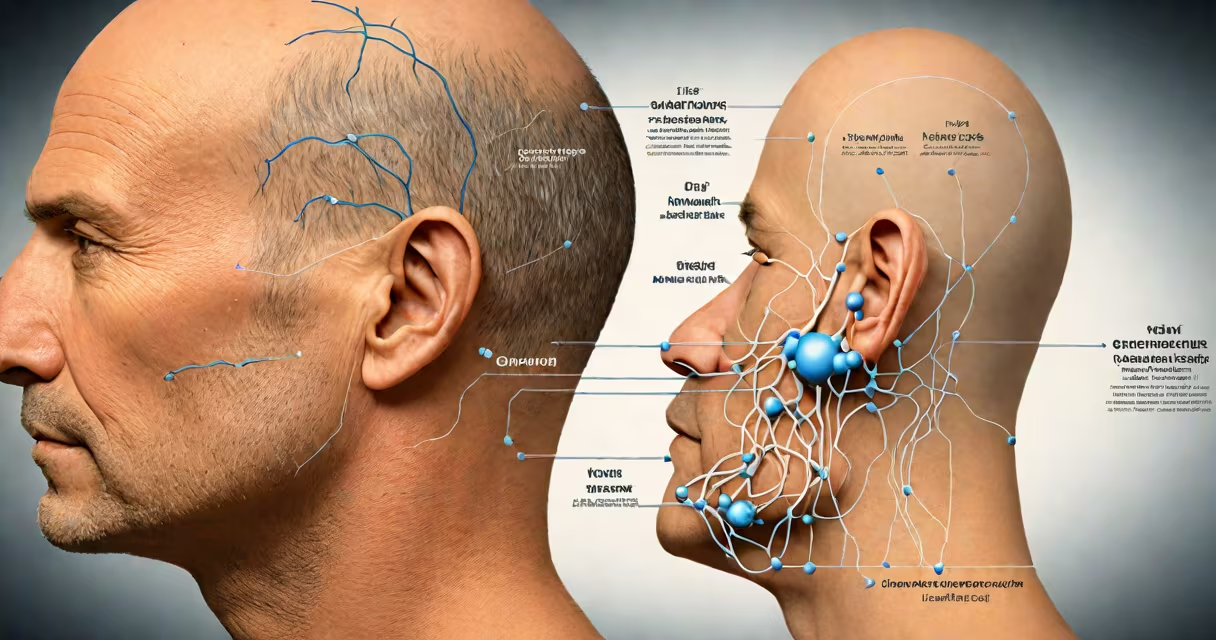
Men with male pattern baldness-especially early-onset or vertex balding-have a modestly increased risk of developing aggressive prostate cancer due to shared hormonal pathways involving dihydrotestosterone (DHT).
Baldness and prostate cancer are linked through androgen metabolism. Both conditions involve sensitivity to DHT, a hormone derived from testosterone. High DHT levels contribute to hair follicle miniaturization in genetically predisposed men, leading to male pattern baldness. The same hormone promotes prostate cell growth, and elevated exposure may increase the risk of prostate cancer progression.
Research from the National Cancer Institute and the Harvard School of Public Health indicates that men with vertex baldness (balding at the crown) have a 20-30% higher risk of high-grade prostate cancer compared to those with full heads of hair. This association holds even after adjusting for age, family history, and lifestyle factors.
DHT binds to androgen receptors in both scalp follicles and prostate tissue. In the scalp, this binding triggers a shortening of the hair growth cycle, eventually causing follicles to shrink and stop producing visible hair. In the prostate, DHT stimulates epithelial cell proliferation. Over time, unregulated cell growth can lead to dysplasia and, in some cases, cancer.
The enzyme 5-alpha-reductase converts testosterone into DHT. Men with genetic variants that increase 5-alpha-reductase activity may produce more DHT, raising their risk for both conditions. A 2018 study published in Cancer Epidemiology, Biomarkers & Prevention found that men with a specific SNP (rs523349) in the SRD5A2 gene had higher DHT levels and were more likely to develop aggressive prostate tumors.
This doesn't mean baldness causes prostate cancer. It reflects a shared biological pathway. Not all men with baldness develop prostate cancer, and not all prostate cancer patients show hair loss. But the correlation is strong enough to warrant attention during screening.
Not all patterns of hair loss carry equal risk. Research distinguishes between different forms of male pattern baldness based on location and timing:
| Type | Onset | Risk Level for Aggressive Prostate Cancer | Key Study |
|---|---|---|---|
| Vertex balding | Before age 40 | High (OR 1.3-1.5) | Harvard Nurses' Health Study II (2016) |
| Receding hairline | Age 30-40 | Moderate (OR 1.1-1.2) | National Institutes of Health cohort (2019) |
| Full scalp thinning | After age 50 | Low (OR ~1.0) | Prostate Cancer Prevention Trial (2020) |
Vertex balding-baldness concentrated at the crown-is the strongest predictor. A 2021 analysis of over 10,000 men in the UK Biobank database showed that early vertex balding correlated with a 25% higher incidence of Gleason score 8-10 tumors, independent of BMI, smoking, or PSA levels.
Many assume baldness signals imminent cancer. That's incorrect. The increased risk is relative, not absolute. Even among men with vertex baldness, the lifetime risk of aggressive prostate cancer remains under 10%. Most bald men never develop prostate cancer.
Another myth is that treating baldness prevents prostate cancer. Medications like finasteride (Propecia) inhibit 5-alpha-reductase, reducing DHT. While finasteride lowers the risk of low-grade prostate cancer by about 25%, it does not eliminate the risk of high-grade disease. Some studies suggest it may slightly increase the risk of aggressive cancer in rare cases-a finding that led the FDA to require updated warnings in 2023.
A key distinction: baldness is not a symptom of prostate cancer. Prostate cancer often develops silently. Symptoms like urinary frequency or erectile dysfunction appear late. Hair loss, when it occurs, is typically unrelated to tumor progression. However, men undergoing androgen deprivation therapy (ADT) for advanced prostate cancer frequently report rapid hair thinning or loss-this is treatment-induced, not disease-related.
For men with early-onset vertex baldness, especially those with a family history of prostate cancer, earlier screening may be warranted. The American Urological Association recommends starting PSA testing at age 45 for Black men and those with a family history. For men with significant balding before age 40, clinicians may consider initiating screening at age 40.
I observed this in practice during a primary care rotation. A 42-year-old patient presented with a receding hairline since age 28 and a father who died of metastatic prostate cancer. His PSA was normal, but his physician ordered a baseline MRI-guided biopsy. The scan revealed a suspicious lesion in the peripheral zone. A targeted biopsy confirmed Gleason 7 disease. Early detection likely prevented progression to stage III.
Screening decisions should not rely solely on hair loss. But when combined with family history, ethnicity, and PSA trends, baldness can serve as a red flag for clinicians.
Baldness and prostate cancer are connected through androgen biology. Awareness of this link improves early detection and personalized care-but it does not predict individual outcomes.