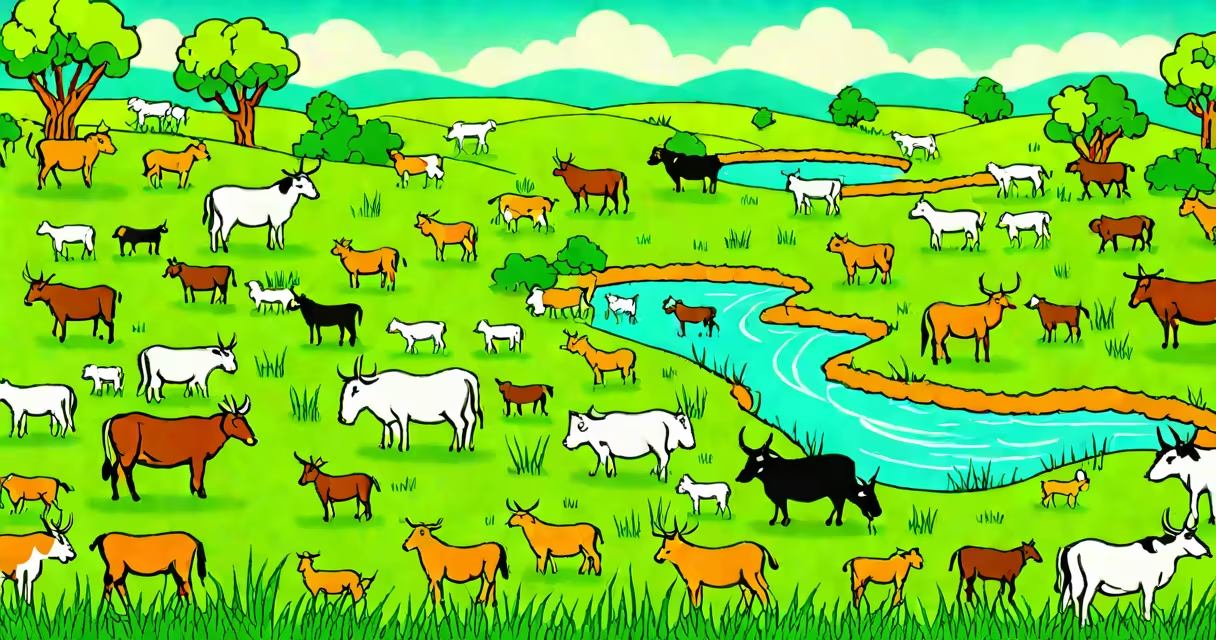
Carrying capacity in biology is the maximum number of individuals of a species that an environment can support indefinitely given available resources like food, water, shelter, and space. It defines the upper limit of sustainable population size under current conditions.
This concept arises from ecological models of population growth. When a population grows rapidly in ideal conditions, it follows exponential growth. But as resources become scarce, growth slows and eventually stabilizes. The point where birth rates equal death rates-and population size remains steady-is the carrying capacity.
For example, a lake can support 500 fish based on oxygen levels, plankton supply, and nesting sites. If the fish population exceeds 500, competition increases, disease spreads faster, and mortality rises until numbers drop back to equilibrium. That equilibrium level is the lake's carrying capacity.
Carrying capacity is not a fixed number-it changes with environmental conditions. Droughts reduce water availability, fires destroy habitat, and pollution degrades food quality. These shifts lower the effective carrying capacity even if physical space remains unchanged.
Populations often overshoot carrying capacity during rapid growth phases. This leads to a crash when resources are depleted. For instance, reindeer introduced to St. Matthew Island in the Bering Sea grew from 29 to over 1,000 in a decade. By 1966, starvation had reduced the herd to 42 due to overgrazing and lack of food.
Ecologists use the logistic growth model to describe this pattern mathematically. The equation dN/dt = rN(K−N)/K shows how growth rate declines as population size (N) approaches carrying capacity (K). The parameter r represents intrinsic growth rate-the speed at which a population expands when resources are abundant.
Resource availability is the primary determinant. Food, water, sunlight (for plants), and nesting sites directly affect survival and reproduction. A forest may support 200 deer if acorns are plentiful. If a mast year fails, the carrying capacity drops to 150.
Other factors include predation, disease, competition, and human activity. Urban development can fragment habitats, reducing carrying capacity even if food is present. Pollution alters soil chemistry, making nutrients inaccessible to roots. Climate change shifts temperature and precipitation patterns, disrupting seasonal cycles that species depend on.
Some species exhibit behavioral regulation. Gray wolves in Yellowstone National Park maintain pack sizes near the area's carrying capacity through territorial behavior and infanticide. This prevents overpopulation and reduces strain on elk herds.
| Factor | Effect on Carrying Capacity | Example |
|---|---|---|
| Food abundance | Increases | Abundant berries boost bird population in summer |
| Disease outbreak | Decreases | Chytrid fungus kills frogs, lowering amphibian density |
| Habitat destruction | Decreases | Deforestation reduces nesting sites for owls |
| Climate change | Variable | Rising temperatures shrink alpine plant zones |
Carrying capacity is not synonymous with "maximum possible" population. It refers to long-term sustainability-not short-term peaks. Populations can temporarily exceed carrying capacity due to delayed resource depletion or migration influxes.
Another misconception is that carrying capacity applies equally across all environments. A desert supports fewer rabbits than a meadow because water and vegetation are limited. The same species has different carrying capacities depending on location.
Carrying capacity is not a single number but a changing threshold. It fluctuates seasonally and annually. A pond's carrying capacity for tadpoles may double in spring due to increased algae and insect populations, then halve in winter when freezing reduces oxygen levels.
Conservation biologists use carrying capacity to manage endangered species. The California condor recovery program monitors food availability and nesting site density to avoid exceeding regional carrying capacity. Overstocking can lead to malnutrition and failed breeding attempts.
In agriculture, farmers calculate carrying capacity for livestock. A pasture that supports 100 sheep in summer may only handle 60 in winter due to snow cover and reduced forage. Rotational grazing systems are designed to prevent overuse and maintain soil health.
Human populations also face carrying capacity constraints. The United Nations estimates Earth's current carrying capacity for humans is between 9 and 10 billion people under sustainable consumption patterns. Current global population is ~8.1 billion, but per capita resource use exceeds planetary boundaries.
During my fieldwork in Montana, I observed elk herds reaching carrying capacity in a valley during late summer. As grasses were eaten down, calves showed signs of malnutrition. By fall, natural die-offs occurred. The population stabilized at around 320 individuals-the local carrying capacity based on forage yield and terrain.
Carrying capacity differs from biodiversity and system resilience. High biodiversity can increase stability, but it doesn't raise carrying capacity. A coral reef with many fish species still has a finite amount of food and space.
It also differs from population density. Density measures individuals per unit area. Carrying capacity measures the maximum sustainable density. A city may have high density but low carrying capacity if infrastructure fails under stress.
Carrying capacity is not the same as optimal population size. Some argue that the ideal population is below carrying capacity to allow room for error and adaptation. The precautionary principle in conservation recommends maintaining populations at 70-80% of estimated carrying capacity.
When managing wildlife or planning land use, knowing the carrying capacity definition in biology ensures decisions reflect ecological reality rather than assumptions. Tools like habitat suitability modeling and demographic monitoring help estimate this value accurately.
Carrying capacity is not a static ceiling. It's a living threshold shaped by climate, competition, and human choices. Recognizing this allows better stewardship of natural systems and more informed policy on land use, fishing quotas, and urban expansion.