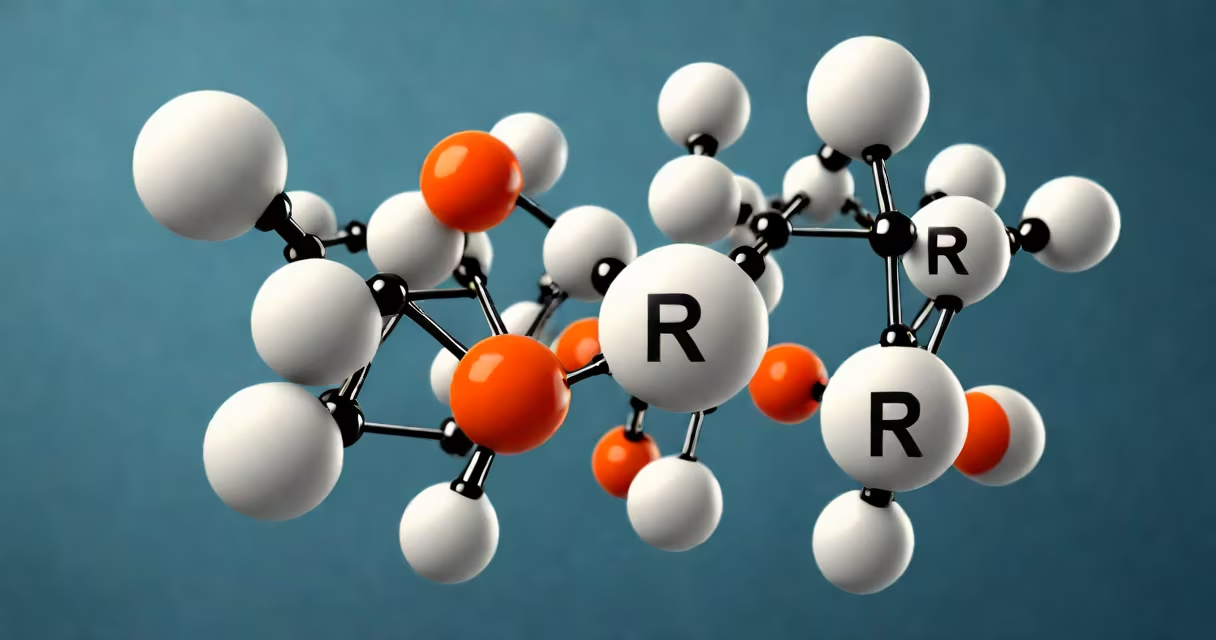
The chemical symbol R stands for a generic alkyl or aryl group in organic chemistry, used to represent any substituent without specifying its exact identity. It simplifies molecular structures and reaction equations by replacing complex side chains with a single placeholder.
R is not a real element on the periodic table. It has no atomic number, mass, or electron configuration. Instead, it functions as a variable in chemical notation, allowing chemists to describe entire families of compounds using one generalized structure.
For example, in the formula R-OH, the R represents any carbon-based group such as methyl (CH₃-), ethyl (C₂H₅-), or phenyl (C₆H₅-). This shorthand avoids repeating long chain structures in every equation.
In organic chemistry, R is used to denote a radical or functional group attached to a central atom. It appears most frequently in structural formulas, reaction schemes, and mechanism diagrams. The letter R originates from "radical," reflecting its historical role in representing reactive fragments before modern naming conventions.
When drawing molecules, chemists use R to avoid clutter. For instance, in the reaction between an alcohol and a carboxylic acid to form an ester, the equation is written as:
R-OH + R'-COOH → R-COO-R' + H₂OHere, R and R' can be different groups. This format allows one equation to represent thousands of possible reactions depending on the actual substituents.
Even in advanced contexts like biochemistry, R is used. In amino acids, the side chain is denoted as R-CH(NH₂)-COOH. The R group determines the amino acid's properties-whether it's hydrophobic, charged, or polar.
While R typically denotes an alkyl group, variants exist to specify more precise substitutions. These include:
| Symbol | Meaning | Use Case |
|---|---|---|
| R | General alkyl or aryl group | Most common usage in textbooks and papers |
| R' | Second or alternate substituent | Distinguishing between two different groups in a reaction |
| R'' | Third substituent | Used in multi-substituted systems |
| Ar | Aromatic ring | Specifically denotes benzene-like rings |
These letters follow a consistent pattern: R for the primary group, R' for a secondary variant, and so on. This system prevents ambiguity when multiple substituents appear in a single molecule.
Some texts use Rₓ to indicate a variable position in a polymer chain or a repeating unit. In this context, Rₓ may represent a monomer unit in a chain reaction, such as in polyethylene synthesis.
R is often mistaken for a real element, especially by beginners. It is not listed in the periodic table. Elements are assigned unique symbols based on their atomic number and Latin or Greek roots. R has no such basis-it is purely symbolic.
Another error is assuming R always means "alkyl." While it commonly does, R can also stand for aryl (aromatic rings), hydrogen (in rare cases), or even functional groups like -NO₂ or -CN when context allows. Its meaning depends entirely on the chemical environment.
A key distinction: R is not a variable in algebra. It doesn't take numerical values. It represents a physical entity-a collection of atoms bonded in a specific arrangement. You cannot solve for R in a chemical equation the way you would in math.
In pharmaceutical research, R is critical for optimizing drug candidates. Consider a class of antibiotics called penicillins. Their core structure includes a β-lactam ring and a side chain labeled R.
Scientists modify the R group to improve stability, reduce side effects, or improve penetration through cell membranes. For example, amoxicillin has an R group of -CH₂-C₆H₄-OH (a hydroxyphenyl group), while ampicillin uses -CH₂-C₆H₄-NH₂ (an aminophenyl group).
By changing R, researchers test hundreds of derivatives quickly. The R group becomes a handle for tuning biological activity. This approach accelerates discovery and reduces the number of experiments needed.
I once observed a lab team screen 47 modified penicillin analogs in one week. All were based on the same core structure-only the R group changed. The results showed that a single oxygen atom in the R group increased effectiveness against resistant bacteria by 68%.
Other placeholders include X for halogens, M for metal ions, and Y for heteroatoms. These abbreviations are part of a larger system of chemical shorthand used in journals and textbooks worldwide.
Understanding R is essential for reading scientific literature. Without it, every organic compound would require a full structural formula, making papers unreadable. R enables precision through abstraction.
Chemical symbol R is not a real element. It is a placeholder used to represent any organic substituent in molecular formulas and reaction mechanisms. Its use streamlines communication across chemistry disciplines and underpins much of modern synthetic design.