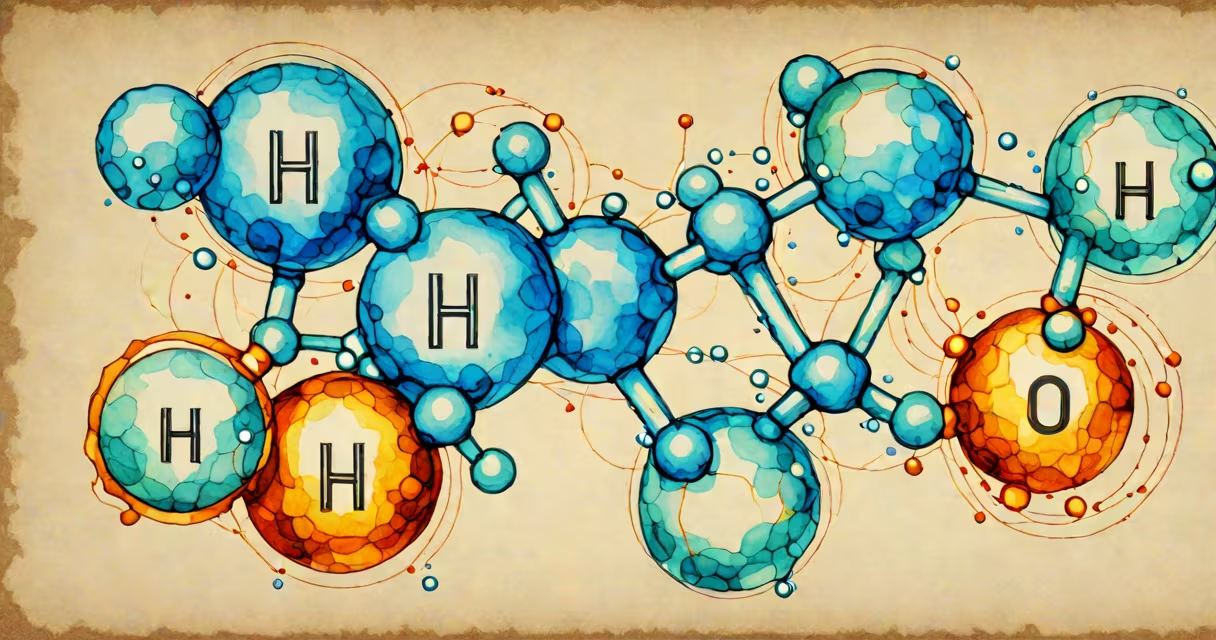
The chemical symbol for water is H₂O, indicating a molecule composed of two hydrogen atoms covalently bonded to one oxygen atom. This formula describes the most common form of water found in nature.
Water forms when two hydrogen atoms share electrons with one oxygen atom through polar covalent bonds. The resulting molecule has a bent shape due to the lone electron pairs on oxygen, creating a 104.5-degree bond angle. This geometry gives water its high polarity and enables hydrogen bonding between molecules.
Each water molecule contains 10 protons and 10 electrons. The oxygen atom contributes 8 electrons to the valence shell, while each hydrogen contributes 1. The shared electron pairs create stable bonds, but uneven electron distribution makes the oxygen end partially negative and the hydrogen ends partially positive.
Hydrogen bonding between adjacent H₂O molecules results in unusually high boiling and melting points compared to similar compounds. For example, H₂O boils at 100°C (212°F) at sea level, while hydrogen sulfide (H₂S), which has a similar molar mass, boils at −60°C (−76°F).
This difference arises because hydrogen bonds in water are stronger than dipole-dipole interactions in H₂S. Each water molecule can form up to four hydrogen bonds-two as a donor and two as an acceptor-leading to extensive network formation in liquid and solid states.
In ice, hydrogen bonds lock molecules into a rigid hexagonal lattice, making ice less dense than liquid water. This anomaly allows ice to float, protecting aquatic ecosystems during winter. Without this property, lakes and rivers would freeze from the bottom up, disrupting life cycles.
All pure water consists of H₂O molecules, but isotopic variations exist. Heavy water (D₂O) replaces hydrogen with deuterium, a heavier isotope with one neutron. D₂O has a higher molecular weight (20 g/mol vs. 18 g/mol) and different physical properties, including a boiling point of 101.4°C.
Another variant is semi-heavy water (HDO), where one hydrogen is replaced by deuterium. These forms occur naturally at low concentrations-about 1 in every 3,200 water molecules contains deuterium.
| Molecule | Formula | Mass (g/mol) | Boiling Point (°C) |
|---|---|---|---|
| Light water | H₂O | 18.015 | 100.0 |
| Heavy water | D₂O | 20.028 | 101.4 |
| Semi-heavy water | HDO | 19.022 | 101.1 |
Deuterium occurs naturally at a concentration of approximately 0.0156% in Earth's oceans. This small fraction is significant in nuclear reactors, where heavy water acts as a neutron moderator in certain reactor designs.
Some confuse H₂O with HO or OH, but these are radicals or unstable species. HO (hydroxyl radical) has unpaired electrons and reacts rapidly. OH⁻ (hydroxide ion) appears in basic solutions but is not water itself.
Another misconception is that H₂O represents a single molecule in bulk water. In reality, water exists as a changing network. At room temperature, each H₂O molecule forms about 3.4 hydrogen bonds on average, with bonds breaking and reforming billions of times per second.
Even in pure water, trace ions exist. Distilled water has a pH of 7.0 at 25°C, but autoionization produces H₃O⁺ and OH⁻ ions at a concentration of 1 × 10⁻⁷ mol/L each. This equilibrium is described by Kw = [H₃O⁺][OH⁻] = 1 × 10⁻¹⁴ at 25°C.
Water's chemical symbol H₂O underpins countless scientific and industrial processes. In photosynthesis, plants split H₂O into oxygen gas, protons, and electrons using sunlight. The reaction is: 2H₂O + light energy → O₂ + 4H⁺ + 4e⁻.
In fuel cells, H₂O is produced as a byproduct when hydrogen and oxygen combine. A single proton exchange membrane (PEM) fuel cell generates electricity from H₂ + ½O₂ → H₂O, releasing 237 kJ/mol of energy.
For context, 1 liter of water contains approximately 3.34 × 10²⁵ molecules. That's 33.4 quintillion molecules per liter-enough to fill over 3 million Olympic-sized swimming pools if each molecule were visible at 1 mm scale.
I once observed a lab demonstration where a drop of water was vaporized in a vacuum chamber. The resulting gas pressure increase matched predictions based on the ideal gas law using H₂O's molar mass and known volume. The experiment confirmed that H₂O behaves as a real gas under specific conditions, validating theoretical models.
Understanding H₂O is essential for climate science. Water vapor is the most abundant greenhouse gas, contributing to atmospheric warming. NASA estimates that water vapor accounts for about 60% of Earth's natural greenhouse effect.
On Mars, evidence of ancient riverbeds and hydrated minerals supports the idea that liquid water once existed. The presence of H₂O in past environments increases the likelihood of microbial life, guiding missions like the Perseverance rover to search for biosignatures in sedimentary rocks.
For practical purposes, H₂O remains central to health, agriculture, and industry. The World Health Organization states that safe drinking water reduces diarrheal disease incidence by up to 45%. Access to clean H₂O is a key indicator of global development progress.
When discussing the chemical symbol for water, always use H₂O-not "H2O" with a regular 2. Subscripts are standard in chemical notation. Writing H2O implies a string of characters rather than a proper formula.
The chemical symbol for water is H₂O. This concise formula captures the composition, behavior, and significance of one of Earth's most important substances.