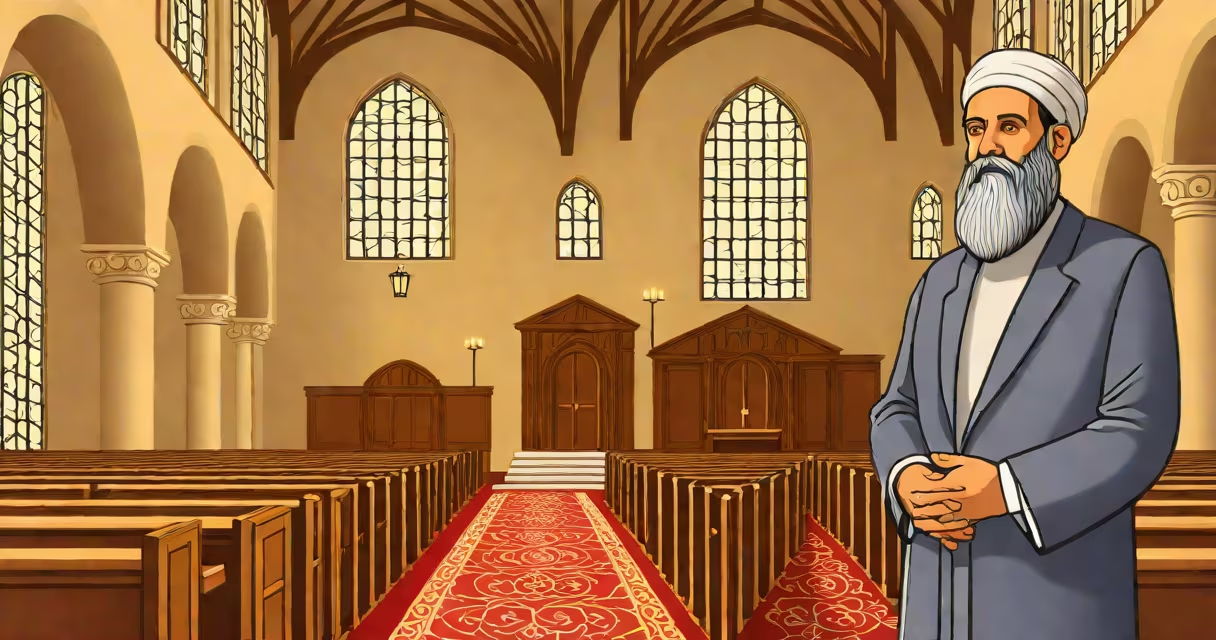
The word "rabbi" is a Hebrew title meaning "my master" or "my teacher," used to denote a Jewish religious leader authorized to interpret scripture, lead worship, and provide spiritual guidance. It originated in the 1st century CE and remains central to Jewish religious life today.
Rabbi is not a formal title conferred by a single institution but rather earned through years of study, ordination, and community recognition. The role evolved from ancient sages who preserved oral law to modern-day clergy who serve in synagogues, schools, and communal organizations.
Today, rabbis are trained in Talmudic and halakhic (Jewish legal) studies, often completing degrees from accredited seminaries such as Yeshiva University's Rabbi Isaac Elchanan Theological Seminary or Hebrew Union College-Jewish Institute of Religion. Ordination, known as *semikhah*, requires mastery of Jewish texts and practical training in pastoral care.
A rabbi leads religious services, delivers sermons, performs lifecycle events like weddings and funerals, and offers counseling. They interpret Jewish law (*halakha*) and apply it to contemporary issues such as medical ethics, gender inclusion, and interfaith relations.
In Orthodox communities, rabbis often serve as authoritative decision-makers on matters of religious practice. In Conservative and Reform Judaism, rabbis work collaboratively with lay leaders and may advocate for social justice causes. A rabbi in a Reform congregation might lead a campaign for LGBTQ+ rights, while an Orthodox rabbi may focus on adherence to dietary laws and Shabbat observance.
For example, Rabbi Amy Eilberg, ordained in 1985 by the Reform movement, became the first woman to receive rabbinic ordination from a major American seminary. Her work challenged long-standing traditions and expanded the role of women in religious leadership.
Rabbis differ based on denomination, training, and responsibilities. The following table outlines key differences:
| Denomination | Ordination Process | Authority Source | Common Roles |
|---|---|---|---|
| Orthodox | Yeshiva-based, multi-year program; requires approval from rabbinical council | Talmud, Mishnah, codes of Jewish law | Community spiritual leader, day school teacher, marriage officiant |
| Conservative | Hebrew Union College or similar; emphasizes tradition and modernity | Halakha with evolving interpretation | Temple leadership, educational programming, advocacy |
| Reform | Training at HUC-JIR; focuses on social action and inclusivity | Textual study combined with ethical reasoning | Interfaith dialogue, social justice campaigns, inclusive ceremonies |
One common misconception is that all rabbis wear black hats or long coats. While certain Hasidic and ultra-Orthodox rabbis do, many Reform and Conservative rabbis wear suits or modest dress appropriate to their setting. Appearance varies widely by culture and context.
"Rabbi" is sometimes mistaken for "priest" or "imam." Unlike priests in Christianity or Islam, rabbis are not part of a sacramental hierarchy. There is no priestly lineage in Judaism. The term "rabbi" applies to scholars and teachers, not ritual performers.
Another misunderstanding is that rabbis are automatically wise or infallible. In reality, rabbis are human beings who debate theology, disagree on interpretations, and face personal challenges. The Talmud records hundreds of debates between rabbis, showing that disagreement is part of Jewish intellectual tradition.
A lesser-known fact: the word "rabbi" appears only 16 times in the Hebrew Bible. Its widespread use began in the 1st century CE, after the destruction of the Second Temple, when Jewish communities needed new forms of leadership to preserve religious continuity. This shift marked the rise of the rabbinic class as central figures in Judaism.
Consider Rabbi David Stern, who serves a Reform synagogue in Chicago. His typical week includes leading Shabbat services on Friday evenings, teaching a high school class on Jewish ethics, meeting with families preparing for bar/bat mitzvahs, and attending city council meetings to advocate for immigrant rights.
On a recent Friday, he delivered a sermon on the parashah *Vayigash* (Genesis 44:18-47:27), connecting Joseph's forgiveness of his brothers to current efforts to heal racial divisions in America. He cited statistics from the Pew Research Center showing that 72% of American Jews support policies promoting racial equity, linking faith to civic responsibility.
After services, he met with a couple planning a wedding under a chuppah. He helped them choose readings from the Song of Songs and discussed how to balance tradition with personal values. His role was not just ceremonial but deeply relational and contextual.
I once attended a Passover seder led by a rabbi in a small town in Vermont. The service included a reading of the Haggadah, songs, and a discussion about modern slavery. The rabbi paused after the *Maggid* section to ask, "Who among us has seen someone forced to work against their will?" A silence followed. Then a young man spoke about labor conditions in garment factories. That moment revealed how a rabbi functions not just as a teacher, but as a catalyst for moral reflection.
The meaning of rabbi extends beyond titles and robes. It represents a lifelong commitment to learning, teaching, and guiding others through Jewish texts and lived experience. Whether interpreting ancient laws or addressing climate change, rabbis remain important interpreters of Jewish identity.