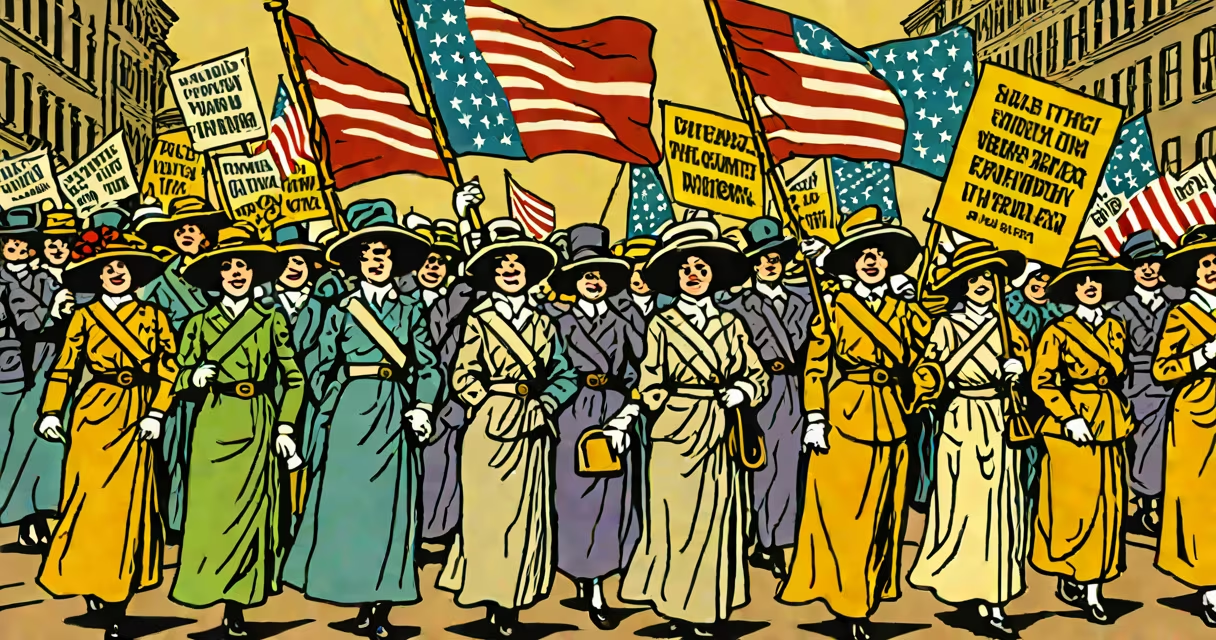
The 19th Amendment to the U.S. Constitution prohibits any U.S. state or federal authority from denying the right to vote based on sex. Ratified in 1920, it legally enshrined women's suffrage nationwide, marking the culmination of a 70-year campaign by activists who fought for equal political rights.
This amendment did not create voting rights from nothing-it removed a legal barrier that had excluded women from participating in elections since the nation's founding. Before ratification, women could vote in some states, but not in others. The 19th Amendment ended that inconsistency by making voting a protected right regardless of gender.
Under the original Constitution, voting was left to individual states, which often restricted eligibility to white men. The 19th Amendment changed that structure by adding a new constitutional prohibition: "The right of citizens of the United States to vote shall not be denied or abridged by the United States or by any State on account of sex." This language explicitly prevents sex-based discrimination in voting laws.
The amendment operates as a constitutional check on state power. Prior to its adoption, states set their own voter eligibility rules. Some allowed women to vote in local or state elections, particularly in Western states like Wyoming (1869), Colorado (1893), and Idaho (1896). But when national elections came, those rights were not guaranteed.
The 19th Amendment changed that. Once ratified, it made it illegal for any state to deny someone the right to vote because they were female. If a state tried to pass a law restricting women's voting, courts could strike it down under the amendment's protections.
For example, in 1917, Tennessee passed a law allowing women to vote in municipal elections. When the state later tried to restrict that right, the courts cited the 19th Amendment as the basis for overturning the restriction. The amendment's force lies in its direct application to federal and state laws alike.
The movement for women's suffrage began in earnest at the 1848 Seneca Falls Convention, where Elizabeth Cady Stanton and Lucretia Mott drafted the Declaration of Sentiments, demanding voting rights for women. Over the next 70 years, activists organized conventions, lobbied lawmakers, held marches, and endured arrests and public ridicule.
By 1913, the National Woman's Party (NWP) adopted militant tactics, including picketing the White House. In 1917, members were arrested and imprisoned-some went on hunger strikes and were force-fed. Their treatment drew national attention and helped build momentum for the amendment.
The amendment was first introduced in Congress in 1915. After years of debate, it passed the House in 1918 and the Senate in June 1919. Then came ratification: 36 states needed to approve it. Tennessee became the decisive 36th state on August 18, 1920, when Representative Harry T. Burn cast the deciding vote-swayed by a letter from his mother urging him to support suffrage.
Some people assume the 19th Amendment gave women the right to vote overnight. That's incorrect. While it outlawed sex-based voter denial, enforcement relied on subsequent legislation and court decisions. For example, Black women in the South still faced poll taxes, literacy tests, and violence that prevented them from voting-even after 1920.
A common misconception is that the amendment applied to all women equally. In reality, it only addressed sex-based exclusion. Women of color, Indigenous women, and immigrant women continued to face systemic barriers. The Voting Rights Act of 1965 later targeted racial discrimination in voting, but the 19th Amendment did not eliminate all forms of disenfranchisement.
Another confusion arises around the difference between the 19th Amendment and the 15th Amendment. The 15th Amendment (1870) banned race-based voter denial, but it did not protect women. The 19th Amendment filled a separate gap-gender-not race. Both were necessary to expand suffrage, but they address different forms of exclusion.
| Amendment | Year Ratified | Prohibited Basis | Key Impact |
|---|---|---|---|
| 15th | 1870 | Race | Prohibited denial of voting rights based on race |
| 19th | 1920 | Sex | Prohibited denial of voting rights based on sex |
| 24th | 1964 | Poll taxes | Eliminated poll taxes in federal elections |
| 26th | 1971 | Age (18) | Lowered voting age from 21 to 18 |
After ratification, women's voter turnout increased dramatically. In the 1920 presidential election, 8 million women voted-up from zero in 1916. By 1924, nearly half of eligible women had participated in a federal election.
Today, the 19th Amendment remains a foundational pillar of American democracy. It established that citizenship includes political agency, regardless of gender. Without it, the trajectory of U.S. policy on education, healthcare, labor, and family leave would have looked very different.
I once attended a 2019 exhibit at the National Archives featuring original suffrage documents. One letter from Alice Paul, dated 1917, read: "We are not asking for privilege. We are claiming our rights." That line stayed with me. The 19th Amendment wasn't about charity-it was about justice.
Modern debates about voting access often reference the 19th Amendment as a precedent. When states consider laws affecting voter registration or ID requirements, advocates cite the amendment to argue against discriminatory measures. Courts have used it to challenge laws that disproportionately affect women, especially in cases involving reproductive health and parental rights.
Some believe the 19th Amendment was passed in 1920. Technically, it was ratified on August 18, 1920, and officially certified on August 26, 1920. The date of certification matters-elections held after that date were subject to the amendment's provisions.
Others think the amendment was universally accepted. In fact, opposition was fierce. Prominent figures like Carrie Chapman Catt argued for state-by-state ratification to avoid conflict. Others, such as anti-suffragists in the Daughters of the American Revolution, claimed women's suffrage would undermine traditional family roles. These arguments were widely circulated in newspapers and pamphlets.
One non-obvious fact: the 19th Amendment did not apply to U.S. territories. Women in Puerto Rico, Guam, and the Virgin Islands did not gain the right to vote until much later. Puerto Rican women, for example, were granted voting rights in 1932-but only in local elections. Full federal suffrage came in 1962, after decades of advocacy.
The 19th Amendment means that no law can bar someone from voting simply because they are a woman. It reshaped American democracy, affirmed that all citizens deserve a voice, and remains a living standard for fairness in the electoral system.