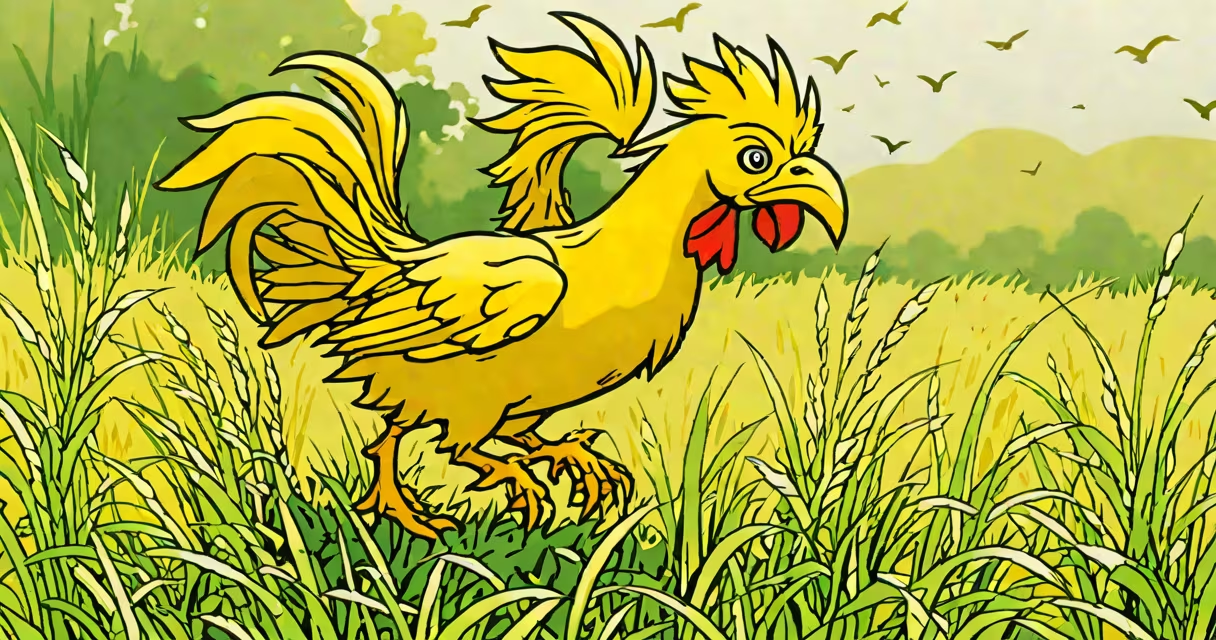
The chocobo is a fictional, flightless bird creature in the Final Fantasy series, known for its speed, loyalty, and distinctive yellow feathers. It serves as both a mount and a recurring symbol across the franchise's many entries.
First introduced in Final Fantasy II (1991), the chocobo evolved from a simple gameplay mechanic into a core part of the series' identity. It appears in over 15 mainline and spin-off titles, including Final Fantasy VII, Final Fantasy X, Final Fantasy XV, and Final Fantasy XIV. Its role varies: in some games, it's a fast mount; in others, it's a companion, pet, or even a boss.
Chocobos are native to the world of Gaia, where they live in herds across grasslands and forests. They are omnivorous, feeding on seeds, fruits, and occasionally small animals. Their long legs allow them to sprint at speeds exceeding 60 km/h (37 mph), making them ideal for travel in open terrain. In-game mechanics often reward players who bond with chocobos through training and care.
In most Final Fantasy titles, the chocobo functions as a player-controlled mount. Once obtained, it can be summoned during overworld traversal, allowing rapid movement across maps. Players gain access to chocobos through quests, item drops, or special events.
For example, in Final Fantasy XV, the player character Noctis acquires a chocobo named "Polly" during a side quest in the region of Altissia. The creature becomes a key transport method, especially in areas where vehicles are restricted. It can be ridden, fed, and even customized with different saddles and accessories.
Training systems exist in several titles. In Final Fantasy XI and Final Fantasy XIV, players can raise chocobos through breeding, feeding, and skill-based progression. These games feature a full economy around chocobo racing, with players breeding high-speed variants for competition. A single champion chocobo in Final Fantasy XIV can achieve speeds of 110 km/h (68 mph) with proper gear and training.
While the standard chocobo is yellow with red eyes and a black beak, multiple color variants appear across the series. These include:
| Type | Color | Game Appearance | Unique Trait |
|---|---|---|---|
| Standard Chocobo | Yellow | Final Fantasy II onward | Fastest base speed; common mount |
| Black Chocobo | Jet black | Final Fantasy VI, Final Fantasy VII Remake | Rare; associated with dark magic and cursed lineage |
| Blue Chocobo | Deep blue | Final Fantasy IX | Can swim; appears in aquatic zones |
| White Chocobo | Pure white | Final Fantasy X, Final Fantasy XIV | Symbol of purity; often linked to religious themes |
| Red Chocobo | Fiery red | Final Fantasy XIII-2 | High stamina; used in endurance races |
One lesser-known fact: in Final Fantasy IV, the chocobo is not a mount but a puzzle-solving NPC. It appears in the Tower of Babel and provides hints about the location of hidden items. This marks a rare departure from its typical role and shows early experimentation with the creature's narrative function.
Many assume chocobos are purely decorative or comedic elements. This is incorrect. In Final Fantasy XIV, chocobos are central to the game's economy and social structure. The Chocobo Racing League hosts monthly tournaments with prize pools exceeding $10,000 USD in real-world currency. Players spend hundreds of hours breeding and training chocobos to compete.
Another misconception: chocobos are not birds in the biological sense. They are classified as "avian-like" creatures within the lore. According to the official Final Fantasy Wiki, they are descendants of ancient sky-dwelling beings that lost flight due to environmental changes on the planet. Their feathers are not organic but contain crystalline structures that absorb light energy, enabling their endurance.
A third error: people often confuse chocobos with the "Moogle," another popular creature in the series. While both are anthropomorphic animals with large eyes and expressive features, moogles are small, round, and wear hats. Chocobos are tall, bipedal, and capable of carrying riders. Moogles serve as merchants and guides; chocobos are transport and companions.
Chocobo Final Fantasy has transcended gaming. The creature appears in merchandise, theme parks, and even a children's book series. In Japan, chocobo-themed cafes operate in Tokyo and Osaka, serving meals shaped like the bird and offering themed rides.
I once visited a Final Fantasy-themed event in Kyoto where attendees could ride mechanical chocobos through a life-sized recreation of the world of Eorzea. The experience was immersive: the mounts responded to voice commands, and the sound design mimicked the creature's signature call-a high-pitched chirp followed by a low hum.
According to Square Enix's internal development logs, the chocobo was designed by artist Yoshitaka Amano as a symbol of freedom and resilience. He described it as "a creature that never stops moving, even when the world is falling apart." This design philosophy continues in modern titles, where chocobos appear in moments of emotional weight-such as in Final Fantasy XV, where Noctis rides a chocobo during a quiet scene reflecting on his father's legacy.
Chocobo Final Fantasy remains one of the most enduring and recognizable symbols in video game history. Its blend of utility, charm, and mythological depth ensures its place across generations of players.