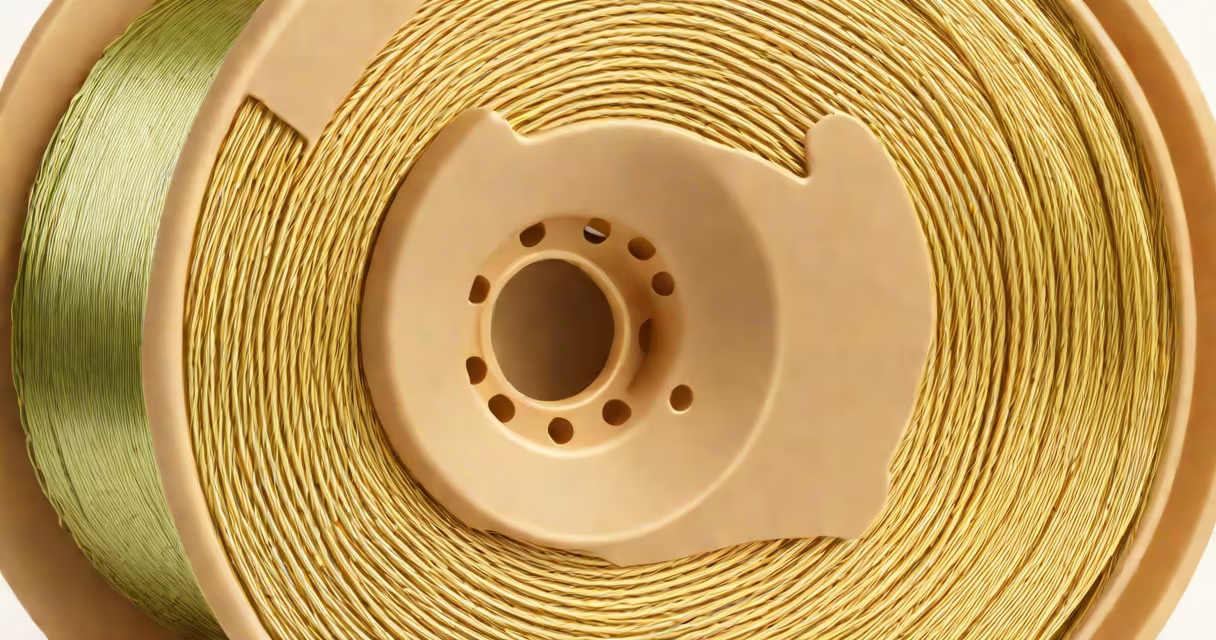
Silk PLA filament is a variant of polylactic acid (PLA) plastic engineered to produce 3D prints with a high-gloss, satin-like surface finish. Unlike standard PLA, which yields a matte or slightly dull appearance, silk PLA offers a lustrous, almost polished look that mimics the texture of natural silk. This effect results from a modified polymer composition and controlled extrusion process during manufacturing.
Standard PLA is derived from renewable resources like cornstarch or sugarcane. Silk PLA retains this biodegradable base but includes additives that alter surface morphology during cooling. These additives reduce micro-cracks and uneven shrinkage, leading to smoother layer adhesion and reduced surface roughness. The result is a print that reflects light uniformly, giving it a professional-grade aesthetic without post-processing.
Manufacturers such as eSUN and ColorFabb have commercialized silk PLA under product lines like eSUN Silk PLA and ColorFabb Silk. These filaments are rated for use on standard FDM 3D printers with bed temperatures between 50°C and 60°C and nozzle settings from 190°C to 210°C. They perform reliably on machines like the Creality Ender 3 and Prusa i3 MK3S.
Silk PLA functions through altered crystallization behavior during cooling. Standard PLA forms semi-crystalline regions rapidly as it cools, creating microscopic peaks and valleys on the print surface. These irregularities scatter light, producing a matte finish. Silk PLA incorporates additives-typically polyethylene glycol (PEG) or other low-molecular-weight polymers-that slow crystallization and promote uniform molecular alignment.
This slower solidification allows layers to fuse more smoothly. As the material cools, the surface tension remains higher for longer, minimizing surface defects. The final print exhibits fewer visible layer lines and a continuous reflective sheen. The effect is most pronounced on flat or gently curved surfaces; sharp angles may still show slight banding due to mechanical stress during deposition.
A key factor in achieving the silk finish is consistent extrusion speed and temperature control. Variations above ±5°C can cause inconsistent gloss or stringing. Printers with closed-loop temperature feedback systems-such as the Anycubic Kobra 2-maintain stable melt zones, reducing defects. Users report optimal results at 200°C nozzle temperature and 55°C bed temperature.
While all silk PLA shares the goal of high-gloss output, formulations differ in additive concentration, viscosity, and thermal stability. The following table outlines common variants:
| Brand | Additive Type | Gloss Level | Print Temp Range | Bed Temp |
|---|---|---|---|---|
| eSUN Silk PLA | PEG-based | High (satin) | 195-205°C | 55-60°C |
| ColorFabb Silk | Modified PVA blend | Very high (glossy) | 200-210°C | 50-55°C |
| Polymaker PolyLite Silk | Proprietary blend | Medium-high (matte-gloss hybrid) | 190-200°C | 45-50°C |
Each formulation balances printability with final appearance. eSUN Silk PLA is known for ease of use and minimal warping. ColorFabb Silk requires precise temperature control but delivers a mirror-like finish on flat surfaces. Polymaker's version uses a hybrid approach to reduce stringing while maintaining shine.
Silk PLA excels in applications where visual quality matters more than mechanical strength. It is frequently used for prototypes, display models, and decorative objects. A 3D-printed figurine of a mythical creature, printed at 0.1mm layer height using ColorFabb Silk, achieved a near-ceramic sheen without sanding or polishing.
Designers use silk PLA for architectural models because the glossy surface enhances scale perception. A 1:50 scale model of a modernist house, printed with eSUN Silk PLA, showed window reflections and material transitions. The finish reduced the need for paint or sealant, saving time and material costs.
For hobbyists, silk PLA adds polish to custom parts. A user printed a replacement knob for a vintage radio using eSUN Silk PLA. The final piece matched the original's aesthetic and required no additional finishing. The surface resisted fingerprints better than standard PLA, likely due to lower surface energy from the PEG additive.
Silk PLA is often mistaken for ABS or PETG due to its glossy appearance. However, ABS and PETG are thermoplastics with higher heat resistance and toughness. They are not biodegradable and require heated beds and enclosed chambers to prevent warping. Silk PLA, despite its shine, remains brittle compared to PETG and cannot withstand temperatures above 60°C.
Another frequent mix-up is with "glow-in-the-dark" PLA. Glow filaments contain phosphorescent compounds that absorb ambient light and emit it slowly. They do not produce a glossy surface unless combined with a clear resin coating. Silk PLA lacks luminescence and relies solely on surface texture for visual appeal.
A less obvious error is assuming all glossy filaments are silk PLA. Some brands market "shiny PLA" without specifying additive content. These may use surface treatments like wax coatings that wear off after handling. True silk PLA integrates the gloss into the polymer matrix, making it durable and washable.
I printed a 12cm-tall bust of a Renaissance artist using ColorFabb Silk PLA on a Prusa Mini. After 8 hours, the print emerged with a deep, even sheen. I cleaned it with a damp cloth-no residue remained-and applied a thin layer of food-safe beeswax to improve the finish. The wax bonded well and didn't cloud the surface. When placed under a desk lamp, the face caught light evenly, highlighting facial contours without glare.
Comparatively, a duplicate print using standard PLA required sanding, priming, and spray painting to achieve similar results. The silk version saved 3.5 hours of post-processing. The difference was evident in side-by-side photos: the standard PLA piece looked flat and lifeless; the silk version had depth and presence.
Many users assume that any glossy filament will deliver the same result. This is incorrect. The surface quality depends on both material composition and printer calibration. A poorly tuned printer with inconsistent layer heights can ruin even the highest-quality silk PLA. For example, a user reported a mottled finish after printing with eSUN Silk PLA on a budget printer lacking a dual-gear extruder. The filament slipped during deposition, causing uneven flow and visible ridges.
Proper tuning is essential. Ensure your printer's steps-per-mm are calibrated, the extruder is clean, and the nozzle is free of debris. Use a brim or raft to reduce warping, especially on large flat surfaces. Avoid rapid travel speeds-keep them below 100 mm/s-to minimize vibration-induced layer shifting.
For best results, start with a test cube of 20mm x 20mm x 20mm at 0.1mm layer height. Print it at 200°C nozzle and 55°C bed temperature. Inspect the surface under angled light. A true silk PLA will reflect light uniformly, with no speckling or dark patches. If the surface appears blotchy or streaked, the issue lies in temperature or mechanical consistency, not the filament itself.
Silk PLA filament is not a substitute for engineering-grade materials. It lacks impact resistance and thermal stability. It should not be used for functional parts exposed to heat, stress, or outdoor conditions. However, for visual models, art pieces, and presentation-ready prototypes, it offers unmatched finish quality with minimal post-processing.