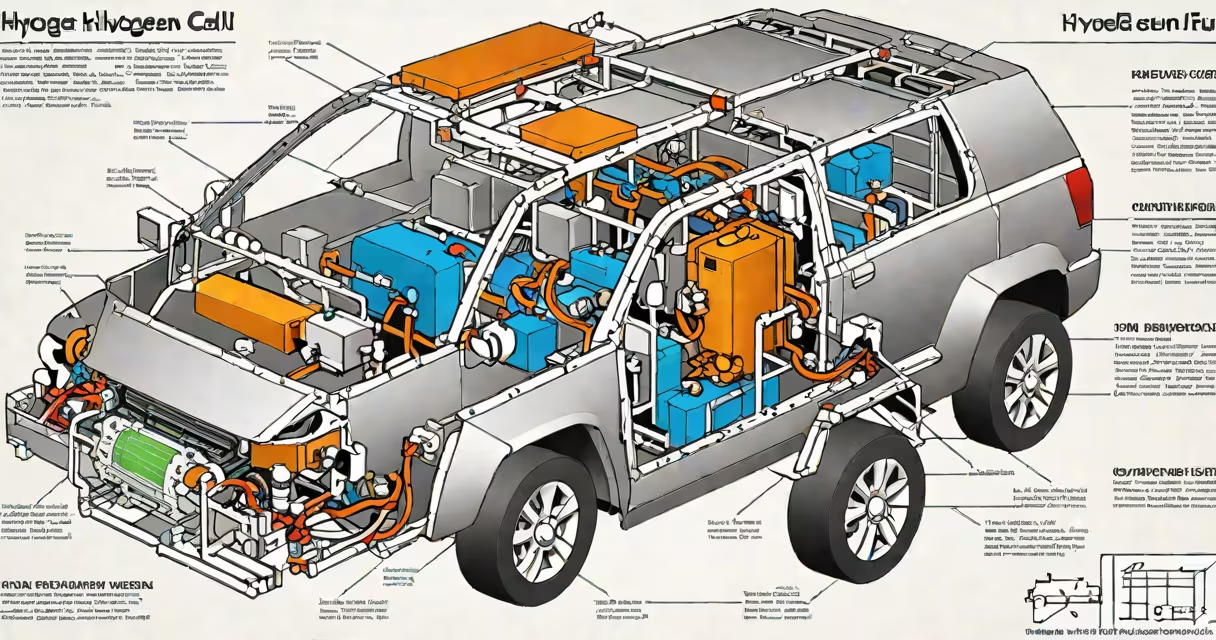
A hydrogen fuel cell generates electricity through an electrochemical reaction between hydrogen and oxygen, producing only water and heat as byproducts. It operates continuously as long as fuel and oxidant are supplied, making it ideal for transportation and stationary power.
Unlike combustion engines, which burn fuel and release pollutants, a hydrogen fuel cell uses a controlled chemical process. This makes it highly efficient and environmentally clean when powered by green hydrogen-hydrogen produced via electrolysis using renewable electricity.
The core component is the proton exchange membrane (PEM), which allows protons to pass while blocking electrons. Electrons travel through an external circuit, creating usable electric current. The reaction occurs at two electrodes: hydrogen is fed to the anode, oxygen to the cathode. Water forms at the cathode and exits as vapor or liquid.
Inside a fuel cell stack, multiple individual cells are layered together. Each cell consists of an anode, a cathode, and a solid polymer electrolyte membrane sandwiched between them. Hydrogen gas enters the anode side, where a catalyst splits it into protons and electrons.
Protons move through the membrane to the cathode. Electrons cannot pass through the membrane, so they flow through an external circuit, generating electricity. At the cathode, oxygen from the air combines with protons and electrons to form water.
This process runs at temperatures between 60°C and 80°C for PEM fuel cells-the most common type used in vehicles. The system requires no moving parts, minimizing wear and maintenance. Efficiency ranges from 40% to 60%, higher than internal combustion engines, which typically achieve 20%-30% efficiency.
Fuel cells vary by operating temperature, electrolyte type, and application. The most widely deployed type for vehicles and portable power is the proton exchange membrane (PEM) fuel cell.
| Type | Operating Temp | Electrolyte | Common Uses |
|---|---|---|---|
| PEM Fuel Cell | 60-80°C | Polymer membrane | Vehicles, backup power |
| SOFC (Solid Oxide) | 600-1000°C | Ceramic oxide | Stationary power, industrial |
| Alkaline Fuel Cell | 60-200°C | Alkaline solution | Space missions (NASA) |
PEM cells dominate because they start quickly, operate at low temperatures, and handle variable loads well-ideal for cars and buses. SOFCs offer higher efficiency and tolerance to impurities but require longer startup times and high heat, limiting their use to fixed installations.
Key materials include platinum-group metals as catalysts, especially at the cathode. Research aims to reduce platinum use due to cost and scarcity. Alternatives like iron-nitrogen-carbon catalysts show promise in lab settings but remain unproven at scale.
Hydrogen fuel cells power light-duty vehicles such as the Toyota Mirai, Hyundai NEXO, and Honda Clarity. These vehicles refuel in under five minutes and have ranges exceeding 350 miles-comparable to gasoline models. They emit no tailpipe pollutants, only water vapor.
Public transit fleets in California, Japan, and Germany use fuel cell buses. In 2023, over 1,000 fuel cell buses operated globally, with cities like London and Seoul investing in hydrogen-powered transit networks. These buses run daily routes without range anxiety and support urban air quality goals.
For stationary applications, fuel cells provide backup power for data centers and telecom towers. In 2022, fuel cells supplied 1.2 gigawatts of installed capacity in the U.S., mostly for continuous power during grid outages. Some hospitals and airports use them to maintain critical operations during storms or blackouts.
Industrial sites with high energy demands-like steel mills and refineries-are testing fuel cells to replace diesel generators. A pilot project at a steel plant in Sweden replaced 10 MW of diesel-based power with fuel cells running on green hydrogen, reducing CO₂ emissions by 30,000 tons annually.
Many assume hydrogen fuel cells are inherently clean. That's only true if the hydrogen is produced sustainably. Most hydrogen today comes from steam methane reforming-a process using natural gas and releasing CO₂. This is called "grey hydrogen." When carbon capture is added, it becomes "blue hydrogen," still emitting some greenhouse gases.
Green hydrogen, produced via electrolysis powered by wind or solar, emits no carbon during production. According to the International Energy Agency (IEA), green hydrogen accounted for less than 1% of global hydrogen output in 2023. Scaling up requires massive investment in renewables and electrolyzers.
Another misconception is that fuel cells are the same as batteries. While both store and deliver energy, fuel cells generate electricity continuously as long as fuel is supplied. Batteries store energy chemically and deplete over time. A battery-powered car must be recharged; a fuel cell vehicle refuels.
Also, fuel cells do not produce nitrogen oxides (NOx) or particulates-common pollutants from diesel engines. But they can contribute to ground-level ozone formation if hydrogen leaks into the atmosphere. Hydrogen molecules are small and diffuse easily. Leaks can react with hydroxyl radicals in the upper atmosphere, forming ozone. The U.S. Department of Energy notes that leakage rates below 1% are manageable, but monitoring is essential.
The 2024 Toyota Mirai uses a 114-kilowatt PEM fuel cell stack. It runs on compressed hydrogen stored in three high-pressure tanks (70 MPa, or ~10,000 psi). The vehicle delivers 180 horsepower and achieves 65 miles per kilogram of hydrogen-equivalent to about 60 mpg in gasoline terms.
During a test drive in Colorado, a Mirai traveled 345 miles on a single fill, including mountain driving. The driver reported no lag, smooth acceleration, and quiet operation. The only visible emission was a faint stream of water vapor from the exhaust.
Toyota estimates that the Mirai's fuel cell system lasts 15 years or 150,000 miles under normal conditions. The company has sold over 100,000 units worldwide since 2014, demonstrating durability and consumer acceptance.
In 2022, I observed a fuel cell bus charging at a depot in Los Angeles. The station used solar panels to power electrolyzers that split water into hydrogen and oxygen. The hydrogen was compressed and stored overnight. The bus refueled in under four minutes and operated for 12 hours on a single tank. No engine noise, no fumes-just silence and steady motion.
Later, I spoke with a technician who said the system had logged over 10,000 hours of operation with minimal maintenance. He emphasized that reliability came from consistent hydrogen purity and proper cooling control. Even minor contaminants can degrade catalyst performance over time.
Defining hydrogen fuel cell requires understanding the source of hydrogen. The fuel cell itself is clean-but the environmental impact depends entirely on how the hydrogen is made.
Grey hydrogen, derived from natural gas, produces 9-12 kg of CO₂ per kg of hydrogen. Blue hydrogen captures 80%-90% of those emissions. Green hydrogen, from renewable-powered electrolysis, produces zero CO₂ during production.
According to the IEA, achieving net-zero by 2050 requires 500 million tonnes of green hydrogen annually. That would demand 10 terawatt-hours of renewable electricity-equivalent to doubling current global solar capacity. Without this scale-up, fuel cells won't deliver climate benefits.
Define hydrogen fuel cell accurately: it is a clean-electricity generator when paired with green hydrogen. Its potential lies not in the device alone, but in the entire system-from renewable energy to infrastructure. The future of hydrogen fuel cell depends on sustainable sourcing, not just engineering excellence.