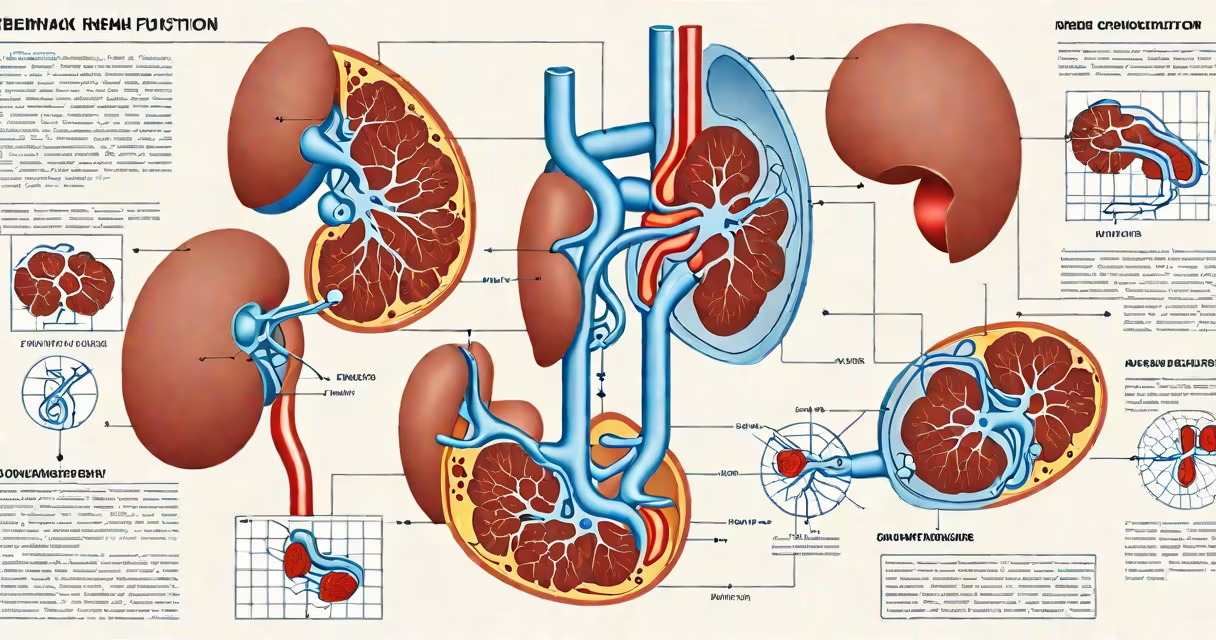
Renal function refers to the ability of the kidneys to filter waste products, excess fluid, and electrolytes from the blood while maintaining acid-base balance and regulating blood pressure. It is measured clinically through tests like estimated glomerular filtration rate (eGFR) and serum creatinine levels.
The kidneys process about 180 liters of blood daily, removing metabolic waste such as urea and creatinine while reabsorbing essential substances like glucose and sodium. This filtration occurs in the nephrons-the functional units of the kidney-where blood passes through the glomerulus and is filtered into the tubules.
Renal function declines gradually with age, but significant drops indicate chronic kidney disease (CKD). The National Kidney Foundation defines CKD stages based on eGFR values: stage 1 (eGFR ≥90 mL/min/1.73 m²) to stage 5 (eGFR <15 mL/min/1.73 m²), with stage 5 indicating end-stage renal disease requiring dialysis or transplant.
Each kidney contains approximately one million nephrons. Blood enters via the renal artery and flows into the glomerulus-a network of capillaries surrounded by Bowman's capsule. Here, water, ions, glucose, and small molecules pass into the tubule due to hydrostatic pressure, while larger proteins and blood cells remain in circulation.
Filtered fluid then moves through the proximal convoluted tubule, loop of Henle, distal convoluted tubule, and collecting duct. Along this path, the body reclaims needed substances and excretes waste. For example, about 99% of filtered water is reabsorbed in the proximal tubule, and potassium is regulated in the distal tubule under hormonal control (aldosterone).
Abnormalities in this process lead to conditions like edema (fluid retention), hyperkalemia (high potassium), or metabolic acidosis. A patient with reduced renal function may show symptoms such as fatigue, swelling in the legs, or changes in urination frequency.
Doctors assess renal function using two primary measurements: serum creatinine and estimated glomerular filtration rate (eGFR). Creatinine is a byproduct of muscle metabolism. Since it's produced at a steady rate and cleared entirely by the kidneys, elevated serum levels suggest impaired filtration.
eGFR estimates how much blood the kidneys filter per minute per 1.73 square meters of body surface area. It uses serum creatinine, age, sex, and race in equations like the CKD-EPI formula. For example, a 65-year-old woman with a serum creatinine of 1.2 mg/dL has an eGFR of approximately 58 mL/min/1.73 m²-indicating stage 3 CKD.
| eGFR (mL/min/1.73 m²) | Kidney Health Status | Common Causes |
|---|---|---|
| >90 | Normal or mildly decreased | Aging, dehydration |
| 60-89 | Mildly decreased | Hypertension, early diabetes |
| 30-59 | Moderately decreased | Chronic kidney disease progression |
| 15-29 | Severely decreased | Advanced CKD, obstructive uropathy |
| <15 | End-stage renal disease | Requires dialysis or transplant |
For more accurate assessment, clinicians may use creatinine clearance testing via 24-hour urine collection. This method measures how much creatinine is excreted in urine over 24 hours and compares it to serum levels. However, it's less practical than eGFR for routine screening.
Renal function is often equated with kidney size or imaging results. But ultrasound or CT scans detect structural issues-not filtration capacity. A person can have normal-sized kidneys with severely impaired function due to scarring or fibrosis.
Another misconception is that high-protein diets directly damage kidneys in healthy individuals. According to the American Society of Nephrology, there's no evidence that protein intake harms renal function in people without pre-existing kidney disease. However, those with existing CKD are advised to limit protein to reduce metabolic load.
Some patients confuse renal function with liver function. While both organs detoxify the body, they handle different substances. Liver enzymes process drugs and bilirubin; kidneys manage electrolytes, acid-base balance, and nitrogenous waste like urea. Confusing them leads to misdiagnosis.
A 58-year-old man presents with fatigue and mild ankle swelling. His lab work shows serum creatinine of 1.8 mg/dL and eGFR of 42 mL/min/1.73 m². He has no history of diabetes but was diagnosed with hypertension five years ago.
Based on guidelines from the National Kidney Foundation, this eGFR places him in stage 3b CKD. Further evaluation reveals microalbuminuria (30-300 mg/g creatinine) in a random urine sample-another sign of kidney damage. He is referred to a nephrologist for management, including blood pressure control and dietary counseling.
This case illustrates that renal function is not a single test but a composite picture. Early detection relies on regular screening, especially in high-risk groups like diabetics and hypertensives.
In my clinical rotation, I reviewed charts of patients with acute kidney injury following contrast dye exposure during CT scans. One patient developed a sharp drop in eGFR from 75 to 32 within 48 hours. Despite normal baseline function, the contrast caused vasoconstriction in renal arterioles, reducing glomerular perfusion. This confirmed that even healthy kidneys can suffer transient dysfunction under stress.
Understanding the definition of renal function enables early diagnosis and intervention. Delayed treatment increases risk of cardiovascular events-kidney disease is a major independent risk factor for heart attack and stroke.
According to the Centers for Disease Control and Prevention, nearly 15% of U.S. adults have CKD, many unaware until advanced stages. Routine screening with serum creatinine and eGFR is recommended for adults over 65 and those with diabetes or hypertension.