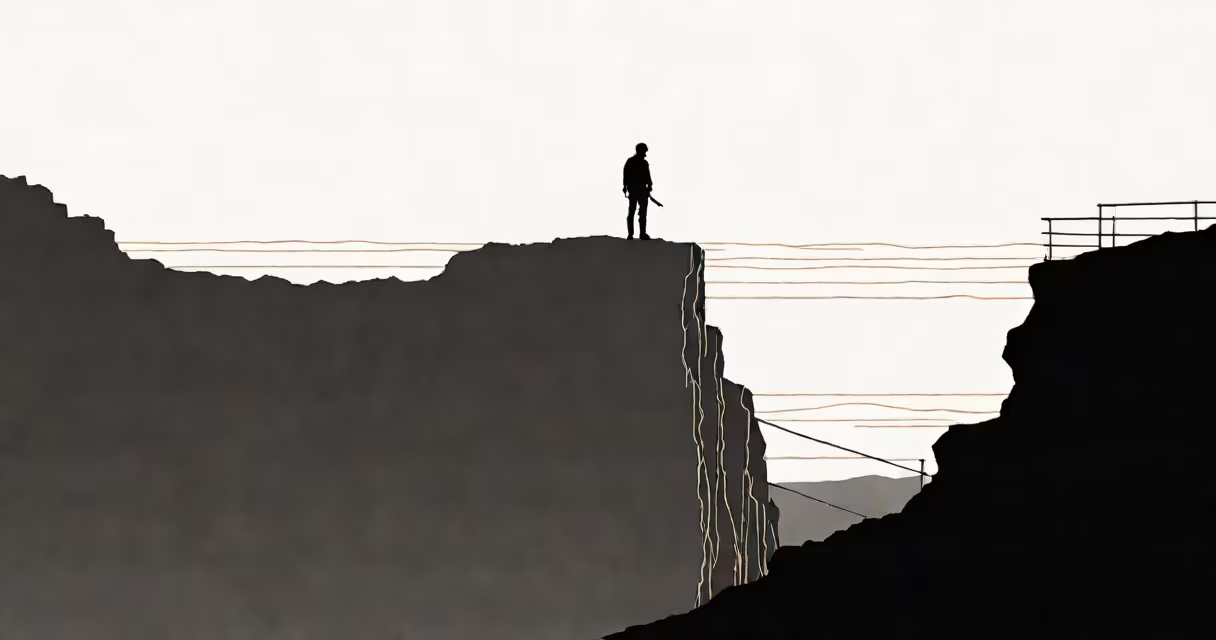
"Edge of my life" is a figurative expression describing the point at which emotional, psychological, or existential endurance reaches its limit. It marks the threshold beyond which a person feels they can no longer sustain their current state-whether through grief, pressure, exhaustion, or moral crisis. The phrase does not refer to a physical location but to an internal boundary.
It functions as a literary device, drawing on spatial metaphors to convey mental and emotional states. The "edge" suggests instability, proximity to collapse, or imminent transformation. This expression appears most frequently in poetry, song lyrics, and narrative fiction where characters face turning points in identity, relationships, or survival.
According to the Merriam-Webster Dictionary, "edge" can mean "the outermost part" or "a critical point." When applied to life, it implies a moment of maximum tension-where decisions must be made, or change becomes unavoidable. The phrase is not literal; it is symbolic of psychological rupture or awakening.
The phrase operates by projecting internal states onto external space. By saying "I'm at the edge of my life," a speaker communicates that they are close to breaking point-not physically, but emotionally or spiritually. This rhetorical strategy allows listeners or readers to visualize a state that would otherwise be abstract.
For example, in the song "The Edge of My Life" by American singer-songwriter Keb' Mo', the narrator reflects on a relationship nearing collapse: "I've been walking on the edge of my life / trying to hold on to something real." The lyrics describe emotional fatigue and the fear of losing oneself in a failing bond. The "edge" here is not a cliff but a fragile balance between staying and letting go.
This kind of metaphor is common in trauma narratives. A study published in Journal of Affective Disorders found that individuals describing severe depression often used spatial metaphors like "edge," "abyss," or "falling" to articulate feelings of helplessness. These metaphors were not random-they reflected how people mentally map emotional distress onto physical environments.
The phrase appears in several distinct contexts, each carrying different weight:
| Context | Meaning | Example |
|---|---|---|
| Personal crisis | Emotional breakdown or decision point | "After the accident, I felt like I was at the edge of my life." |
| Moral or ethical dilemma | Loss of self-identity under pressure | "I've been lying so long, I'm at the edge of my life." |
| Existential reflection | Confrontation with mortality or purpose | "At 65, I stood at the edge of my life and asked, 'Was it enough?'" |
These uses show that "edge of my life" is not limited to sadness. It can signal a moment of clarity, rebirth, or defiance. In some cases, being at the edge is not a sign of failure but of readiness to change.
Many assume "edge of my life" means imminent death or suicide. That's incorrect. While the phrase may appear in contexts involving self-harm or despair, it primarily denotes emotional extremity-not necessarily fatal action. The edge is a threshold, not a destination.
Another misconception is that it's a direct quote from a famous work. It is not. Though similar phrasings exist-such as "the edge of existence" in philosophical texts-the exact phrase "edge of my life" is rare in formal literature. Its popularity stems from music and informal speech, not canonical sources.
A key distinction: "edge of my life" differs from "edge of sanity" or "edge of reason." The latter focus on cognitive control. "Edge of my life" centers on identity, continuity, and the sense of self. One can be at the edge of their life without losing rational thought.
In 2018, a woman named Sarah Thompson wrote a memoir titled At the Edge of My Life, detailing her recovery from postpartum psychosis. She described the moment she realized she could no longer recognize herself: "I looked in the mirror and didn't know who was looking back. I was at the edge of my life-so far from who I'd been, yet still alive."
Her account illustrates how the phrase captures a psychological fracture. She wasn't attempting suicide. She was undergoing a transformation. The edge wasn't a fall-it was a pivot point.
I once heard a friend say, "I've been at the edge of my life since my father died." She wasn't referring to a specific event but to the ongoing state of emotional dislocation. What struck me was how the phrase gave form to something intangible-grief not as a feeling, but as a location.
Later, she told me she'd begun writing letters to her father that she never sent. That act-writing to someone absent-became her way of staying anchored. The edge wasn't a place to fall from, but a place to stand while rebuilding.
"Edge of my life" shares thematic ground with other expressions that mark psychological thresholds:
While both phrases contain "life" and "edge," their meanings diverge sharply. "For the life of me" is about effort and failure. "Edge of my life" is about endurance and transformation.
Understanding the difference prevents misapplication. Using "edge of my life" to describe minor annoyance-like being late to a meeting-distorts its gravity. It belongs to moments of deep personal reckoning.
The phrase "edge of my life" is a metaphor for the point at which emotional or existential endurance is nearly exhausted. It describes a moment of extreme vulnerability, not physical danger. It is used in literature, music, and personal storytelling to express inner strain, identity crisis, or the brink of change.
It is not a warning of death. It is a declaration of presence-of standing at a moment so intense that even breathing feels like a choice.