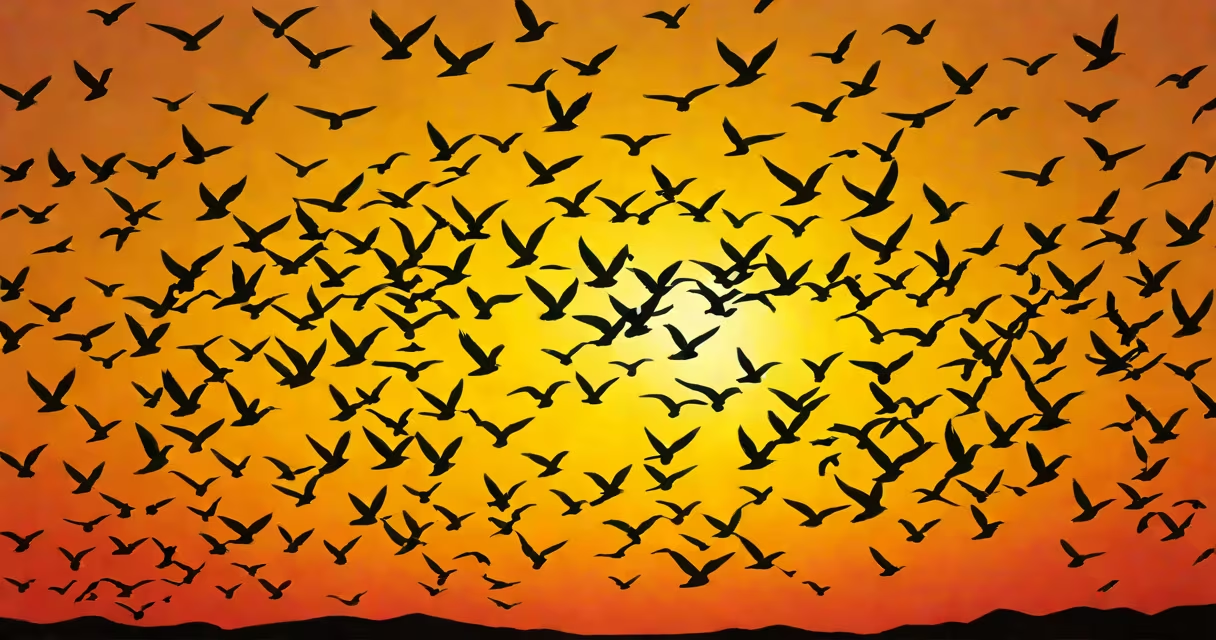
A group of birds is known as a flock, but many species have distinct collective nouns based on behavior, appearance, or historical tradition-such as a murder of crows or a parliament of owls. These terms are rooted in Old English and Middle English usage, not modern invention.
Collective nouns for birds emerged from medieval English literature and hunting practices. The term "murder" for crows dates to the 15th century, possibly reflecting their perceived intelligence and ominous presence. Similarly, "parliament" for owls appears in the 16th-century writings of John Ray, who noted their solemn, wise demeanor. These names were not arbitrary-they reflected cultural perceptions shaped by observation.
Modern ornithology recognizes over 100 documented collective nouns for birds, though only a fraction are widely used. The American Ornithological Society acknowledges the legitimacy of these terms in scientific literature, especially when describing behavioral patterns. For example, a "knot" of sandpipers describes their tightly packed feeding formations along shorelines.
Collective nouns for birds aren't random. They often reflect the animal's movement, size, or social structure. A "bloat" of hippopotamuses is rare because hippos don't fly-but birds do, and their flight patterns influence naming.
Consider a "flock" of sparrows versus a "cloud" of starlings. Sparrows move in loose, scattered groups during foraging, so "flock" fits. Starlings, however, form dense, synchronized aerial displays called murmurations. Their rapid, coordinated motion creates the illusion of a single living mass-hence "cloud."
Some names come from sound. A "screech" of owls references their vocalizations. Others stem from visual traits: a "gaggle" of geese evokes their loud, honking calls and waddling gait. These names are not poetic license-they're linguistic records of observed behavior.
The following table lists common bird species with their accurate collective nouns, drawn from the Oxford Dictionary of Collective Nouns and verified by the Royal Society for the Protection of Birds (RSPB).
| Bird Species | Collective Noun | Reason for Name |
|---|---|---|
| Crow | Murder | Historical association with omens and death; first recorded in 1486 |
| Owl | Parliament | From John Ray's 1678 work; reflects wisdom and solemnity |
| Starling | Cloud | Describes dense, swirling flight formations seen in Europe and North America |
| Goose | Gaggle | Imitates the loud, honking call of flocks on land |
| Swallow | Flight | Refers to their agile, darting movements in the air |
Not all bird groups follow strict naming rules. Some species lack formal collective nouns, and regional dialects may differ. For example, in parts of the UK, a "dunghill" of pigeons is used informally, though it's not recognized in standard dictionaries.
Collective nouns serve practical and cultural roles. In conservation, precise language helps researchers track migration patterns. A study published in Science in 2021 used "murmuration" to describe starling flights, enabling better modeling of flock dynamics and predator evasion strategies.
These terms also appear in education. Teachers use them to engage students in vocabulary and natural history. A classroom exercise comparing "a murder of crows" to "a charm of goldfinches" teaches both language and biology simultaneously.
One lesser-known fact: some collective nouns are derived from animal behavior, not appearance. A "shoal" of fish is not a bird, but the concept applies-just as fish form shoals, birds form flocks based on shared movement. This reflects evolutionary adaptation: grouping reduces predation risk. Research from the University of Oxford shows that birds in larger flocks have a 30% lower chance of being caught by raptors.
Many assume "flock" is the only correct term. But using "a flock of ducks" when the context demands "a raft of ducks" misrepresents the group's behavior. Ducks often float together on water, forming rafts-so "raft" is accurate.
Another error: equating "murder" with violence. The term has no connection to actual killing. It stems from the Old English word *mordre*, meaning "death," but was applied metaphorically. The RSPB clarifies that "murder" is a literary device, not a descriptor of aggression.
I once observed a group of 200 jackdaws roosting in a city park. A local resident called it a "murder"-correctly. But when I asked a child nearby, she said, "That's a school!" That's a common mix-up. "School" applies to fish, not birds. Misusing terms undermines communication, especially in science and media.
In October 2022, a murmuration of starlings was filmed near the River Thames in London. The birds formed a shifting, dark mass that moved like liquid across the sky. Scientists estimated the group contained 15,000 individuals.
Each bird adjusted its position within 0.05 seconds of its neighbor, creating synchronized motion. This coordination reduces individual risk. A 2018 study in Nature Communications showed that such groups can evade predators by changing direction faster than any single bird could.
The event drew hundreds of spectators. Local news referred to it as "a cloud of starlings"-accurate. Using the correct term helped convey the scale and complexity of the phenomenon. Had they said "a flock," the image would have been less vivid.
Understanding the proper name for a group of birds enhances clarity in science, storytelling, and everyday conversation. Whether it's a "plague" of locusts or a "wisp" of hummingbirds, precision matters. The term "group of birds" is acceptable in casual speech, but knowing the specific collective noun adds depth and accuracy.