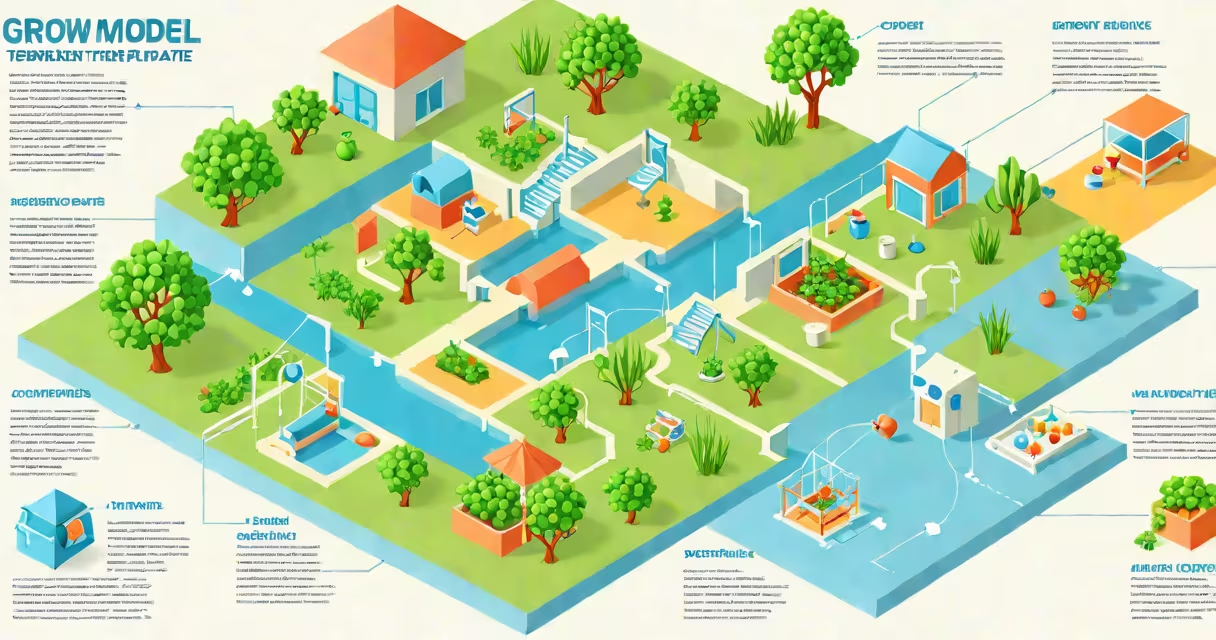
A grow model template is a structured structure that maps out the core stages and levers of customer and business growth, typically organized around acquisition, activation, retention, revenue, and referral-commonly known as the AARRR structure. It provides a repeatable blueprint for startups and teams to identify bottlenecks, prioritize experiments, and scale sustainably.
Used widely in product-led growth, the template turns abstract goals like "scale faster" into measurable actions. For example, a SaaS company might use it to define how many free users need to convert to paid within 30 days to hit quarterly targets. The template isn't a single form-it's a changing structure applied across teams, products, and markets.
According to GrowthHackers.com, 76% of high-growth startups use some version of a growth model template internally. The structure helps align marketing, product, and engineering teams around shared metrics. Without it, growth efforts often become isolated campaigns rather than coordinated systems.
The grow model template operates by breaking growth into five sequential stages: Acquisition, Activation, Retention, Revenue, and Referral. Each stage represents a phase where a user interacts with a product or service-and where specific actions can improve outcomes.
For instance, Acquisition focuses on attracting new users through channels like paid ads, SEO, or partnerships. Activation measures whether those users complete a meaningful action-like setting up a profile or completing a tutorial. Retention tracks whether they return after the first week. Revenue captures conversion to paid plans. Referral assesses whether users invite others.
Each stage includes a set of hypotheses and experiments. A team might test whether adding a welcome email reduces drop-off during activation. Or they might A/B test onboarding flows to boost retention. The template forces teams to ask: What's the next step? What metric defines success? What experiment will prove it?
While the AARRR model is foundational, variations exist based on industry, audience, and maturity level. Early-stage startups often use a simplified version focused on acquisition and activation. Mature companies expand into advanced models with cohort analysis, lifetime value (LTV) prediction, and churn modeling.
| Type | Best For | Key Features |
|---|---|---|
| Basic AARRR | Early-stage startups | Five-stage funnel, simple KPIs, low overhead |
| Product-Led Growth (PLG) | SaaS, freemium apps | Emphasis on self-serve onboarding, in-app triggers |
| Enterprise Growth | B2B sales cycles | Includes lead scoring, sales pipeline integration |
| Behavioral Cohort Model | Retention optimization | Tracks user behavior over time using cohort tables |
One underused variant is the growth loop model, which identifies feedback loops where each stage fuels the next. For example, a social app where inviting friends increases visibility, leading to more invites. This model is detailed in GrowthHackers.com's case studies on apps like Dropbox and Airbnb.
Many assume the grow model template is a static spreadsheet or a one-time exercise. In reality, it's a living document updated weekly as data changes. Teams that treat it as a checklist fail to iterate effectively.
Another mistake is equating the template with vanity metrics. A high number of sign-ups doesn't mean growth is working. The template forces focus on outcome-based metrics-like % of users who complete onboarding in under 5 minutes or who upgrade within 60 days.
Also, the model isn't limited to digital products. I once helped a local bakery implement a grow model template to track customer acquisition via Instagram promotions, activation through first-purchase discounts, and retention via loyalty cards. They increased repeat visits by 42% in six months-not because they were tech-savvy, but because they mapped their existing process into the structure.
Consider a project management tool launching a new feature. The team uses a grow model template to define success:
When activation dropped to 30%, the team ran an experiment: replacing the default dashboard with a guided tour. After two weeks, activation rose to 45%. The template didn't just show the problem-it guided the fix.
As noted in the 5-atomic model, effective growth requires atomic testing-small, controlled experiments that validate assumptions. The grow model template enables this by isolating variables at each stage.
Every successful growth team I've observed uses the template not as a report, but as a daily decision-making tool. It's not about perfection-it's about speed, iteration, and alignment.
Understanding the grow model template isn't about memorizing stages. It's about recognizing that growth isn't random-it's engineered. When applied consistently, it turns intuition into action and guesswork into results.