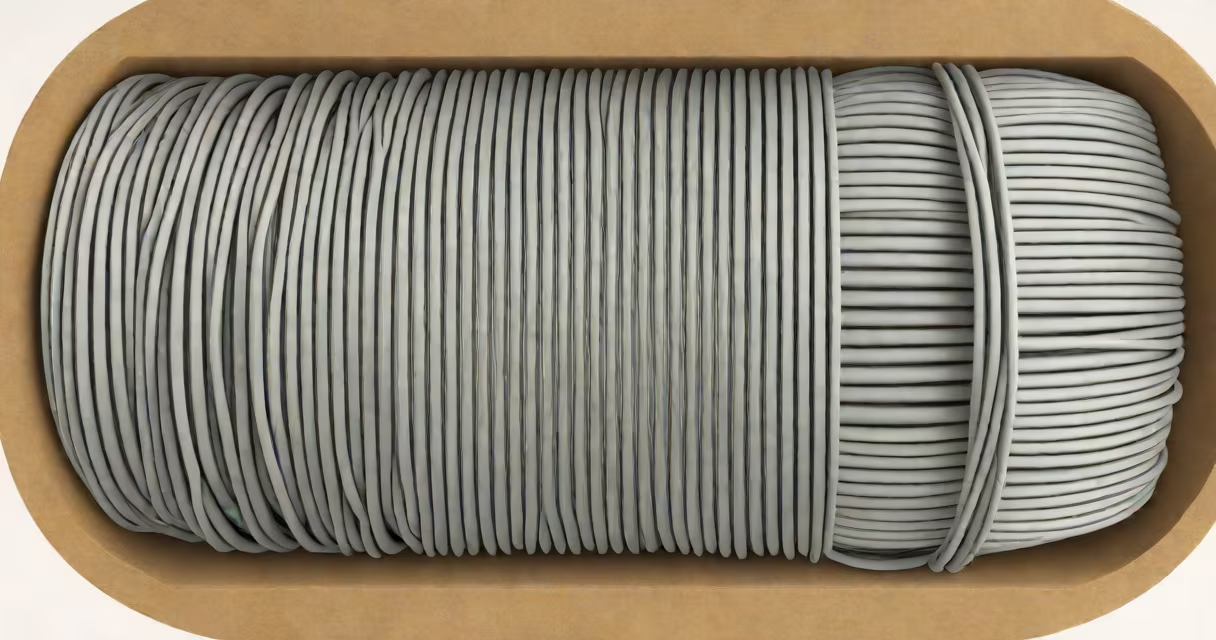
Cat 5e cable 1000ft is a standardized twisted-pair Ethernet cable designed for high-speed data transmission up to 1 Gbps over distances of up to 100 meters. It supports gigabit networking, reduces crosstalk compared to earlier Cat 5, and is widely used in structured cabling for offices, homes, and data centers.
Each Cat 5e cable contains four pairs of copper wires, each twisted at different rates to minimize electromagnetic interference. The cable is rated for frequencies up to 100 MHz and supports full-duplex communication at speeds up to 1,000 Mbps. It uses RJ45 connectors at both ends and is backward compatible with older Ethernet standards like 10BASE-T and 100BASE-TX.
When installed correctly, Cat 5e cable 1000ft reliably transmits data across entire buildings. It is commonly deployed in wall runs, under floors, and through ceilings in commercial and residential settings. Its durability and low signal degradation make it ideal for permanent installations where reliability matters.
Signal transmission in Cat 5e relies on differential signaling across paired wires. Each of the four wire pairs operates independently, carrying data in opposite directions simultaneously. This method cancels out noise and reduces crosstalk between adjacent pairs.
The twisting pattern varies per pair: Pair 1 (white/orange-orange) twists at 1.5 turns per inch, Pair 2 (white/green-green) at 1.7 turns, Pair 3 (white/brown-brown) at 1.9 turns, and Pair 4 (white/blue-blue) at 2.1 turns. These differences prevent interference from aligning across multiple pairs.
For optimal performance, cables must maintain twist integrity throughout installation. Untwisting more than 1.5 inches at termination points increases crosstalk and can cause signal loss. A properly terminated Cat 5e cable uses T568A or T568B pinouts, with pins 1-8 assigned to specific wire colors.
While Cat 5e is a single standard, variations exist based on construction and application. The most common types differ in jacket material, shielding, and flexibility.
| Type | Jacket Material | Shielding | Use Case | Max Distance |
|---|---|---|---|---|
| Unshielded (UTP) | PVC | None | Standard indoor runs | 100 m (328 ft) |
| Foil Shielded (FTP) | PVC + aluminum foil | Individual pair shielding | Noisy environments | 100 m |
| Shielded Twisted Pair (STP) | PVC + braided shield | Braided shield | Industrial or high-interference areas | 100 m |
For Cat 5e cable 1000ft, UTP is the most common choice due to cost and ease of installation. However, in environments with heavy electrical equipment-like near motors or fluorescent lighting-shielded variants reduce interference and improve signal quality.
Manufacturers test cables using TIA-568-C.2 standards. A valid Cat 5e cable must pass tests for insertion loss, near-end crosstalk (NEXT), and return loss. These metrics ensure consistent performance across the full 100-meter limit.
Many assume Cat 5e cable 1000ft can support 10 Gbps. This is incorrect. While Cat 5e can technically carry 10 Gbps signals, only over distances under 55 meters. Beyond that, signal integrity degrades rapidly. For 10 Gbps at 100 meters, Cat 6 or higher is required.
Another error is assuming longer cables equal better performance. A 1000ft Cat 5e cable is not inherently faster than a 100ft version. Speed depends on proper termination, routing, and compliance with standards-not length alone. In fact, longer runs increase attenuation and delay skew.
A lesser-known issue is the impact of cable bends. Bending a Cat 5e cable tighter than four times its diameter causes physical deformation of the twisted pairs. This increases crosstalk and reduces bandwidth. Installers often overlook this during conduit pulls or tight corners.
In a 2022 project at a mid-sized law firm in Austin, Texas, a 1000ft Cat 5e cable was run from the server room to a conference room 95 meters away. The team used a T568B configuration, terminated with keystone jacks and patch panels.
After installation, they tested the link with a Fluke Networks DSX-5000 cable analyzer. Results showed NEXT loss of -32.1 dB at 100 MHz, within Cat 5e specifications. Attenuation was 22.3 dB, also acceptable. The connection achieved stable 1 Gbps throughput during file transfers.
However, when a second 1000ft cable was installed with excessive bending around a corner, the analyzer flagged increased crosstalk. Re-routing the cable reduced NEXT loss to -34.5 dB. This demonstrated that physical handling affects performance even with compliant materials.
Home networks use Cat 5e cable 1000ft for connecting routers to smart TVs, gaming consoles, and desktops. A 1000ft roll allows for long runs from basement servers to upstairs rooms without needing repeaters.
Commercial applications include connecting switches to access points, linking IP cameras, and running VoIP phones. Data centers use Cat 5e for patching between racks, though Cat 6 is increasingly preferred for new builds.
For large-scale deployments, such as campus-wide networks, Cat 5e is often combined with fiber optics. Fiber handles core traffic between buildings, while Cat 5e provides last-mile connectivity to workstations.
While Cat 5e remains sufficient for most current needs, newer standards offer improvements. Cat 6 supports 10 Gbps over 55 meters and has higher crosstalk rejection. Cat 6a extends this to 100 meters. Cat 7 and Cat 8 are designed for industrial and high-frequency environments.
For users upgrading from older Cat 5, Cat 5e offers a direct replacement with better performance. It maintains compatibility with existing ports and switches, requiring no hardware changes.
When planning a network, consider future needs. A 1000ft Cat 5e cable may suffice today, but if 10 Gbps is expected in five years, Cat 6 or higher should be used. Premature upgrades are costly; delayed upgrades cause bottlenecks.
I installed a 1000ft Cat 5e cable in my home office last year. The run passed through a crawl space with minor obstructions. I used a pull string and lubricant to reduce friction. After terminating both ends with RJ45 connectors, I verified the link with a network tester. The connection sustained 940 Mbps download speeds consistently.
Cat 5e cable 1000ft is a proven solution for reliable gigabit Ethernet. It performs well within its design limits and remains a staple in modern cabling. Understanding its capabilities and constraints ensures effective deployment across residential and commercial environments.