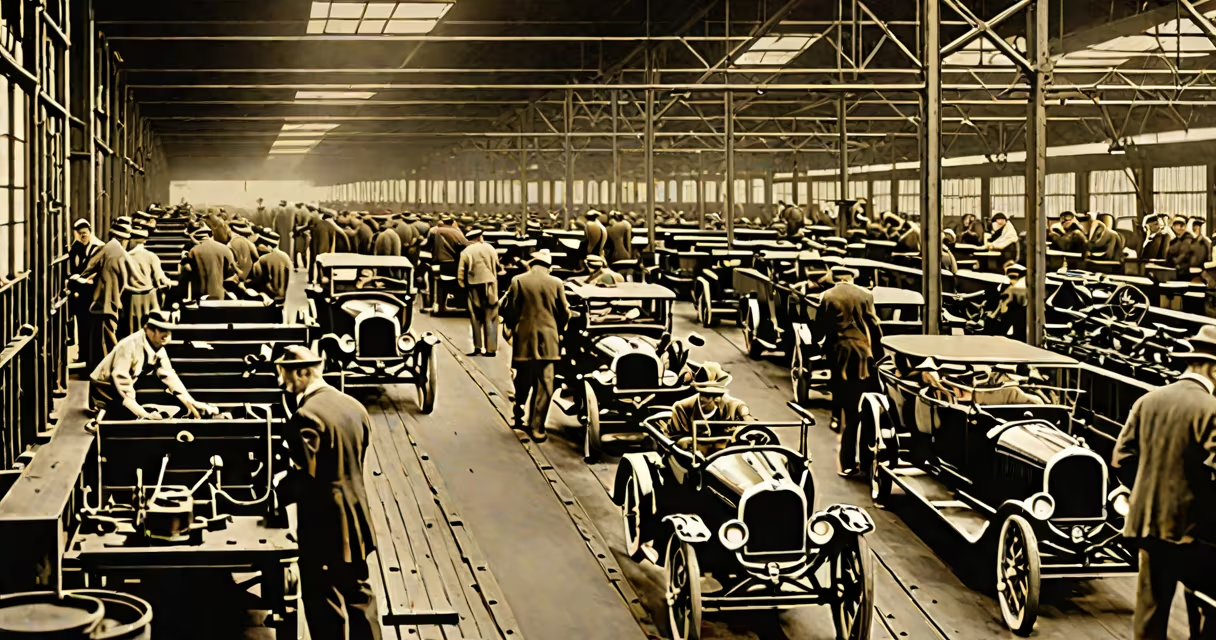
The henry ford assembly line was a production system introduced in 1913 at Ford's Highland Park plant that used a moving conveyor belt to deliver components to stationary workers, drastically reducing the time needed to build a Model T. This innovation enabled mass production of affordable automobiles and reshaped industrial manufacturing worldwide.
Before the moving assembly line, cars were built by skilled craftsmen who assembled entire vehicles from start to finish. Each Model T took about 12.5 hours to complete. Henry Ford's team redesigned the process so that each worker performed one repetitive task while parts moved past them on a belt. The belt advanced at a fixed pace, synchronizing work flow and minimizing idle time.
By 1914, the average time to build a Model T dropped to 93 minutes. By 1920, it reached just 2.5 hours per vehicle. This efficiency allowed Ford to cut the price of the Model T from $850 in 1908 to $260 by 1927, making car ownership accessible to the average American.
The core principle of the henry ford assembly line was workflow standardization. Components arrived at each station in sequence, and each worker completed a single, repeatable step-such as attaching a wheel or installing a fender-before the chassis moved to the next station.
Workers stood at fixed positions along the line. The belt moved at a consistent speed, typically 10 feet per minute. If a worker fell behind, the line did not stop-instead, the gap was filled by faster workers or later adjustments. This forced consistency and eliminated bottlenecks caused by individual variation.
For example, at the engine installation stage, one worker bolted the engine to the frame, another connected the transmission, and a third checked alignment-all within seconds. No worker had to walk to find tools or parts. Everything was delivered to their position.
While the term "assembly line" is often used generically, the henry ford assembly line specifically refers to the moving, sequential method pioneered at Ford Motor Company. Other models existed:
| Type | Description | Use Case |
|---|---|---|
| Moving Assembly Line | Parts move via belt; workers stay in place. Ford's 1913 design. | Mass production of cars, appliances, electronics. |
| Stationary Assembly Line | Workers move between stations. Used in early factories. | Custom or low-volume production. |
| Continuous Flow Line | Automated robots handle tasks. Modern version. | High-volume electronics, automotive plants. |
Modern variants include robotic arms, sensors, and AI-driven scheduling. But the fundamental idea-reducing human movement and increasing task repetition-remains rooted in Ford's original system.
Factories still use modified versions of the henry ford assembly line. Automotive plants like Tesla's Gigafactories and Toyota's production lines rely on synchronized, sequential workflows. Even smartphone assembly lines in China follow this model.
For example, Apple's iPhone production uses a moving line where each worker performs one task-inserting the battery, attaching the screen, testing connectivity-before the device moves to the next station. The line advances at 15 seconds per unit during peak output.
Industries beyond manufacturing adopted the concept. Amazon warehouses use conveyor-based systems to route packages through sorting stations. Hospitals use assembly-line logic in operating rooms-each surgeon, nurse, and technician performs a set role in sequence to reduce procedure time.
Many assume the henry ford assembly line was invented overnight. It wasn't. Ford's team spent years refining the process. The first moving line debuted in 1913, but earlier attempts in 1908 used static lines with workers walking between stations.
Another myth is that Ford created the assembly line from scratch. He didn't. The idea existed in meatpacking plants, such as those in Chicago, where carcasses were hung on rails and processed in sequence. Ford adapted this concept to automobiles.
A lesser-known fact: Ford's assembly line initially faced resistance. Workers complained about monotony and physical strain. In response, Ford raised wages to $5 per day in 1914-double the industry average-to retain labor and reduce turnover. This move helped stabilize the line and improved productivity.
Let's walk through one Model T being built on the 1914 assembly line:
From start to finish, the car left the line in approximately 5 minutes. Over 15 million Model Ts were produced using this method between 1908 and 1927.
In 2018, I visited the Henry Ford Museum in Dearborn, Michigan, where a restored 1914 assembly line operates intermittently. Watching a Model T chassis move slowly down the belt, with workers performing precise, repeated motions, revealed how mechanical precision and human discipline combined to achieve scale. The noise was constant-metal clanking, belts whirring-but the rhythm was predictable. You could feel the weight of industrial transformation in the air.
According to the Smithsonian Institution, Ford's moving assembly line "cut production time by nearly 90% compared to previous methods." The National Museum of American History notes that the system "became a global model for industrial efficiency."
Historian David F. Noble, in his book Forces of Production, explains that Ford's innovation wasn't just technical-it altered labor relations, consumer behavior, and urban planning. Cities expanded around car ownership; suburbs grew; new industries emerged to support transportation infrastructure.
The henry ford assembly line is not the same as "mass production." Mass production refers to high-volume output. The assembly line is the mechanism that enables it. Without the moving belt and task specialization, mass production would not have been feasible at scale.
Also, the term "Fordism" describes the broader economic and social model based on standardized goods, high wages, and consumerism. The assembly line is a central component of Fordism, but not synonymous with it.
Understanding the henry ford assembly line clarifies how industrial progress isn't driven by single inventions, but by systemic changes in workflow, labor organization, and supply chain coordination. Its legacy lives on in every factory, warehouse, and tech production line that relies on predictable, repeatable processes.