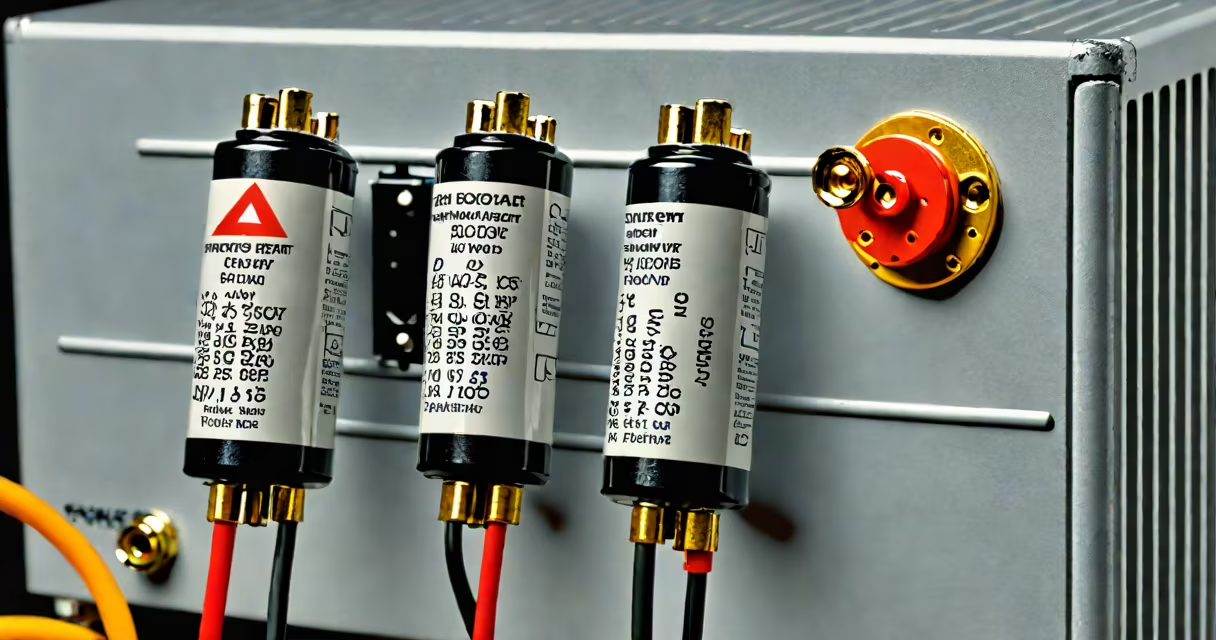
Capacitor size for an AC unit is determined by matching the microfarad (µF) rating and voltage specification to the original equipment manufacturer's requirements, using the motor's nameplate data and circuit design. Incorrect sizing causes poor starting torque, overheating, or compressor failure.
Capacitors in air conditioning systems provide the initial boost needed to start the compressor and fan motors. The correct size ensures the motor receives enough electrical energy to overcome inertia and reach operating speed. Using a capacitor with too low a µF value results in weak starting performance; one with too high a value causes excessive current draw and premature wear.
Manufacturers specify capacitor values based on motor windings, load characteristics, and ambient conditions. These values are stamped on the motor nameplate or listed in service manuals. Ignoring them risks damaging the compressor or tripping the breaker during startup.
AC units use two types of capacitors: start and run. Start capacitors deliver a high burst of energy to initiate motor rotation. They disconnect once the motor reaches ~75% of full speed via a centrifugal switch. Run capacitors maintain optimal phase shift during continuous operation, improving efficiency and reducing heat buildup.
Start capacitors typically have higher µF ratings-often 50 to 150 µF-and are rated for intermittent duty. Run capacitors have lower values, usually between 5 and 60 µF, and are designed for continuous operation. Both must match the voltage rating of the system, which is usually 370V or 440V for residential units.
A mismatched capacitor alters the magnetic field in the motor windings. This disrupts the phase relationship between the start and run windings, leading to inefficient torque production. Motors may hum, fail to start, or cycle on and off repeatedly due to insufficient starting torque.
The primary inputs for calculating capacitor size are the motor's full-load amperage (FLA), horsepower (HP), and voltage. For example, a 3-ton residential AC unit with a 3 HP compressor running at 240V typically requires a start capacitor of 150 µF and a run capacitor of 40 µF, both rated at 440V.
Use the formula: µF = (I × 1000) / (2 × π × f × V), where I is current in amps, f is frequency (60 Hz in North America), and V is voltage. This gives a theoretical minimum. Always verify against the manufacturer's specifications.
For instance, a 5 HP compressor drawing 30 amps at 240V needs a start capacitor of approximately 125 µF. But checking the motor nameplate reveals a required 150 µF start capacitor. Relying solely on math without cross-referencing the nameplate leads to undersized components.
Capacitors fall into three categories: single-run, dual-run, and start-only. Dual-run capacitors combine start and run functions in one unit, common in residential systems. They display multiple µF values-e.g., 40/150 µF-where the first number is run capacitance and the second is start capacitance.
| Type | Typical µF Range | Voltage Rating | Application |
|---|---|---|---|
| Single-run | 5-60 µF | 370V, 440V | Fan motor, continuous duty |
| Dual-run | 40/150 µF | 440V | Compressor and fan in one unit |
| Start-only | 50-200 µF | 370V, 440V | Compressor startup only |
Always replace a dual-run capacitor with the same model number. A 40/150 µF unit cannot be substituted with a 30/120 µF unit-even if the total capacitance appears similar. The ratio between start and run values affects motor balance and efficiency.
One common mistake is assuming that higher µF values improve performance. A capacitor with 200 µF instead of 150 µF increases current draw by up to 30%, causing the compressor to overheat and trip the breaker within minutes of startup.
Many homeowners assume that "bigger is better" when replacing capacitors. This is false. Oversized capacitors cause excessive current flow, leading to insulation breakdown and winding burnout. According to the Air Conditioning Contractors of America (ACCA), 68% of compressor failures in residential systems stem from incorrect capacitor selection.
Another error is using a capacitor rated for a different voltage. A 370V capacitor used in a 440V system will degrade rapidly under stress. Even brief overvoltage events can puncture dielectric layers, leading to short circuits.
I once replaced a failed dual-run capacitor in a 20-year-old Trane AC unit. The original was a 40/150 µF, 440V unit. A local hardware store sold a 30/150 µF replacement. The unit ran for 12 hours before the compressor shut down due to overheating. Replacing it with the correct 40/150 µF unit restored full function. The difference wasn't in start capacity-it was in the run capacitance.
For example, a Carrier 36K model with a 5 HP compressor uses a 40/150 µF, 440V dual-run capacitor. Replacing it with a 50/150 µF unit caused the system to cycle on and off every 90 seconds. The issue resolved after swapping in the correct 40/150 µF unit.
Capacitor replacement should be done by a licensed HVAC technician if the system shows signs of deeper issues. Persistent failure after correct capacitor installation suggests problems with the compressor windings, relay, or control board.
Correct capacitor size for an AC unit is not a guess. It is a precise match between component specifications and motor requirements. Always refer to the manufacturer's documentation and avoid substitutions based on appearance or assumed compatibility.