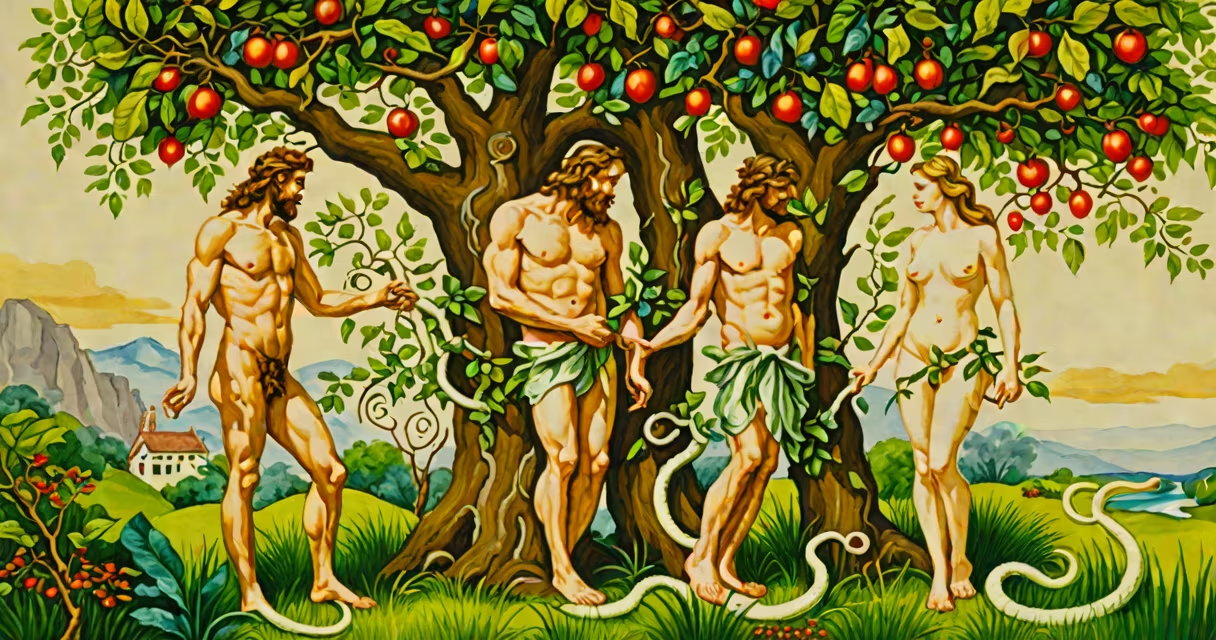
Original sin is the Christian doctrine that all humans inherit a state of spiritual brokenness and moral weakness because of Adam and Eve's disobedience in the Garden of Eden. This condition separates people from God and makes them prone to sin, even before committing personal wrongdoing.
The concept appears in Genesis 3, where Adam and Eve eat fruit from the tree God forbade. Their act introduces moral failure into human nature. Theologians interpret this event not as a single historical moment but as the origin of a universal human condition-sin as a shared reality.
St. Augustine of Hippo, writing in the early 5th century, formalized original sin as a core element of Western Christianity. He argued that through Adam's fall, humanity lost original righteousness and was born into a state of guilt and corruption. This view became foundational in Roman Catholic theology and influenced Protestant doctrine.
Original sin does not mean infants commit sins or are punished for Adam's actions. Instead, it describes a relational and spiritual rupture. Humans are born into a world shaped by brokenness-family conflict, greed, fear, and alienation from God and others.
According to the Catechism of the Catholic Church, "The whole human race is implicated in Adam's sin." This does not imply collective guilt but rather a shared inheritance of a fallen nature. People are not born guilty of Adam's specific act, but they are born into a world where sin is both possible and likely.
Protestant theologian Martin Luther emphasized that original sin affects every part of human life-mind, will, emotions. He wrote that even good deeds done without faith are spiritually corrupted. This idea underpins the Reformation's focus on salvation by grace alone, not by human effort.
Original sin is often confused with personal sin-the deliberate choices individuals make. But original sin is about the condition that makes such choices possible. It's not a punishment handed down like a curse, but a theological explanation for why evil exists and why redemption is necessary.
A common error is thinking original sin means people are irredeemably bad. That's incorrect. The doctrine holds that while human nature is wounded, it remains capable of good. Christians believe God offers grace to heal this wound. Baptism, in Catholic and Orthodox traditions, is seen as washing away original sin and restoring access to divine life.
Another misconception is that original sin applies only to Christians. It's actually a doctrine shared across major branches of Christianity-Catholic, Eastern Orthodox, and most Protestant denominations. Even though interpretations differ, the core idea remains consistent: humanity's relationship with God is damaged, and healing requires divine intervention.
Different Christian traditions interpret original sin with distinct nuances. The table below outlines key differences:
| Tradition | View on Original Sin | Baptismal Role |
|---|---|---|
| Catholic | Humanity inherits a fallen nature; baptism removes original sin. | Infant baptism is standard; cleanses the soul of original sin. |
| Eastern Orthodox | Emphasizes ancestral sin (not "original" in the Latin sense); focuses on death and separation from God. | Baptism and chrismation restore communion with God; infant baptism practiced. |
| Protestant (Lutheran, Reformed) | Humans are totally depraved; incapable of choosing God without grace. | Baptism signifies inclusion in Christ's saving work; infants receive it. |
Eastern Orthodoxy avoids the term "original sin" in favor of "ancestral sin," emphasizing that Adam and Eve's choice affected all creation, not just human will. They see death as the ultimate consequence-not punishment, but a natural result of separation from God's life-giving presence.
Some modern theologians, like Karl Rahner, suggest original sin is not a historical event but a symbolic way of expressing the human condition-our tendency toward self-centeredness and disconnection from others and God.
Consider a family where parents argue frequently, children feel anxious, and trust erodes. This changing reflects the effects of original sin-not because anyone committed a specific sin, but because relationships are shaped by patterns of fear, pride, and selfishness passed down through generations.
When the parents seek counseling, they don't blame each other solely. They recognize their behavior stems from deeper wounds-unresolved grief, childhood trauma, or unmet emotional needs. These are not sins in the legal sense, but symptoms of a fractured human condition. The healing process involves acknowledging brokenness and seeking grace-through therapy, prayer, or community support.
This mirrors the Christian belief that individual healing requires more than personal effort. It demands grace-divine love that restores what was broken. In this way, original sin is not a burden but a diagnosis of a universal problem-and the beginning of a solution.
Original sin is not a scientific theory. It is not a biological flaw or a psychological disorder. It is a theological structure for understanding human suffering, moral failure, and the need for redemption. It doesn't explain why people lie or steal-it explains why lying and stealing are possible in the first place.
It is also not a justification for blaming others. Some have misused the idea to excuse abuse or oppression. But mainstream Christian teaching rejects this. Original sin points to a shared human vulnerability, not a reason to dehumanize anyone.
Finally, original sin does not negate free will. Catholics affirm that humans can choose good, even if weakened by sin. Free will is impaired, not erased. Grace enables freedom, not replaces it.
I attended a Good Friday service at a small Episcopal church. The priest read from Romans 5:12: "Therefore, just as sin entered the world through one man, and death through sin, and in this way death spread to all people, because all sinned."
He paused, then said, "This is not about blaming Adam. It's about recognizing that we all carry a weight we didn't choose-but we can still choose to walk toward light."
That moment struck me. The sermon didn't demand guilt. It offered release. The doctrine of original sin, properly understood, isn't about shame. It's about honesty-with ourselves, with God, and with each other.
Original sin means humanity shares a condition of brokenness rooted in the story of Adam and Eve. It explains why people struggle with morality, why relationships fail, and why grace is necessary. It is not a punishment, nor a label of worthlessness. It is a starting point for healing.