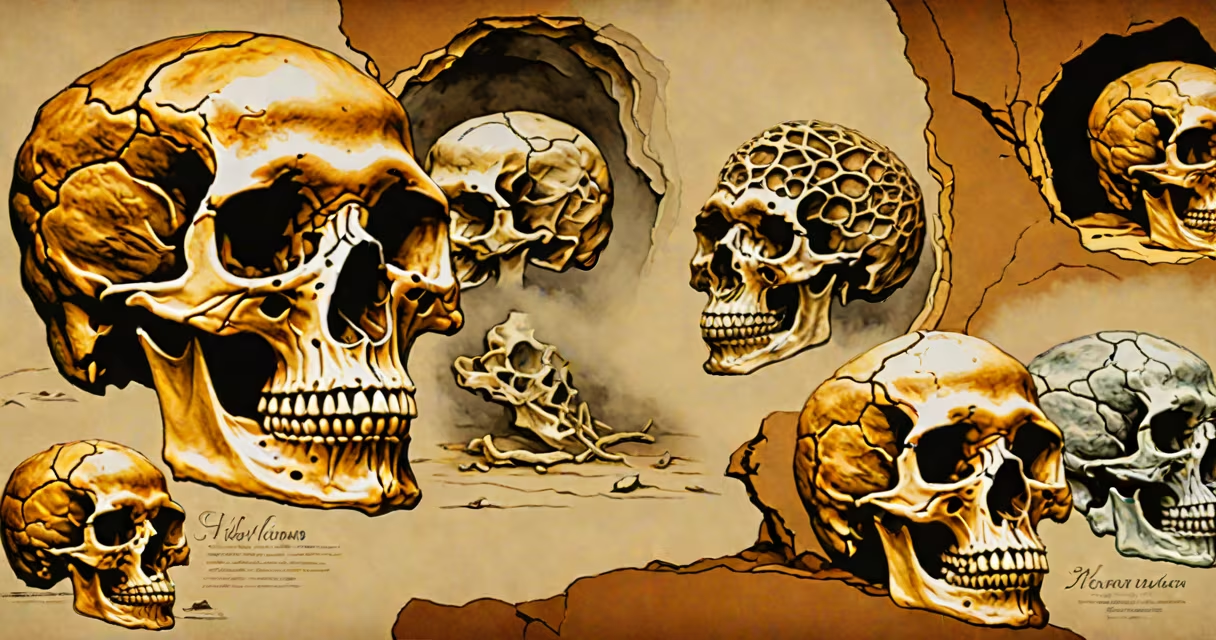
Humans arose through a process of biological evolution over millions of years, beginning with shared ancestors with apes, while religious traditions describe creation by divine will. The scientific explanation relies on fossil records, genetics, and paleoanthropology; the religious version varies by faith but often involves intentional design.
Modern humans (Homo sapiens) emerged around 300,000 years ago in Africa, according to fossil and genetic evidence. This timeline is supported by multiple lines of research, including mitochondrial DNA analysis tracing maternal lineage back to a single woman living about 150,000-200,000 years ago, known as "Mitochondrial Eve." Fossil remains such as those from Jebel Irhoud in Morocco, dated to 315,000 years ago, show early Homo sapiens with modern facial features and brain size.
Genetic comparisons reveal that humans share approximately 98.8% of their DNA with chimpanzees, our closest living relatives. This similarity confirms a common ancestor that lived between 6 and 7 million years ago. The divergence is marked by changes in skull structure, bipedalism, brain expansion, and tool use, all documented in the fossil record from sites like Olduvai Gorge and Hadar.
Human evolution is not a linear progression from ape to modern human. Instead, it's a branching tree with multiple hominin species coexisting. For example, Homo neanderthalensis lived in Europe and parts of Asia until about 40,000 years ago, overlapping with early Homo sapiens. Genetic studies confirm interbreeding occurred, with modern non-African populations carrying 1-4% Neanderthal DNA.
Fossil discoveries such as the 3.2-million-year-old "Lucy" (Australopithecus afarensis) demonstrate upright walking long before large brains evolved. Lucy's pelvis and leg bones indicate habitual bipedalism, a key adaptation that freed hands for tool use and enabled migration out of Africa.
Climate shifts during the Pliocene and Pleistocene epochs drove evolutionary pressures. Drying climates in East Africa led to savanna expansion, favoring endurance running and social cooperation. These environmental changes shaped both anatomy and behavior, leading to increased brain size and complex cultural development.
Different religions offer distinct narratives. In the Judeo-Christian tradition, Genesis describes God forming Adam from dust and breathing life into him, then creating Eve from Adam's rib. This account is interpreted literally by some, but mainstream theologians and scholars recognize it as symbolic, emphasizing humanity's moral responsibility and relationship with God.
The Quran states that Allah created Adam from clay and breathed spirit into him. Islamic teachings allow for compatibility between scripture and science, with many Muslim scholars accepting evolution as part of divine design. The concept of *tawhid* (oneness of God) supports viewing natural processes as expressions of divine will.
Buddhist and Hindu traditions often view creation as cyclical. In Hindu cosmology, humans emerge through repeated cycles of creation (*srishti*) and dissolution (*pralaya*), governed by cosmic time. The Vedas describe humans as evolving through stages (*yugas*), though not in the Darwinian sense.
One widespread error is believing that humans evolved from modern apes. Humans and chimps share a common ancestor, but neither species descended from the other. Apes did not evolve into humans-they are cousins, not ancestors.
Another misconception is that evolution implies progress toward perfection. Evolution selects for traits that improve reproductive success in specific environments, not for complexity or superiority. A bacterium adapted to extreme heat may outperform a human in survival under those conditions.
A third myth is that the fossil record lacks transitional forms. In reality, hundreds of fossils document morphological changes over time. The sequence from Ardipithecus to Australopithecus to early Homo shows gradual shifts in limb proportions, jaw structure, and cranial capacity.
| Aspect | Scientific View | Religious View (Judeo-Christian) |
|---|---|---|
| Timeframe | ~300,000 years for Homo sapiens; ~6-7 million for human-chimp split | ~6,000 years since creation (based on genealogies in Genesis) |
| Origin Mechanism | Natural selection, mutation, genetic drift | Divine act of creation |
| Human Uniqueness | Result of gradual adaptation; shared ancestry with primates | Special status due to being made in God's image (imago Dei) |
| Evidence Basis | Fossils, genetics, comparative anatomy | Scripture, revelation, theological interpretation |
When I visited the National Museum of Natural History in Washington, D.C., I stood before a display of early hominin skulls. The contrast between the heavy brow ridges of Homo heidelbergensis and the smooth forehead of a modern human was stark. That moment clarified how much change occurs over tens of thousands of years-not overnight, not in a single generation, but through countless small adaptations.
A lesser-known fact is that Neanderthal DNA contributes to immune function in modern humans. Studies published in Nature show that certain Neanderthal alleles improve resistance to viral infections, particularly in European and Asian populations. This suggests that interbreeding wasn't just incidental-it had functional benefits.