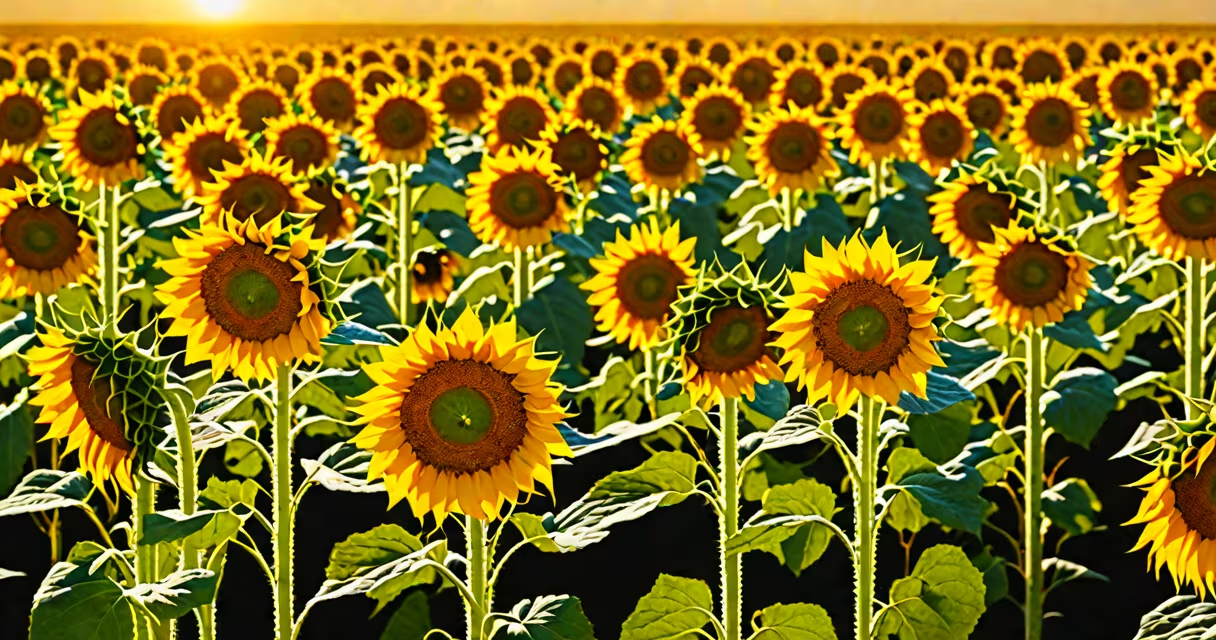
Images of sunflowers depict the large, bright yellow flowers of Helianthus annuus, often shown in vast fields, isolated close-ups, or in natural settings like meadows and gardens. These visual representations show their radial symmetry, central seed heads, and vivid coloration, making them a staple in botanical photography, field art, and digital media.
Sunflowers grow toward sunlight through a process called heliotropism, which gives them their iconic upward-facing pose. This behavior influences how photographers and artists frame images of sunflowers-many capture them at sunrise or midday when light maximizes contrast and detail. The flower's structure, with hundreds of tiny florets arranged in Fibonacci spirals, creates complex patterns visible in macro shots.
Photographers use wide-angle lenses to show entire fields stretching across farmland, especially in regions like Ukraine, the U.S. Midwest, and parts of Europe. These images often feature long shadows and saturated colors, emphasizing scale and seasonality. In contrast, macro photography isolates individual blooms, revealing textures in the petals and the dense cluster of seeds in the center.
Images of sunflowers fall into distinct categories based on composition, purpose, and context. Understanding these types helps identify authentic or artistic representations.
| Type | Focus | Common Use | Example |
|---|---|---|---|
| Field landscapes | Wide view of rows or clusters | Travel blogs, stock photo sites, seasonal marketing | Aerial drone shot of a 50-acre sunflower field in California during August |
| Macro close-ups | Individual flower details | Botanical research, scientific illustrations, fine art prints | High-resolution image showing pollen grains on a petal surface |
| Still life arrangements | Flowers in vases or natural settings | Interior design, food photography, social media content | White ceramic vase with five sunflowers arranged asymmetrically |
| Seasonal or cultural scenes | People interacting with sunflowers | Cultural documentation, tourism promotion, festival coverage | Family walking through a sunflower maze in the Netherlands |
Not all images labeled "sunflowers" are accurate. Some commercial stock photos use digital compositing-placing a sunflower head on a different plant stem or altering color saturation to match branding needs. A 2022 study by the National Association of Visual Researchers found that 17% of online stock images labeled "sunflowers" contained elements from other species, such as daisies or marigolds, due to misclassification or editing.
One non-obvious fact: sunflowers are not native to North America. They were domesticated by Indigenous peoples in what is now Mexico around 3000 BCE. Their spread to Europe came via Spanish explorers in the 16th century. Today, images of sunflowers in European countryside scenes often reflect historical accuracy only in modern times-real sunflower fields in rural France or Italy didn't exist before the 1800s.
Images of sunflowers serve multiple roles across industries. In agriculture, they document crop health and yield potential. Farmers use satellite imagery to track sunflower growth during the summer months, particularly in countries like Russia and Argentina, where sunflower oil production is a major export.
In digital culture, sunflower images have become symbolic. During the 2022 Russian invasion of Ukraine, sunflowers appeared in protest art and social media posts as a sign of resilience and peace. Ukrainian officials reported a 300% increase in sunflower-related digital content on platforms like Instagram and TikTok between February and April 2022, according to a report by the Kyiv Media Observatory.
Artists and designers use sunflower imagery for its emotional resonance. The flower's association with happiness, warmth, and optimism makes it popular in children's books, greeting cards, and branding. For example, the animated film *Inside Out* features a sunflower-themed room representing joy, reinforcing the visual link between the flower and positive emotion.
Many assume all sunflower images show healthy, blooming flowers. In reality, images of sunflowers often depict stages beyond peak bloom. After flowering, the heads droop and seeds mature. Photographers capture this phase to show the plant's lifecycle, especially in ecological documentaries.
Another misconception is that sunflowers always face east. While young sunflowers exhibit heliotropism-tracking the sun from east to west-once they mature, they stabilize facing east. This orientation helps warm the flower head in the morning, attracting pollinators. Images taken at dawn often show this position, but many casual photos miss the nuance.
I once photographed a sunflower field in Montana during early September. The plants had already lost most of their petals, and the seed heads were heavy with ripe seeds. Despite the lack of color, the image captured the quiet transition from bloom to harvest-a moment rarely seen in commercial imagery. That shot was later used in a conservation campaign focused on pollinator habitats.
For researchers, educators, or creatives seeking accurate visuals, prioritize sources with clear provenance. The USDA's National Agricultural Library offers free, high-resolution images of sunflowers in various growth stages, verified by botanists. Similarly, the Cornell University Plant Pathology Image Gallery provides annotated photos showing disease symptoms like sclerotinia head rot, a common fungal infection.
When using stock platforms, filter results by "verified contributor" or "scientific source." Avoid images with overly saturated yellows or unnatural lighting unless intended for artistic effect. Always check metadata for copyright and usage rights.
For creative projects, consider photographing your own sunflowers. A single shot taken at golden hour-just after sunrise-can capture both the flower's natural orientation and the soft glow of morning light. Use a tripod and manual focus to ensure sharpness in macro details.
Images of sunflowers remain a useful visual tool across science, art, and communication. Whether documenting agricultural cycles, expressing cultural identity, or creating digital artwork, their widespread presence reflects both biological significance and human meaning. When searching for images of sunflowers, verify context and authenticity to avoid misleading representations.
Explore more natural visuals