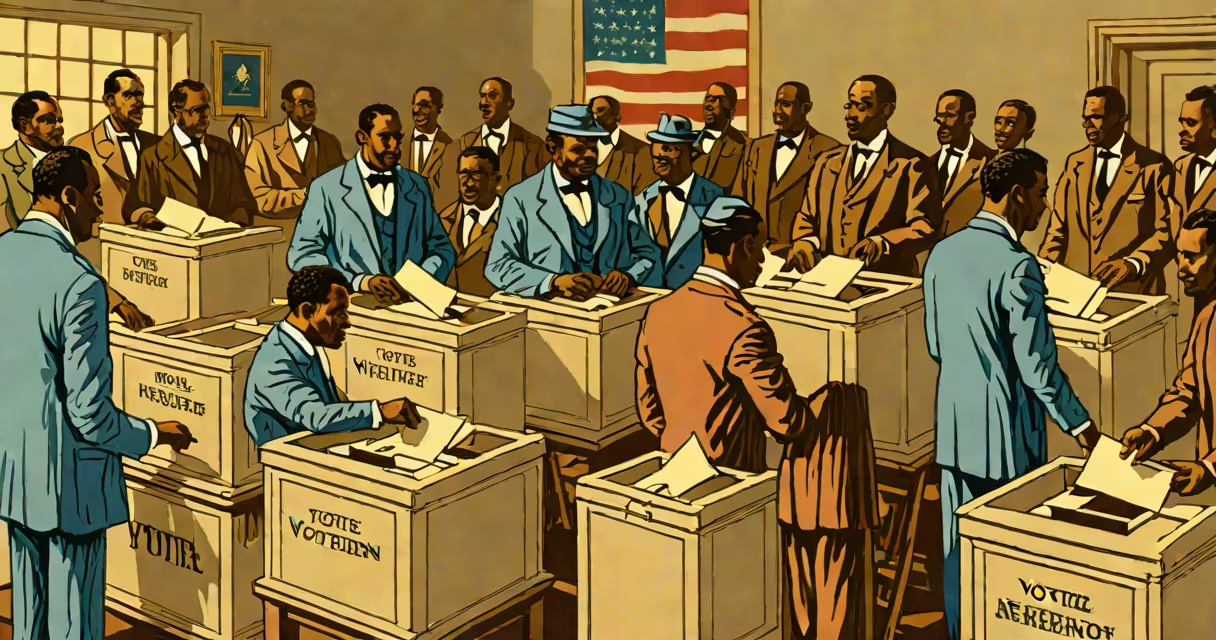
The 15th Amendment to the U.S. Constitution, ratified in 1870, prohibited states from denying the right to vote based on race, color, or previous condition of servitude. It was the first federal law to affirm that citizenship included the right to vote regardless of race.
This amendment emerged from the turmoil of the Civil War and the promise of Reconstruction. After the Union victory, Congress sought to secure freedom not just as liberation from slavery, but as full participation in civic life. The 15th Amendment was designed to ensure that newly emancipated Black men could exercise their right to vote without state interference.
Its passage followed years of debate and resistance. Southern states responded with literacy tests, poll taxes, and violence to suppress Black voter turnout. Despite these efforts, the amendment laid the legal foundation for future civil rights advances. The Supreme Court later cited it in cases challenging racial discrimination in elections.
The amendment's language is direct: "The right of citizens of the United States to vote shall not be denied or abridged by the United States or by any State on account of race, color, or previous condition of servitude." This clause applies to both federal and state actions that restrict voting access.
Enforcement relies on federal oversight. When a state law appears to discriminate, courts can strike it down under the 15th Amendment. For example, in 1965, the Voting Rights Act was passed to enforce the amendment's intent after decades of systemic barriers in the South.
Without the 15th Amendment, many of today's voting protections would lack constitutional grounding. The Equal Protection Clause of the 14th Amendment addresses discrimination broadly, but the 15th Amendment specifically targets racial disenfranchisement in electoral processes.
The amendment was drafted to counter specific tactics used to exclude Black voters. These included:
These methods persisted for nearly a century. In 1944, the Supreme Court ruled in Smith v. Allwright that white-only primary elections violated the 15th Amendment. That decision helped dismantle one of the most insidious forms of exclusion.
The 15th Amendment remains relevant in modern court cases involving voting rights. In 2013, the Supreme Court struck down Section 4(b) of the Voting Rights Act, which required certain states with histories of discrimination to get federal approval before changing voting laws. The ruling in Shelby County v. Holder effectively weakened enforcement mechanisms tied to the 15th Amendment.
Since then, several states have enacted new voter ID laws, redistricting plans, and early voting restrictions. Critics argue these measures disproportionately affect communities of color. Legal challenges continue under the 15th Amendment's structure. In 2021, the Supreme Court heard arguments in Brnovich v. Democratic National Committee, evaluating whether Arizona's voting rules violated the amendment.
When courts assess such cases, they apply the "totality of the circumstances" test. This means they look at the effect of a law-not just its wording-to determine if it results in racial discrimination in voting access.
Many assume the 15th Amendment immediately granted Black men the right to vote. That is false. While the amendment outlawed racial voter denial, it did not mandate enforcement. Federal power to protect voting rights came later through legislation.
Another misconception is that the amendment applied only to men. It did not explicitly address gender. Women of all races still lacked the vote until the 19th Amendment in 1920. This gap highlights how the 15th Amendment focused narrowly on race, not gender.
A less known fact: the amendment's ratification was delayed because of political maneuvering. Louisiana and Georgia initially refused to ratify it. The process took over two years after Congress passed it in 1869. Only after pressure from Republican leaders and military occupation in the South did enough states approve it.
In 1872, Mississippi held its first statewide election after Reconstruction began. Over 100,000 Black men registered to vote. In some counties, Black voter turnout exceeded 80%. This was new in the South.
At the time, the 15th Amendment had not yet been ratified. But the Freedmen's Bureau and Republican officials encouraged registration using the principle that freed people deserved political rights. After ratification, these votes were legally protected.
Results showed a shift in power. Black candidates won local offices in several districts. One county elected a Black sheriff and a Black school board member. These changes were short-lived-by 1876, white supremacist groups regained control through intimidation and fraud-but the 1872 election proved the amendment's potential.
Understanding the 15th Amendment requires comparing it to other amendments that shaped civil rights. The table below outlines key differences:
| Amendment | Focus | Key Protection | Enforcement Mechanism |
|---|---|---|---|
| 13th | Abolition of slavery | Prohibits involuntary servitude | Enforced through federal prosecution |
| 14th | Citizenship and equal protection | Guarantees due process and equal treatment under law | Used in landmark civil rights cases |
| 15th | Voting rights by race | Bars denial of vote based on race or color | Applied in federal court challenges to discriminatory laws |
The 15th Amendment is unique in that it focuses exclusively on electoral access. The 14th Amendment protects rights in daily life-education, employment, housing-but not specifically voting. The 13th Amendment abolished slavery, but left the door open for new forms of forced labor.
Together, these amendments form a legal chain. The 13th ended bondage. The 14th gave legal personhood. The 15th gave political power. Without any one, the others would lack full force.
I attended a voter registration drive in Atlanta during the 2016 presidential election. Volunteers set up tables in historically Black neighborhoods. One man, in his 70s, told me he'd been turned away from polling stations in the 1960s because of a literacy test. He remembered being asked to define "sovereignty" in a way that made no sense.
He registered to vote that day. His granddaughter stood beside him. She was born in 2000-she'd never faced a literacy test. Her vote, like his, was protected under the 15th Amendment. That moment showed how far we've come-and how much work remains.
The importance of the 15th Amendment lies in its role as a foundational guarantee of democratic inclusion. It established that citizenship includes the right to vote, regardless of race. Though enforcement has faltered over time, the amendment remains a living standard against which voting laws are judged.