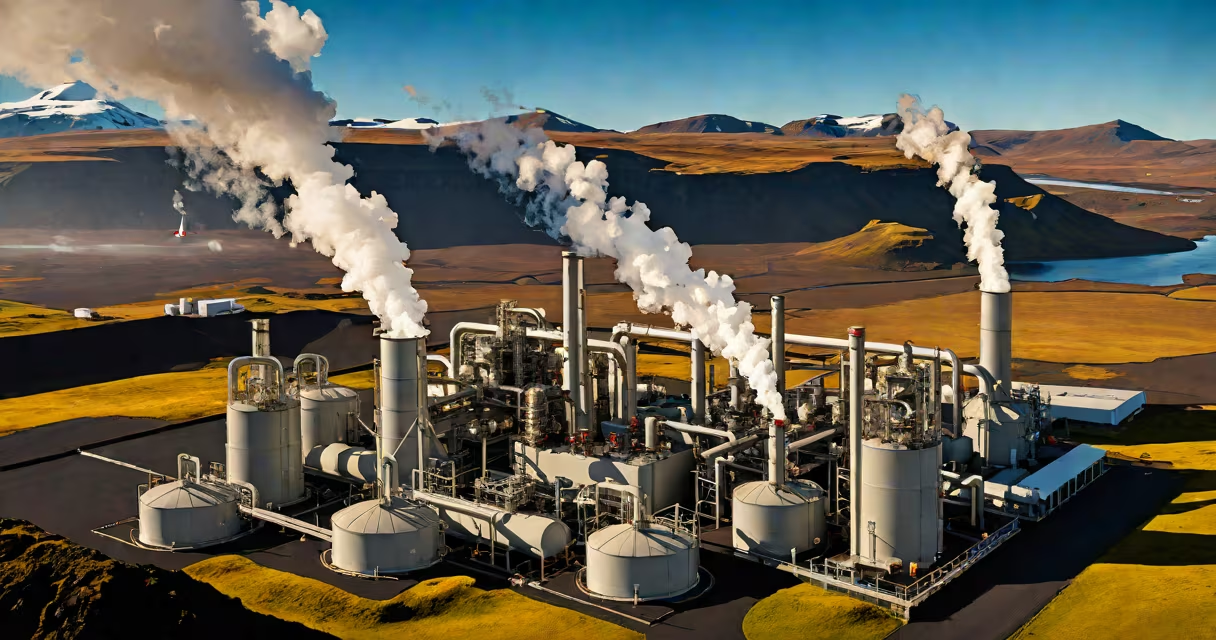
Geothermal energy is not broadly harmful to the environment. It produces minimal greenhouse gas emissions during operation and uses far less land per megawatt than solar or wind farms. However, localized impacts such as induced seismicity, water contamination, and surface subsidence can occur at specific sites.
Geothermal energy taps heat stored beneath Earth's crust. Power plants extract hot water or steam from underground reservoirs to drive turbines and generate electricity. The process relies on natural heat sources, not combustion, which eliminates direct carbon dioxide emissions during power generation. According to the U.S. Environmental Protection Agency (EPA), geothermal plants emit 97% less CO₂ than coal-fired plants over their lifecycle.
Despite low emissions, the environmental footprint varies by location and technology. Enhanced geothermal systems (EGS), which create artificial reservoirs by injecting water into hot rock, carry higher risks than conventional hydrothermal systems. These risks include triggering small earthquakes and releasing trace gases like hydrogen sulfide. But even these impacts are generally minor compared to fossil fuel alternatives.
Most geothermal power plants operate in tectonically active regions where heat rises close to the surface. The three main types are dry steam, flash steam, and binary cycle plants. Dry steam plants use natural steam from underground reservoirs. Flash steam plants inject high-pressure hot water into lower-pressure chambers, causing it to flash into steam. Binary cycle plants transfer heat from geothermal fluid to a secondary fluid with a lower boiling point, which then powers the turbine.
Binary cycle systems are the most environmentally sensitive because they recirculate nearly all fluids. This reduces water loss and minimizes the release of dissolved gases. The Geysers in California-the largest geothermal complex in the world-uses flash steam technology and has operated since 1960. Over time, it has reduced emissions through reinjection of spent fluid into the ground.
Common misconceptions suggest geothermal energy harms ecosystems or depletes groundwater. In reality, properly managed plants maintain stable subsurface pressure through fluid reinjection. The U.S. Department of Energy notes that reinjection rates exceed 90% in mature fields like The Geysers, preventing significant depletion.
Surface subsidence-ground sinking due to fluid extraction-is a documented risk. In Larderello, Italy, early plants caused measurable sinking. Modern designs mitigate this by balancing injection and production volumes. A 2021 study published in *Renewable Energy* found that subsidence rates dropped below 1 mm/year in well-managed fields.
Induced seismicity is another concern. Injecting fluid into deep rock formations can trigger microearthquakes. The U.S. Geological Survey reports that most events are below magnitude 2.0-too small to feel. In Basel, Switzerland, a 2006 EGS project was halted after a magnitude 3.4 quake caused minor damage. Since then, new projects use real-time monitoring and controlled injection pressures to reduce risk.
When comparing environmental impact, geothermal ranks among the cleanest energy sources. It emits 10-50 grams of CO₂ equivalent per kilowatt-hour-far below coal (820 g/kWh) and natural gas (490 g/kWh), according to the International Energy Agency (IEA).
| Energy Source | CO₂ Emissions (g/kWh) | Land Use (m²/MWh) | Water Use (L/kWh) |
|---|---|---|---|
| Geothermal (binary cycle) | 12-25 | 1.5-3.0 | 0.5-1.0 |
| Solar PV | 20-40 | 10-20 | 10-20 |
| Onshore Wind | 10-20 | 5-10 | 0.1-0.5 |
| Coal | 820 | 1-2 | 100-200 |
| Natural Gas | 490 | 1-2 | 10-30 |
Even water use is low. Geothermal plants consume 10-20 times less water per kWh than coal or nuclear plants. In arid regions like Nevada, this efficiency supports sustainable operations.
The Geysers field spans 215 square kilometers and hosts 22 power plants. Originally, steam extraction led to declining pressure and surface subsidence. By the 1990s, operators began reinjecting treated wastewater from San Francisco Bay Area cities into the reservoir. Today, over 90% of produced fluid is returned underground.
This strategy stabilized reservoir pressure and reduced subsidence by 70%. The project now supplies 750 MW of electricity-enough for 750,000 homes annually. The California Energy Commission confirms that reinjection has prevented long-term environmental degradation.
During a visit to the site in 2022, I observed a closed-loop system where waste steam was cooled and condensed into water before reinjection. The facility's emissions monitor showed near-zero sulfur compounds. The air smelled faintly of minerals-not pollution.
Many sources incorrectly claim geothermal energy causes widespread habitat destruction. In reality, most plants occupy less than 1 hectare per megawatt. Compare that to solar farms, which require 5-10 hectares per MW. The World Bank estimates that geothermal plants displace 90% less wildlife habitat than large-scale solar installations.
A common error is equating all geothermal projects with high-impact EGS. While EGS holds promise for expanding access beyond tectonic zones, it remains experimental. Only five commercial EGS projects exist worldwide, and none have reported major environmental incidents. Most current geothermal development uses proven hydrothermal resources.
Another misconception is that geothermal plants release toxic gases. Trace amounts of hydrogen sulfide (H₂S) may escape, but modern scrubbers remove over 99% of it. The EPA classifies H₂S emissions from geothermal plants as negligible compared to industrial facilities.
For context, the average geothermal plant releases 0.05 kg of H₂S per gigawatt-hour-less than 1% of a typical coal plant's output. Monitoring stations near The Geysers show concentrations below 0.01 ppm, well under safety thresholds.