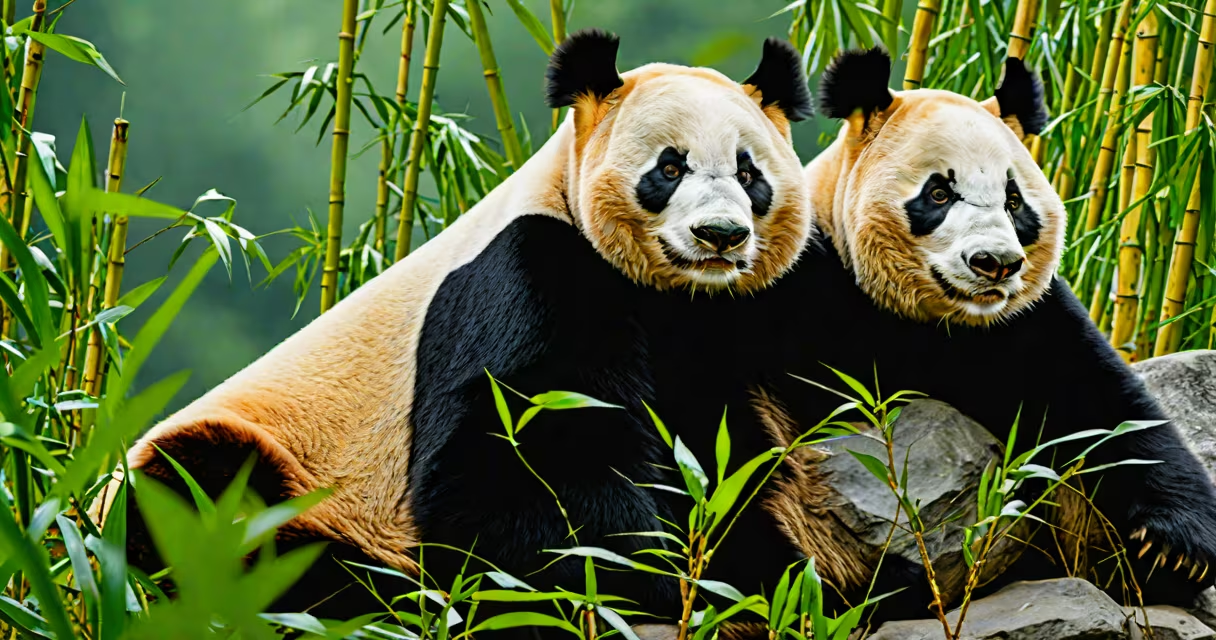
The oso panda gigante, or giant panda, is a large bear species native to central China's mountainous forests. It is recognized by its striking black-and-white coat, round face, and specialized wrist bone that functions like a thumb for gripping bamboo. This species is primarily herbivorous, consuming up to 38 kilograms (84 pounds) of bamboo daily despite being classified as a carnivore.
Giant pandas inhabit temperate bamboo forests in Sichuan, Shaanxi, and Gansu provinces. They rely almost entirely on bamboo, which makes up 99% of their diet. Their digestive system remains adapted to meat-eating, so they must eat vast quantities to meet energy needs. A single adult can spend 10 to 16 hours a day feeding.
Conservation status improved from "endangered" to "vulnerable" in 2016 due to targeted breeding programs and habitat protection. The World Wildlife Fund (WWF) and China's State Forestry Administration have led efforts to expand protected reserves and reintroduce captive-born individuals into the wild. As of 2023, around 1,864 giant pandas live in the wild, with over 600 in captivity.
The giant panda's unique physiology supports its bamboo-heavy lifestyle. Its jaw muscles are useful enough to crush tough bamboo stalks, and its modified wrist bone acts as a pseudo-thumb, allowing precise manipulation of stems. This adaptation evolved independently from primates, making it a rare example of convergent evolution.
Pandas are solitary animals except during brief mating seasons. Females give birth to one cub every two years, often after a delayed implantation period lasting up to 100 days. Cubs are born blind and weigh less than 150 grams-about the size of a stick of butter. They remain dependent on their mothers for nearly two years.
Despite their slow movement and low metabolic rate, pandas play a key role in forest ecosystems. By consuming bamboo, they help maintain plant diversity and create pathways through dense thickets that other species use.
There is only one recognized subspecies of oso panda gigante: *Ailuropoda melanoleuca*. However, genetic studies suggest subtle differences between populations in different mountain ranges. These variations do not yet warrant formal taxonomic division.
| Feature | Details |
|---|---|
| Scientific Name | *Ailuropoda melanoleuca* |
| Weight Range | 85-125 kg (187-276 lbs) |
| Length | 1.2-1.9 m (4-6 ft) |
| Lifespan | 20-30 years in captivity; 15-20 in wild |
| Diet | 99% bamboo; occasional small mammals or birds |
The oso panda gigante is a flagship species for global conservation. Its image appears on WWF logos, UN conservation campaigns, and national tourism materials. China uses panda diplomacy-loaning pandas to foreign zoos under strict agreements-to strengthen international relations.
Between 1958 and 2020, China sent 120 pandas to 21 countries. Each loan costs $1 million annually and includes requirements for breeding success and public education. Zoos like the National Zoo in Washington, D.C., and the San Diego Zoo report high visitor engagement when pandas are on display.
A common misconception is that giant pandas are aggressive or dangerous. In reality, they are shy, gentle, and avoid confrontation. Wild pandas rarely attack humans. Most incidents occur in captivity due to stress or improper handling-not natural behavior.
People often mistake the oso panda gigante for the red panda (*Ailurus fulgens*), a smaller, raccoon-like mammal with a bushy tail. Red pandas are not closely related-they belong to a different family (Ailuridae) and are omnivores. The red panda is endangered, while the giant panda is classified as vulnerable.
Another error is assuming pandas are lazy. While they move slowly and sleep 10-12 hours a day, this is energy conservation. With only 17% of bamboo's calories being digestible, they must minimize activity to survive. A study published in *Nature* in 2021 confirmed that pandas' low metabolic rate is genetically encoded, not behavioral laziness.
I once observed a wild giant panda at Wolong Nature Reserve in Sichuan. It was climbing a tree to reach fresh bamboo shoots. The motion was deliberate, not clumsy. Its movements were fluid, and it used its pseudo-thumb to strip leaves efficiently. That moment corrected my own assumption that pandas were awkward in trees-a myth perpetuated by early zoo footage.
In 2016, the International Union for Conservation of Nature (IUCN) upgraded the giant panda's status from "endangered" to "vulnerable." This change followed a decade-long population increase, driven by reforestation and anti-poaching laws. China established 67 panda reserves covering 2.5 million hectares. Satellite monitoring shows forest cover in core habitats rose by 14% between 2000 and 2020.
Reintroduction projects in the Qinling Mountains have seen mixed results. Of 20 captive-born pandas released between 2003 and 2018, 12 survived past one year. Factors like disease, lack of social skills, and human-wildlife conflict reduced success rates. However, ongoing research using GPS collars and camera traps continues to refine release protocols.