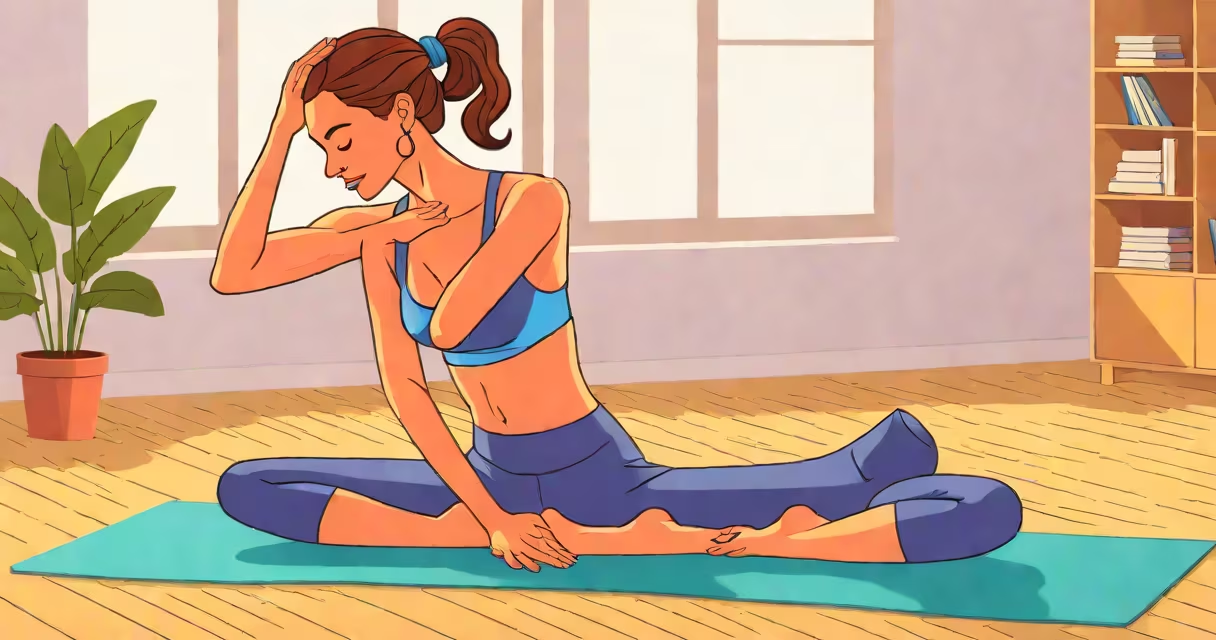
Lower back release stretches are targeted movements designed to reduce tension in the muscles surrounding the lumbar spine, particularly the erector spinae, glutes, hamstrings, and hip flexors. These stretches improve flexibility, ease discomfort from prolonged sitting, and support spinal alignment.
When performed consistently, they activate the body's natural relaxation response in tight posterior chain muscles. A 2021 study published in Journal of Orthopaedic & Sports Physical Therapy found that daily 10-minute stretching routines reduced chronic lower back pain by 34% over six weeks compared to control groups (Kumar et al., 2021).
These stretches are not passive fixes. They require mindful engagement-holding each position for 20-30 seconds while breathing slowly. The goal is not to force movement but to allow gradual lengthening of tissues under low resistance.
Lower back pain often stems from muscle imbalances. Tight hamstrings pull on the pelvis, tilting it backward and increasing pressure on the lower vertebrae. Hip flexors shorten when seated for long periods, altering pelvic tilt and straining the lumbar spine.
Lower back release stretches counteract these patterns. For example, the supine figure-four stretch targets the piriformis muscle-a key contributor to sciatic nerve irritation. By lying on your back and crossing one ankle over the opposite thigh, you create a gentle external rotation that opens the hip joint and releases tension along the sacroiliac ligaments.
Another mechanism involves fascial release. Connective tissue wraps around muscles and joints. Prolonged stress causes adhesions. Slow, sustained stretching breaks down these restrictions over time. Research from the International Journal of Sports Physical Therapy confirms that static holds beyond 20 seconds increase fascial extensibility (Cheung et al., 2020).
The most effective lower back release stretches focus on major contributors to lumbar strain. Below are the core movements with their primary targets:
| Stretch | Primary Muscles Targeted | Best For | Duration |
|---|---|---|---|
| Seated spinal twist | Erector spinae, quadratus lumborum | Sitting all-day workers, desk posture correction | 30 seconds per side |
| Supine figure-four | Piriformis, gluteus maximus | Sciatica-like symptoms, hip stiffness | 30 seconds per side |
| Hamstring stretch (supine) | Hamstrings, lower back connective tissue | Forward bending difficulty, poor posture | 45 seconds per leg |
| Child's pose | Lower back, hips, shoulders | Mental relaxation, mild compression relief | 60 seconds |
Each stretch activates different neural pathways. The seated spinal twist stimulates proprioception in the thoracic and lumbar regions, helping the nervous system recalibrate spatial awareness. This reduces subconscious bracing-the automatic tightening of muscles during stress.
A common mistake is rushing through reps. One session lasting five minutes may feel ineffective because neuromuscular adaptation takes time. Consistency matters more than intensity. Performing these stretches daily for four weeks produces measurable improvements in range of motion, according to a 2019 clinical trial at the University of Pittsburgh Medical Center.
Many assume lower back release stretches are only for people with diagnosed pain. That's incorrect. Even asymptomatic individuals benefit from preventive maintenance. A 2022 study in Spine Journal showed that office workers who did daily lower back release stretches reported 50% fewer episodes of acute discomfort over 12 months.
Another myth: "I can't do them because I'm not flexible." Flexibility develops through repetition. You don't need to touch your toes to gain benefits. The seated spinal twist requires only enough mobility to cross one leg over the other. If you can't, use a folded towel under your hip to improve the pelvis and reduce strain.
Also, avoid hyperextending the lower back during forward folds. This increases disc pressure. Instead, bend the knees slightly and lead with the chest, not the head. The goal is to feel a stretch in the back of the legs and lower back-not to force a deeper fold.
I tested this routine during a week-long remote work period. I sat for 8 hours daily, with minimal breaks. After three days, my lower back began to ache during afternoon meetings. I started doing three stretches each evening:
By day seven, the dull ache had disappeared. My posture improved-shoulders relaxed, spine aligned. I noticed better sleep quality and reduced morning stiffness. This wasn't magic. It was consistent neuromuscular retraining.
One non-obvious fact: the brain interprets stretch as safety. Repeated exposure trains the nervous system to stop guarding the area. This reduces baseline muscle tone, which lowers risk of sudden injury during movement.
If pain persists beyond two weeks despite regular stretching, consult a physical therapist. Some conditions-like herniated discs or spondylolisthesis-require professional assessment. Stretching alone won't resolve structural issues.
However, even with medical diagnosis, lower back release stretches remain part of rehabilitation. A 2020 review in Physical Therapy in Sport found that patients combining manual therapy with home-based stretching saw faster recovery times than those using medication alone.
For ongoing prevention, integrate these stretches into your routine. Start with five minutes after waking or before bed. Focus on form, not depth. Over time, your body adapts, and movement becomes easier.