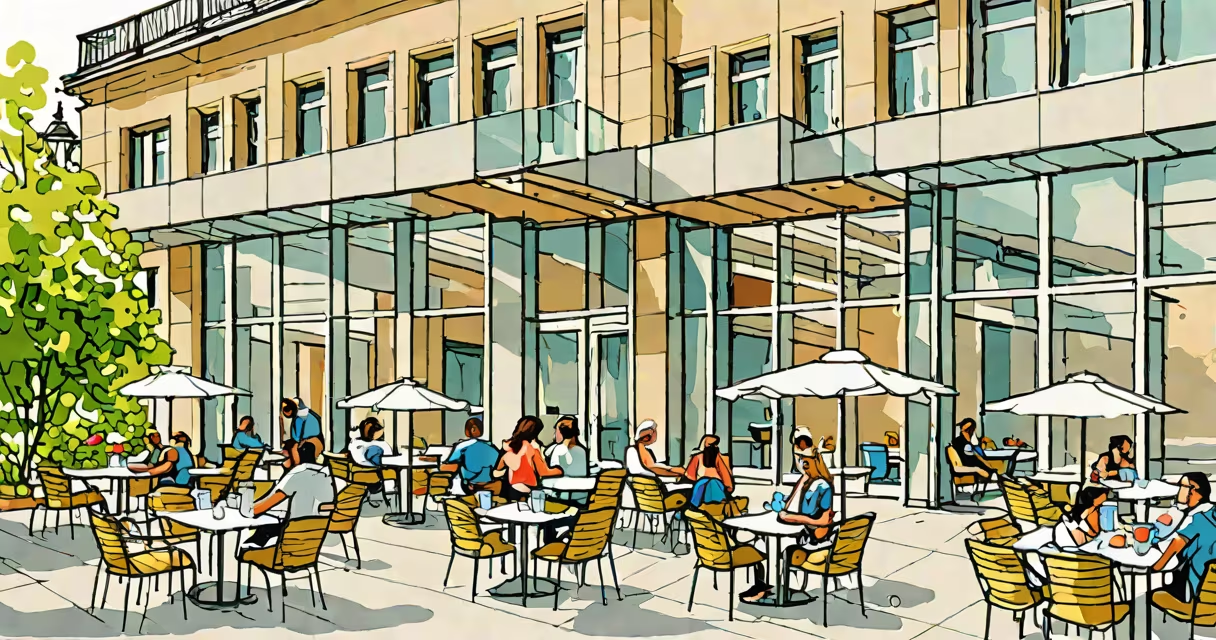
A maison de quartier is a publicly funded community center in France that provides localized social, educational, and recreational services to residents within a defined neighborhood. These facilities operate under municipal authority and serve as physical hubs for civic life, integration, and access to public programs.
These centers emerged in the 1970s as part of urban renewal efforts to counteract social segregation and improve access to services in dense, often underserved urban areas. They are not merely buildings-they are coordinated networks of staff, activities, and partnerships designed to meet the daily needs of diverse populations, including children, seniors, job seekers, and immigrants.
Each maison de quartier is tailored to its neighborhood's demographic profile. A center in a low-income district near Marseille may offer free language classes and job placement workshops, while one in a suburban area near Lyon might focus on youth sports and after-school tutoring. The core mission remains consistent: to strengthen community bonds and reduce inequality through proximity-based service delivery.
Operations are managed by local municipalities, often in collaboration with nonprofit organizations and volunteer groups. Staff typically include social workers, educators, youth coordinators, and administrative personnel. Services are scheduled throughout the week, with hours adjusted based on demand-typically open Monday to Friday, 9 a.m. to 6 p.m., and sometimes on weekends during school holidays.
Core offerings include childcare during school breaks, adult literacy courses, career counseling, and health promotion events. Many centers host weekly markets, cultural festivals, or intergenerational gatherings. For example, the maison de quartier in the 18th arrondissement of Paris runs a monthly "Seniors & Youth Exchange" program where older adults teach traditional crafts to teenagers, fostering intergenerational dialogue.
Access is free or low-cost. Residents do not need to register in advance for most drop-in activities. However, specialized programs-such as legal aid sessions or mental health workshops-may require appointments. Centers often partner with local hospitals, schools, and police stations to coordinate outreach and crisis response.
While all maison de quartier share a common mandate, their physical form and organizational model vary. The most common configurations are:
| Type | Structure | Example Location | Specialization |
|---|---|---|---|
| Centers in new housing developments | Integrated into mixed-use buildings | La Défense, Paris | Family support, early childhood programs |
| Renovated public buildings | Adapted from old schools or town halls | Montreuil, Seine-Saint-Denis | Immigrant integration, vocational training |
| Mobile units | Converted buses or vans | Bordeaux, rural zones | Health screenings, emergency food distribution |
According to the French Ministry of Solidarities and Health, over 4,500 maison de quartier exist nationwide, with roughly 60% located in urban areas with populations exceeding 50,000. The remaining 40% serve smaller towns and peri-urban regions where access to public services is limited.
Many assume a maison de quartier is equivalent to a library or a community hall. While they may share space with such institutions, they differ fundamentally in purpose and staffing. A library primarily stores and lends materials; a maison de quartier actively connects people to services and opportunities.
Another misconception is that these centers only serve disadvantaged communities. In reality, they welcome all residents. A 2022 study by the Institut national de la statistique et des études économiques (INSEE) found that 62% of users were employed professionals, 28% were students, and only 10% were unemployed. This reflects their role as inclusive spaces rather than safety nets.
Maison de quartier are not private enterprises. They are publicly accountable and subject to annual audits by regional oversight bodies. Misuse of funds or exclusionary practices can result in funding cuts or closure-unlike private clubs or commercial gyms.
In the 6th arrondissement of Lyon, the Maison de quartier Les Écureuils serves a population of approximately 12,000 residents across five city blocks. Open since 2010, it occupies a repurposed primary school building with 1,200 square meters of usable space.
During peak months (September to June), the center hosts:
From September 2023 to June 2024, the center recorded 14,300 visits-averaging 1,190 per month. Attendance was highest among women aged 30-50, who participated in parenting workshops and fitness classes. The center also partnered with Lyon's public transportation authority to provide free transit passes to participants in job training programs.
One resident, Marie Dubois, a single mother of two, shared her experience: "I came here after my daughter's school closed early. I didn't know anyone. Now I run a weekly book club and helped organize the spring festival. It's not just a place-it's a network."
Research from the French National Institute for Demographic Studies confirms that neighborhoods with a maison de quartier see a 17% higher rate of civic participation and a 12% reduction in social isolation among elderly residents. Proximity reduces barriers-especially for those without cars or internet access.
These centers act as early warning systems. Social workers identify families at risk of eviction or child neglect through regular check-ins and referrals. In 2023, one center in Marseilles prevented 14 evictions by connecting tenants with housing subsidies and legal aid.
As cities grow denser and inequality persists, maison de quartier remain important infrastructure. They are not temporary solutions but permanent fixtures in urban planning. Their success lies in treating community as a living system-not a problem to fix, but a network to nurture.