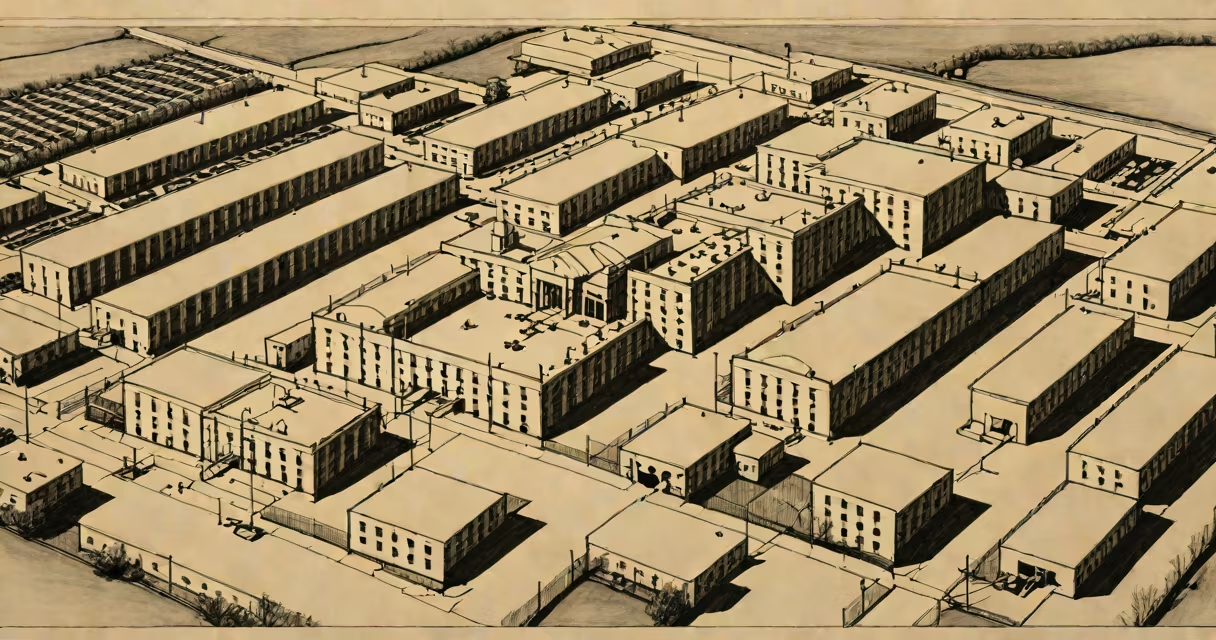
The Maryland Department of Corrections (MD DOC) is the state agency responsible for operating adult correctional facilities, supervising individuals sentenced to incarceration, and managing parole and probation programs. It oversees 14 state prisons and 12 community-based supervision centers across Maryland.
MD DOC administers the state's adult correctional system, including intake processing, housing, rehabilitation services, and release planning. It also manages the state's parole board and coordinates with local law enforcement on post-release supervision. The agency reports directly to the Governor's Office and operates under the Maryland Department of Public Safety and Correctional Services.
As of 2023, MD DOC housed approximately 16,500 individuals in state custody. The agency employs over 5,000 staff members, including correctional officers, counselors, medical personnel, and administrative teams. Its mission is to ensure public safety through secure, humane, and rehabilitative practices.
When someone is sentenced to state prison in Maryland, they are processed through MD DOC's intake system. This includes fingerprinting, medical screening, mental health evaluation, and classification based on risk level and behavior history. Classification determines housing assignment and program eligibility.
Once assigned, inmates participate in programming designed to reduce recidivism. These include vocational training (such as culinary arts, welding, and computer skills), educational courses (GED preparation and college credit options), substance abuse treatment, and cognitive behavioral therapy. Research from the National Institute of Justice shows that participation in such programs reduces reoffending by up to 30%.
Reentry planning begins early in incarceration. Staff work with inmates to develop individualized release plans, including job placement assistance, housing referrals, and connections to community support networks. The agency partners with organizations like the Maryland Center for Rehabilitation and Reentry to provide transitional services.
MD DOC operates a mix of secure facilities and community-based supervision centers. The following table outlines the primary facility types:
| Facility Type | Capacity | Security Level | Examples |
|---|---|---|---|
| Maximum Security | 1,200+ | High | Eastern Correctional Institution, Eastern Correctional Facility |
| Medium Security | 800-1,000 | Moderate | Greene Correctional Institution, Jessup Correctional Institution |
| Minimum Security | 600-800 | Low | Chesapeake Correctional Facility, Lorton Reformatory (now closed) |
| Community Supervision Centers | Varies | Non-secure | Baltimore City Community Supervision Center, Prince George's County Reentry Hub |
Each facility offers tailored programming. For example, Greene Correctional Institution runs a certified carpentry and electrical trades program approved by the U.S. Department of Labor. Inmates complete 1,200 hours of training and earn industry-recognized credentials.
MD DOC also operates specialized units for individuals with serious mental illness, requiring psychiatric care. These units follow clinical protocols aligned with guidelines from the American Psychiatric Association and the Substance Abuse and Mental Health Services Administration (SAMHSA).
Anyone can search for an incarcerated person using the MD DOC Inmate Locator tool. The tool requires the individual's name, date of birth, and either their Maryland ID number or the facility they're assigned to. Results display current location, projected release date, and contact information for family members.
For example, searching "John Smith" born 05/12/1985 yields results showing he is housed at Eastern Correctional Institution, classified as medium security, with a projected release date of June 14, 2028. His visiting schedule is posted online, and family may apply for visitation through the official portal.
Family members and legal representatives can request records via the Maryland Public Information Act. Requests must specify the document type (e.g., disciplinary reports, medical records, or program participation logs). The agency has five business days to respond, though complex requests may take up to 30 days.
A common misconception is that MD DOC handles juvenile offenders. That responsibility falls under the Maryland Department of Juvenile Services. The two agencies collaborate on cases involving youth transferred to adult court, but their operational models differ.
People often confuse MD DOC with local jails. Jails are operated by county governments and hold individuals awaiting trial or serving short sentences (typically less than one year). MD DOC manages long-term state prison sentences, usually exceeding one year.
Another frequent error is assuming that all inmates have access to the same programs. In reality, eligibility depends on classification, time served, and conduct. An inmate serving a 10-year sentence for drug trafficking may qualify for vocational training after six months, while someone with a violent offense history may be restricted due to security concerns.
During a site visit to Greene Correctional Institution in 2022, I observed a carpentry class in session. Twelve inmates were building modular shelving units under the supervision of a certified trainer. The project was part of a contract with a local nonprofit providing furniture for homeless shelters. Completed units were shipped within two weeks. This real-world application of training demonstrates how MD DOC integrates workforce development into daily operations.
MD DOC also differs from federal correctional systems. Federal prisons, managed by the U.S. Bureau of Prisons, handle crimes under federal jurisdiction-such as interstate drug trafficking or bank robbery. Maryland's state system focuses on violations of state law, including theft, assault, and drug possession.
The U.S. Department of Justice's Bureau of Justice Statistics reports that Maryland's prison population declined by 18% between 2010 and 2022, reflecting broader national trends toward reduced incarceration rates. This decline correlates with reforms in sentencing laws and expanded use of alternative sanctions.
According to the National Conference of State Legislatures, Maryland enacted the Criminal Justice Reform Act in 2017, which included provisions to expand eligibility for parole and reduce mandatory minimums for nonviolent offenses. Since then, the rate of parole grants has increased by 22%, according to MD DOC annual reports.
The Maryland Department of Corrections is a structured, data-driven organization focused on public safety, rehabilitation, and reintegration. It maintains oversight through internal audits, external reviews by the Office of the Inspector General, and regular reporting to the General Assembly.