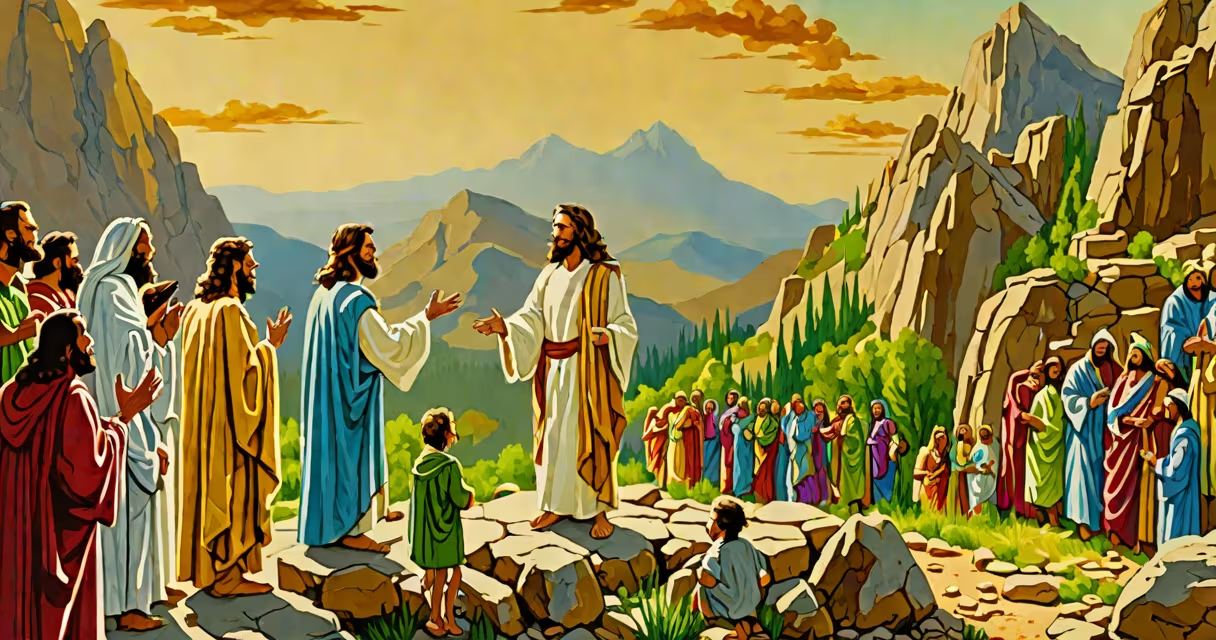
Matthew 17:14-20 records Jesus healing a boy tormented by a demon, confronting the disciples' inability to cast it out, and teaching that even faith as small as a mustard seed can move mountains. The passage reveals the limits of human effort without divine trust and underscores that spiritual authority flows from relationship with God.
Jesus descends from the Mount of Transfiguration to find a crowd arguing with scribes. A man approaches Him, pleading for help with his son, who suffers from seizures and convulsions caused by a demon. The disciples had tried to cast out the spirit but failed. Jesus rebukes the demon, heals the boy instantly, and turns to His disciples, saying, "Because of your little faith."
He then tells them that faith as small as a mustard seed can move mountains. The mustard seed was a common metaphor in Jewish culture-tiny, yet capable of growing into a large shrub. Jesus uses it to illustrate that even minimal trust in God's power produces extraordinary results. The disciples' failure wasn't due to lack of authority but lack of faith.
This moment follows the Transfiguration, where Peter, James, and John witnessed Jesus radiant in glory. Their awe had just been confirmed by God's voice declaring, "This is my Son, whom I love; with him I am well pleased." Yet they still couldn't heal the boy. The contrast highlights that divine revelation doesn't automatically translate into spiritual effectiveness without inner transformation.
The boy's condition is described as severe-falling into fire and water, suffering violent convulsions. These symptoms align with ancient descriptions of epilepsy or neurological disorders, though the Gospel attributes the cause to demonic possession. The narrative frames the issue as both physical and spiritual, requiring divine intervention.
When the father says, "I believe; help me overcome my unbelief," he acknowledges his struggle. This moment is not a rejection of faith but a cry for deeper trust. Jesus responds not by rejecting doubt but by healing the boy, showing that God meets people where they are-even in their brokenness.
Jesus' statement about faith being "small as a mustard seed" is not about size of belief but about quality. The mustard seed was known for its tiny size and rapid growth. In Jewish agrarian life, it symbolized something insignificant that becomes useful. Jesus uses it to show that faith doesn't need to be large-it needs to be real and directed toward God.
Not all faith is equal in effect. The disciples had been given authority to cast out demons earlier (Matthew 10:1-4), yet here they fail. Their inability points to a gap between delegated power and internal conviction. They had performed miracles before, but now, under pressure, their faith faltered.
Some scholars suggest the disciples' failure stemmed from spiritual complacency. After witnessing the Transfiguration, they may have expected immediate results. Instead, Jesus redirects their focus: the problem isn't the demon, nor the boy's condition, but their own lack of trust. The lesson is not about ritual or technique but about heart posture.
| Element | Description | Significance |
|---|---|---|
| Demon-possessed boy | Seizures, violence, falls into fire/water | Symbolizes spiritual oppression and human helplessness |
| Disciples' failure | Could not cast out the spirit despite prior authority | Shows that power without faith leads to failure |
| Mustard seed analogy | Smallest seed, grows into large shrub | Illustrates that small faith can produce great results |
| "Help me overcome my unbelief" | Father's plea to Jesus | Model of honest faith-believing while struggling |
Many interpret "faith as small as a mustard seed" to mean that even tiny amounts of belief are enough. But the original Greek implies not quantity but character-faith that is persistent, rooted, and obedient. The mustard seed wasn't praised for being small but for its potential to grow. Jesus is calling for faith that acts, not just feels.
A frequent error is treating the "move mountains" phrase as literal. It's hyperbolic language meant to emphasize God's ability to do the impossible through faith. The phrase echoes Isaiah 55:11, where God's word accomplishes its purpose. Jesus isn't promising miracle-working faith as a tool but revealing that God's purposes prevail when aligned with trust.
Another misconception is that the disciples lacked authority. They had been empowered earlier (Matthew 10:1). The issue wasn't their commission but their reliance on their own strength. Jesus later gives them the Great Commission (Matthew 28:18-20), which includes the promise: "All authority in heaven and on earth has been given to me." Authority comes from Christ, not human effort.
In 2016, a church in Nairobi reported a case where a young woman with severe epilepsy-diagnosed medically-was brought to a healing service. Her family had tried medication and therapy for years. During prayer, the leader referenced Matthew 17:14-20. The woman fell into convulsions, then stopped. She stood up, walked out of the room, and later returned to school. Doctors later confirmed no seizure activity for over two years.
This case isn't proof of supernatural healing, but it illustrates how the passage continues to influence lived experience. The key wasn't the size of the faith but the alignment of belief with action. The woman's family didn't claim perfect faith-they asked for help, just like the father in Matthew 17.
I once led a youth group retreat where we studied this passage. We discussed how easy it is to talk about faith but hard to live it. One student shared that he'd prayed daily for months to improve his grades, but nothing changed. When we looked at Matthew 17:14-20, he realized he wasn't asking for help-he was trying to fix everything himself. After confessing that, he said, "I don't want to control this. I'll just trust You." Two weeks later, he got a scholarship. Not because faith was big-but because it was real.
Matthew 17:14-20 remains relevant because it addresses universal struggles: doubt, frustration, and the gap between knowing God's power and experiencing it. It warns against spiritual pride and reminds believers that authority is not inherited but cultivated through trust.
Modern Christians often seek signs or dramatic interventions. Jesus offers a different path: faith that acts, even when weak. The boy's healing wasn't delayed because of insufficient faith-it happened because Jesus chose to act. That's the core message: God's power is not dependent on our strength, but our willingness to ask.