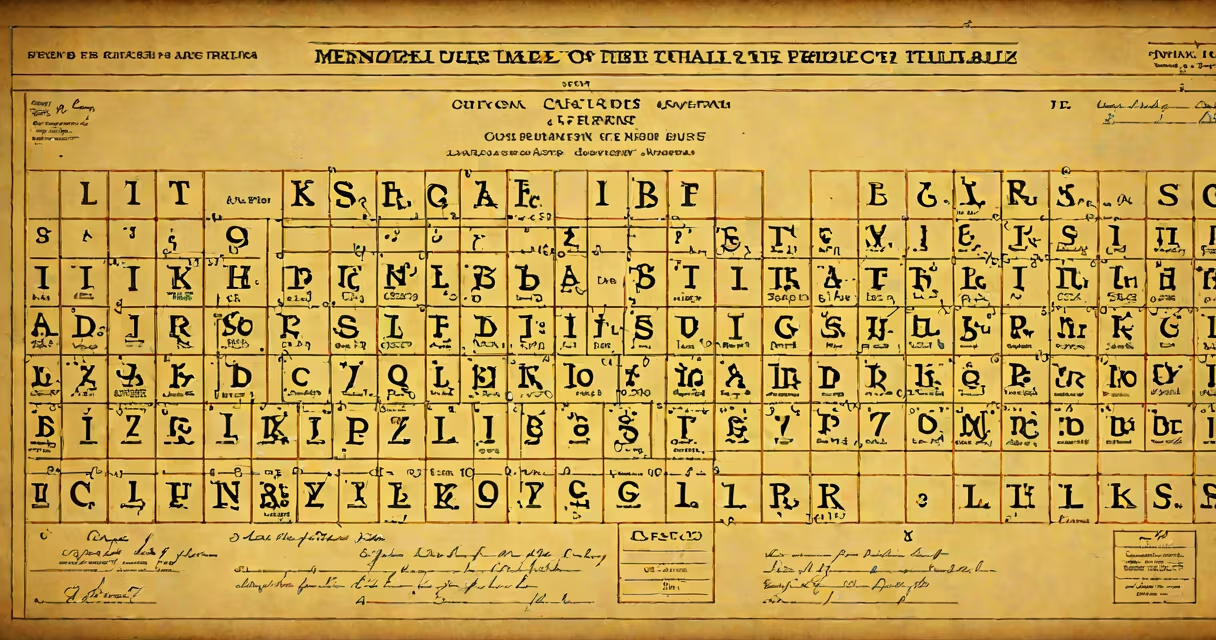
Dmitri Mendeleev's 1869 periodic table arranged known elements by increasing atomic weight and grouped them by chemical properties, revealing patterns that allowed him to predict undiscovered elements with notable accuracy.
Mendeleev's system was not a random grid. He placed elements in horizontal rows based on atomic weight and vertical columns based on similar chemical behavior. When an element didn't fit the pattern, he left a gap rather than force it into place. This bold move showed he trusted the underlying structure more than the data at hand.
He published his table in a Russian journal, Zeitschrift für Chemie, in 1869. The version that became famous had 63 elements arranged in seven periods and eight groups. Mendeleev didn't just organize existing knowledge-he used the table to forecast new elements. He called them eka-aluminum, eka-boron, and eka-silicon, naming them after elements in the same group but one period below.
Mendeleev prioritized chemical similarity over strict atomic weight order. When tellurium (atomic weight ~127.6) came before iodine (atomic weight ~126.9), he swapped their positions because iodine behaved like halogens and tellurium like chalcogens. His decision was later validated by the discovery of atomic number-the actual organizing principle of the modern table.
He left spaces for elements not yet discovered. For example, he predicted an element with atomic weight around 68, forming compounds like M₂O₃ and MCl₃. When gallium was isolated in 1875, its measured atomic weight was 69.7, and its oxide was Ga₂O₃-matching Mendeleev's predictions precisely.
A key insight: Mendeleev didn't assume all elements were known. He treated the table as incomplete. This mindset allowed him to make testable predictions. When germanium was found in 1886, its density, melting point, and compound formulas aligned with his "eka-silicon" forecast. These successes cemented the table's credibility.
The original table used atomic weights derived from experimental measurements of the time. Values were often approximate-some were off by 1-2%. Mendeleev accepted these inaccuracies because he believed the pattern mattered more than perfect numbers.
Elements were listed in order of increasing atomic weight, but the table wasn't linear. It had zigzagging rows to maintain group alignment. For example, lithium, sodium, potassium formed a column. Calcium, strontium, barium followed below. This vertical grouping revealed recurring chemical behavior every eight elements-a pattern Mendeleev called the "periodic law."
Not all elements were known. Some were still hypothetical. Mendeleev included elements like "eka-manganese" (later manganese itself) and "eka-iron," though the latter wasn't confirmed until much later. The table was a living structure, not a finished product.
Modern science doesn't use Mendeleev's original layout, but educators still show it to illustrate scientific reasoning. It demonstrates how prediction and revision drive progress. Textbooks compare it to the current table to show how atomic number replaced atomic weight as the organizing principle.
Historical analysis shows that Mendeleev's table was not unique. Lothar Meyer independently developed a similar table in 1864, but he didn't publish predictions. Mendeleev did. That difference made his work stand out. His willingness to leave gaps and name missing elements gave the table predictive power others lacked.
Many assume Mendeleev created the first periodic table. That's incorrect. Several chemists before him-like Alexandre-Émile Béguyer de Chancourtois and John Newlands-had noticed periodicity. De Chancourtois arranged elements on a spiral cylinder in 1862. Newlands proposed the "Law of Octaves" in 1864, comparing element patterns to musical octaves. But neither predicted new elements or explained anomalies.
Another myth: Mendeleev arranged elements strictly by atomic weight. He didn't. He reversed tellurium and iodine to preserve chemical groupings. This choice was controversial at the time. Critics argued he violated the data. But the reversal proved correct when atomic number was later discovered.
A lesser-known fact: Mendeleev initially rejected the existence of noble gases. When argon was discovered in 1894, he refused to include it. He saw no chemical reactivity, so it didn't fit his model. Only after helium and neon were found did he accept they belonged in a new group. The table evolved to accommodate new discoveries.
| Feature | Mendeleev's Original (1869) | Modern Periodic Table |
|---|---|---|
| Organizing Principle | Atomic weight | Atomic number |
| Number of Elements | 63 | 118 |
| Predictive Power | High (forecasted gallium, germanium) | None (elements are known) |
| Group Structure | 8 groups, some overlapping | 18 groups, consistent spacing |
I once held a facsimile of Mendeleev's original table during a visit to the State Museum of the History of Science in St. Petersburg. The paper was brittle, ink faded. What struck me wasn't the age-it was the confidence in the blank spaces. He didn't call them "unknowns." He labeled them with names: eka-aluminum, eka-boron. That naming wasn't guesswork. It was a hypothesis written in ink.
Mendeleev's original periodic table remains a landmark in scientific history. It transformed chemistry from a collection of facts into a predictive science. Its legacy lives not in the form it took, but in the method it established: observe patterns, trust them, and let them guide discovery.