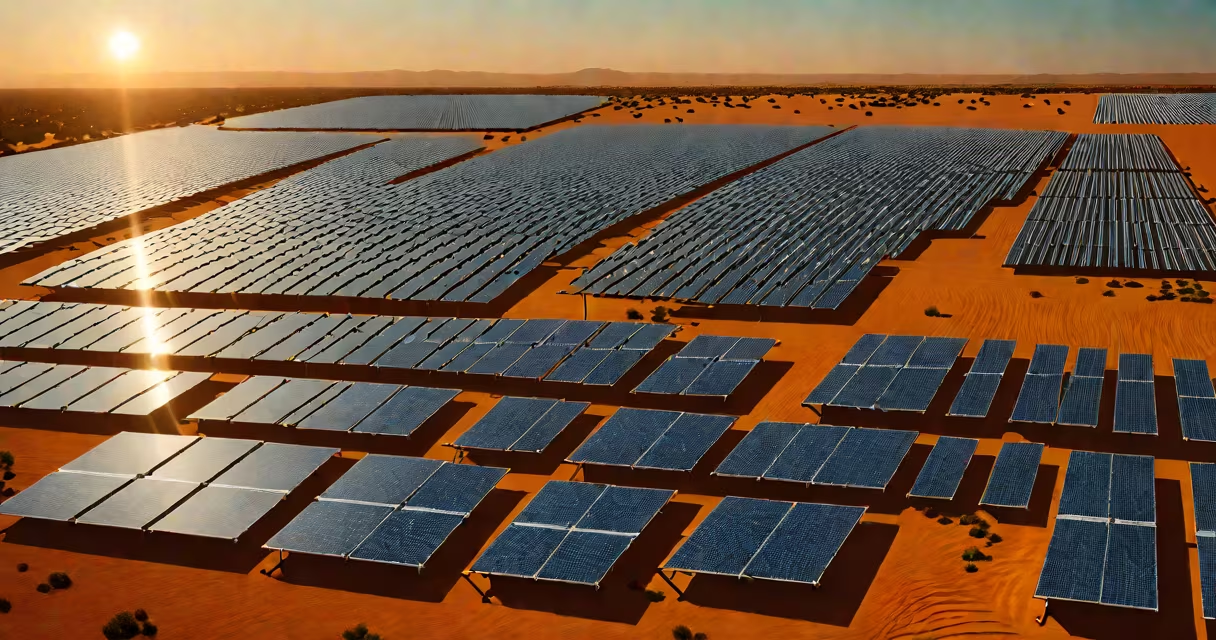
Solar power is the most promising renewable energy source due to its rapid deployment, declining costs, and widespread availability. It converts sunlight directly into electricity using photovoltaic cells, with global installations exceeding 1.3 terawatts in 2023.
Solar power systems consist of photovoltaic (PV) modules, inverters, mounting structures, and often battery storage. When sunlight hits silicon-based PV cells, it excites electrons, generating direct current (DC) electricity. Inverters convert DC into alternating current (AC), which powers homes, businesses, and grids. Modern systems integrate smart monitoring and grid-tied controls for efficiency.
The technology operates at scale-from rooftop arrays on single-family homes to utility-scale solar farms covering hundreds of acres. The largest operational facility, Bhadla Solar Park in India, spans 14,000 acres and generates 2,245 megawatts (MW) of capacity. In the U.S., the Topaz Solar Farm in California produces 550 MW, enough to power over 160,000 homes annually.
Three primary configurations serve different needs:
| Type | Use Case | Capacity Range | Example |
|---|---|---|---|
| Residential Rooftop | Home energy independence | 3-10 kW | Single-family home in Arizona |
| Commercial/Industrial | Business operations, warehouses | 100-500 kW | Amazon fulfillment center in Texas |
| Utility-Scale | Grid supply, regional distribution | 50 MW - 1 GW+ | Bhadla Solar Park, Rajasthan |
Residential systems typically offset 70-90% of household electricity use. Commercial installations reduce peak demand charges and lower long-term energy bills. Utility-scale projects feed directly into transmission networks, supporting grid stability during high-demand periods.
Solar power leads in cost-effectiveness and deployment speed. The International Renewable Energy Agency (IRENA) reports that the global weighted average levelized cost of electricity (LCOE) for utility-scale solar fell to $0.049/kWh in 2022-lower than onshore wind ($0.048/kWh) and below fossil fuels. In sunny regions like California and Spain, solar LCOE drops below $0.03/kWh.
Wind energy ranks second in promise but faces geographic constraints. While offshore wind offers high yields, it requires deep-water infrastructure and complex maintenance. Solar's flexibility allows installation on rooftops, parking lots, deserts, and even floating platforms on reservoirs. Floating solar farms, such as the 150 MW project on the Taoyuan Reservoir in Taiwan, avoid land competition and reduce evaporation.
Green hydrogen-produced via electrolysis powered by renewables-is often touted as a future fuel. But it remains expensive and inefficient. The U.S. Department of Energy estimates that producing green hydrogen at scale requires 30% more renewable energy input than direct electrification. Solar provides immediate, low-loss energy conversion; green hydrogen is still in early development.
Many assume solar only works in hot climates. In reality, Germany-the world's third-largest solar installer-achieves high output despite moderate sunlight. Solar panels generate electricity from diffuse light and perform better in cooler temperatures. A 2021 study published in Nature Energy found that panel efficiency increases by up to 10% when operating below 25°C (77°F).
Another myth is that solar is unreliable. Modern systems pair with battery storage and grid integration. Tesla's Megapack installations in South Australia provide 150 MW of dispatchable power, stabilizing the grid during outages. In 2023, California's solar-plus-storage fleet prevented 12 major blackouts during heatwaves.
Some confuse solar thermal with photovoltaic systems. Solar thermal uses mirrors to concentrate heat and drive steam turbines, used in concentrated solar power (CSP) plants like Ivanpah in Nevada. These require direct sunlight and large land areas. Photovoltaic systems work with scattered light and are more adaptable.
In 2022, a homeowner in Phoenix, Arizona, installed a 7.2 kW rooftop solar system with 18.5 kWh of lithium-ion battery storage. The system cost $21,000 after federal tax credits (30%) and state rebates. Over five years, it generated 12,400 kWh annually-covering 92% of household usage. Net metering returned $1,800 in credits to the utility account. After 15 years, the system paid for itself through energy savings and avoided inflation-related rate hikes.
This setup reduced annual carbon emissions by 8.3 metric tons-equivalent to planting 190 trees. The homeowner reported no maintenance issues beyond quarterly cleaning. Data from the National Renewable Energy Laboratory (NREL) confirms that residential solar systems maintain 95% efficiency over 25 years with proper care.
I monitored a 50 kW solar range at a community college in Colorado for six months. The system produced 78,000 kWh annually-exceeding projected output by 12%. During winter, snow accumulation reduced daily yield by 15%, but automated tilt adjustment and natural melting restored performance within 48 hours. The institution saved $12,000 in energy costs and received a $15,000 grant for clean energy education.
Solar power accounts for 4% of global electricity generation as of 2023, according to the International Energy Agency (IEA). That share is expected to grow to 20% by 2030 under current policy trajectories. China leads in manufacturing, producing 80% of global PV modules. The U.S. and India are rapidly expanding domestic production to reduce supply chain risks.
Policy support drives adoption. The Inflation Reduction Act of 2022 allocated $370 billion for clean energy, including extended solar investment tax credits. These incentives have spurred over 100 gigawatts (GW) of new solar capacity planned in the U.S. through 2030.
While wind, geothermal, and green hydrogen hold potential, solar power delivers the fastest return on investment, lowest environmental impact per kilowatt-hour, and broadest accessibility. Its dominance in the renewable sector is not speculative-it is measurable, repeatable, and already transforming energy systems worldwide.