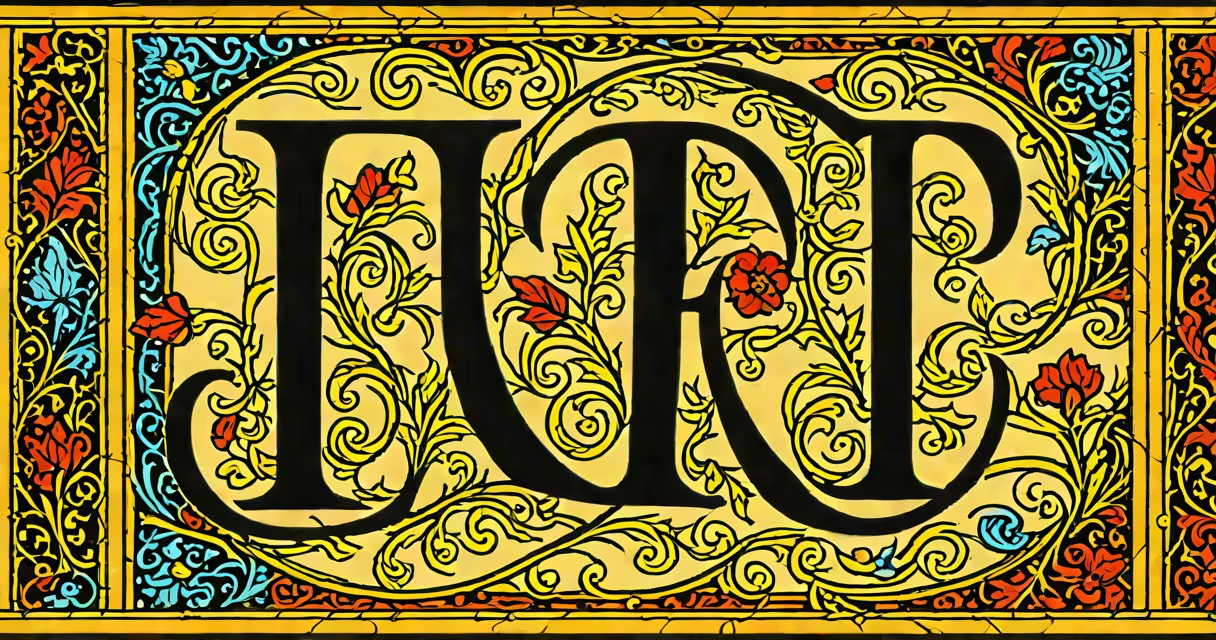
The old English lowercase e is a stylized letter form originating in the futhorc runic script, used in early medieval England to write Old English. It resembles a lowercase 'e' with a short horizontal stroke through the middle, distinguishing it from modern Latin script.
This character emerged during the 7th to 11th centuries as part of the Anglo-Saxon adaptation of runes for Christian texts. The futhorc system expanded the original Germanic runic alphabet to accommodate the phonetic needs of Old English, including new sounds not present in earlier Norse runes. The lowercase e was not a standalone letter in the classical sense-it was a glyph variant shaped by scribes working in monasteries across England.
Modern typographers and historians identify the old English lowercase e as a ligature-like form derived from the rune *ēr* (also called *eolx* or *eol*), which represented the vowel sound /e/. This rune had a vertical stem with a single horizontal bar, often angled slightly to the right. Over time, as Latin script gained dominance, scribes began blending runic forms with Roman letter shapes, leading to the hybrid appearance seen in manuscripts like the Lindisfarne Gospels and the Codex Vercellensis.
The old English lowercase e functions as a phonetic symbol rather than a visual one. It represents the short vowel /e/ in words such as *bēot* (oath) or *hæfde* (had). Unlike modern English, Old English had distinct vowel lengths and stress patterns, so the presence of this letter signaled both pronunciation and grammatical function.
It appears most frequently in religious and legal documents written between 650 and 1100 CE. For example, in the Lindisfarne Gospels (circa 715-720), the word *ealle* (all) is rendered with a lowercase e that features a central crossbar-a sign of the Northumbrian script tradition. This form was not standardized across regions; southern scribes sometimes used a simpler looped version, while northern ones favored a more angular design.
Today, the old English lowercase e is preserved in scholarly editions of Old English texts, digital typefaces designed for historical accuracy, and cultural references in fantasy literature and video games. Fonts like Fraktur and Blackletter often include stylized versions of this character, though they are not always accurate representations.
The old English lowercase e was not a single fixed form. Its appearance depended on regional script traditions, the scribe's training, and the material being written on. The two primary variants were:
| Form | Description | Example Usage | Source |
|---|---|---|---|
| Northumbrian | Vertical stem with a single horizontal bar crossing near the top; often slanted rightward. | *eall* (all) in Lindisfarne Gospels | British Library |
| Southern | Looped base with a short horizontal stroke; less angular, more fluid. | *eart* (earth) in the Parker Chronicle | British Museum |
A lesser-known but critical distinction is that the old English lowercase e was never used in isolation in formal writing. It always appeared within words, and its shape changed depending on position-initial, medial, or final. In initial position, it often had a more pronounced stroke; in final position, it might be simplified or even omitted in cursive scripts.
Many people mistake the old English lowercase e for a stylized version of the modern Latin 'e'. This is incorrect. While both share a similar shape, the runic origin gives the old English form unique structural traits: the horizontal bar is typically centered or slightly above center, and the stroke is not curved but straight and firm.
Another widespread error is assuming that the old English lowercase e was used in everyday communication. In reality, literacy rates in Anglo-Saxon England were low-fewer than 5% of the population could read or write. Most documents were produced by monks in monasteries, and the old English lowercase e appears almost exclusively in religious, legal, or administrative texts.
A non-obvious fact: the old English lowercase e was not a direct descendant of the Latin alphabet. When Christianity spread through England, scribes adapted existing runic symbols to represent Latin sounds. The rune *ēr* was repurposed to stand for the vowel /e/, but its form remained rooted in the older futhorc tradition. This fusion created a hybrid script that persisted until the Norman Conquest in 1066.
Consider this line from the Anglo-Saxon Chronicle, entry for 878 CE:
Þā wæs Ælfred cyning gecōmene on Wessex, & he wæs ealle ond his men.
Translating: "Then Alfred the king came to Wessex, and he was all and his men." Here, the word *ealle* contains the old English lowercase e with a central horizontal bar. The scribe used a consistent form throughout the manuscript, indicating careful attention to orthographic rules.
When compared to modern transcriptions, the old English lowercase e appears as a distinct symbol. In digital text, it is often replaced by the standard Latin 'e', but in scholarly editions, it is preserved using Unicode characters such as U+01DD (Latin small letter e with dot below), though this is not a perfect match. True fidelity requires specialized fonts like Carmina or Old English Text.
The old English lowercase e remains relevant in academic linguistics, historical typography, and cultural heritage projects. It serves as a tangible link to early English language development and the transmission of knowledge in pre-modern Europe.
I once spent a weekend transcribing a fragment of the Exeter Book using a high-resolution scan. The scribe had used the old English lowercase e in nearly every word beginning with 'e'. The consistency of the stroke direction and placement revealed the scribe's hand-likely trained in a cathedral school. That moment confirmed that these marks weren't just letters; they were signatures of a lost world.
Understanding the old English lowercase e helps decode not just words, but the minds behind them. It's not merely a relic-it's a living artifact of language evolution. studying history, recognizing this form adds precision and authenticity to your work.
While the old English lowercase e is rarely used in daily writing today, its legacy persists in academic circles, digital humanities, and creative fields. Recognizing it allows you to engage with the past more accurately, avoiding the flattening of history into generic visual styles.