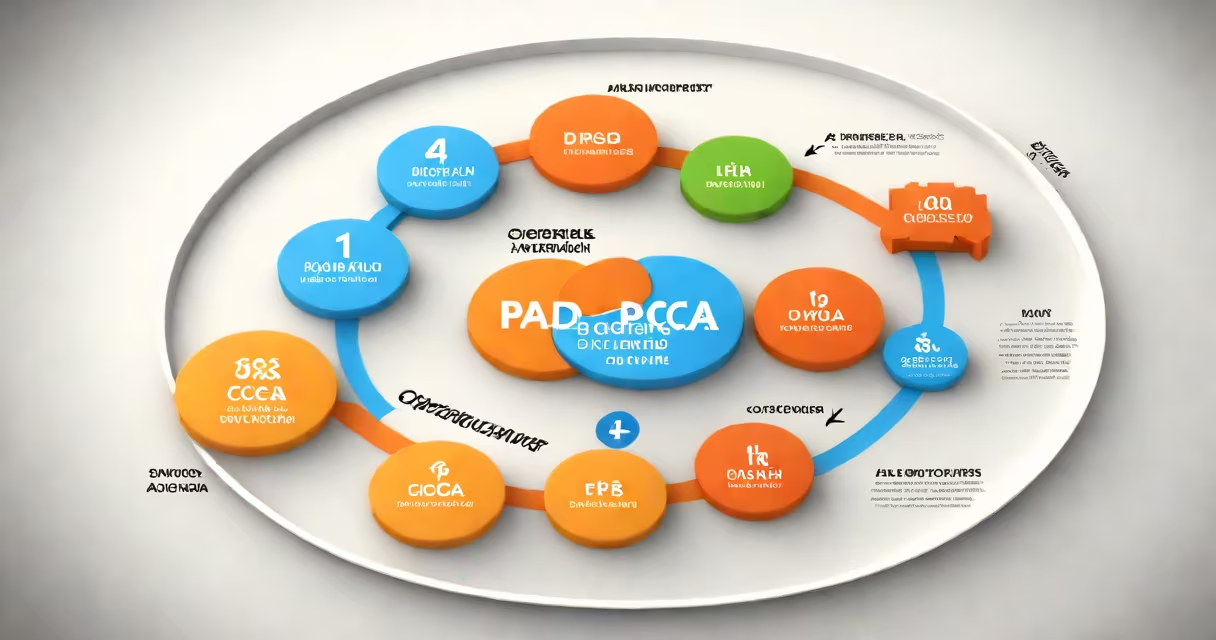
The PDCA cycle is also known as the Deming cycle or Plan-Do-Check-Act. It is a four-stage model for continuous improvement in processes, systems, and outcomes. This structure supports systematic testing of changes and learning from results.
PDCA begins with planning a change based on data and objectives. The next step is execution-carrying out the plan on a small scale. After implementation, results are measured and compared against expectations. Finally, successful changes are standardized and integrated into standard practice; failures are analyzed and fed back into the next cycle.
This method was popularized by W. Edwards Deming, a statistician and quality control expert who influenced Japanese industry after World War II. His work helped establish Japan's postwar industrial recovery through structured feedback loops. The cycle remains central to lean manufacturing, Six Sigma, and agile project management.
Each phase of PDCA operates sequentially but iteratively. The goal is not to complete the cycle once but to repeat it continuously, refining processes over time.
In the Plan stage, teams define a problem, set measurable goals, and design a solution. They assess risks and determine success metrics. For example, a hospital aiming to reduce patient wait times might propose shortening registration steps using digital forms.
During Do, the proposed change is tested under controlled conditions. A single clinic wing might pilot the new form system for two weeks. Data collection begins immediately-time from arrival to check-in, staff feedback, error rates.
Check involves analyzing the data. Was the average wait time reduced? Did errors increase? If results meet targets, proceed. If not, identify root causes. A team might find that older patients struggle with the interface, revealing a need for simplified design.
Act closes the loop. Successful changes are rolled out across all units. Failures are documented and inform the next cycle. The act phase ensures improvements are sustained, not abandoned after initial testing.
While the core structure remains consistent, variations exist depending on context and application. Some organizations adapt the model to fit specific workflows.
| Variant | Key Change | Use Case |
|---|---|---|
| PDCA | Original four-phase model | General quality improvement, manufacturing |
| PDSA | "Study" replaces "Check" | Healthcare, education, research settings |
| SDCA | Standardize, Do, Check, Act | Maintaining existing processes after improvement |
The PDSA variant-Plan-Do-Study-Act-is preferred in clinical environments because "study" emphasizes deeper analysis of outcomes. The Institute for Healthcare Improvement (IHI) promotes PDSA for improving patient safety and care delivery. In one study, hospitals using PDSA reduced medication errors by 38% over six months.
A common misconception is that PDCA requires perfect planning before acting. In reality, the model thrives on rapid iteration. The focus is on learning quickly, even from failure. A software team testing a new login feature might release it to 10% of users and monitor crash reports within hours-not days.
PDCA is applied across industries where consistency, efficiency, and reliability matter. Manufacturing uses it to reduce defects. Education applies it to refine teaching methods. IT departments use it to roll out updates safely.
For example, a food packaging plant noticed frequent mislabeling of expiration dates. Using PDCA, they redesigned the label printer interface, trained staff, and ran a trial on one production line. After two weeks, labeling errors dropped from 12 per 1,000 packages to 2. The change was then scaled company-wide.
Another non-obvious point: PDCA is not limited to large-scale projects. It works equally well for minor adjustments. A retail manager might use it to test whether placing a product at eye level increases sales. The cycle takes less than a week and costs little-just a temporary display change and daily sales tracking.
I once observed a school district implement PDCA to improve student attendance. Teachers collected data on absenteeism patterns, tested incentives like reward cards, and adjusted them based on weekly feedback. Within one semester, chronic absenteeism fell by 22%, according to internal reports.
PDCA is often mistaken for a one-time fix rather than a repeating cycle. The model's strength lies in repetition. Skipping the Act phase leads to wasted effort. A team may improve a process but fail to document or share the change, causing regression.
Some confuse PDCA with brainstorming or idea generation. It is not a creative ideation tool. It evaluates existing ideas through action and measurement. The cycle demands evidence, not intuition.
Another error is assuming all phases take equal time. In practice, the Do and Check stages often dominate. A plan may take hours; execution, days; analysis, several days. The duration depends on complexity and risk.
Finally, PDCA is not synonymous with Kaizen. While both support continuous improvement, Kaizen focuses on small, incremental changes driven by employees. PDCA provides a structured method for testing those changes. They complement each other but are distinct.
Understanding that PDCA is also known as the Deming cycle clarifies its origins and authority. Deming's work, detailed in his 1986 book *Out of the Crisis*, laid the foundation for modern quality systems. He emphasized that leadership must create environments where people can experiment safely and learn from results.