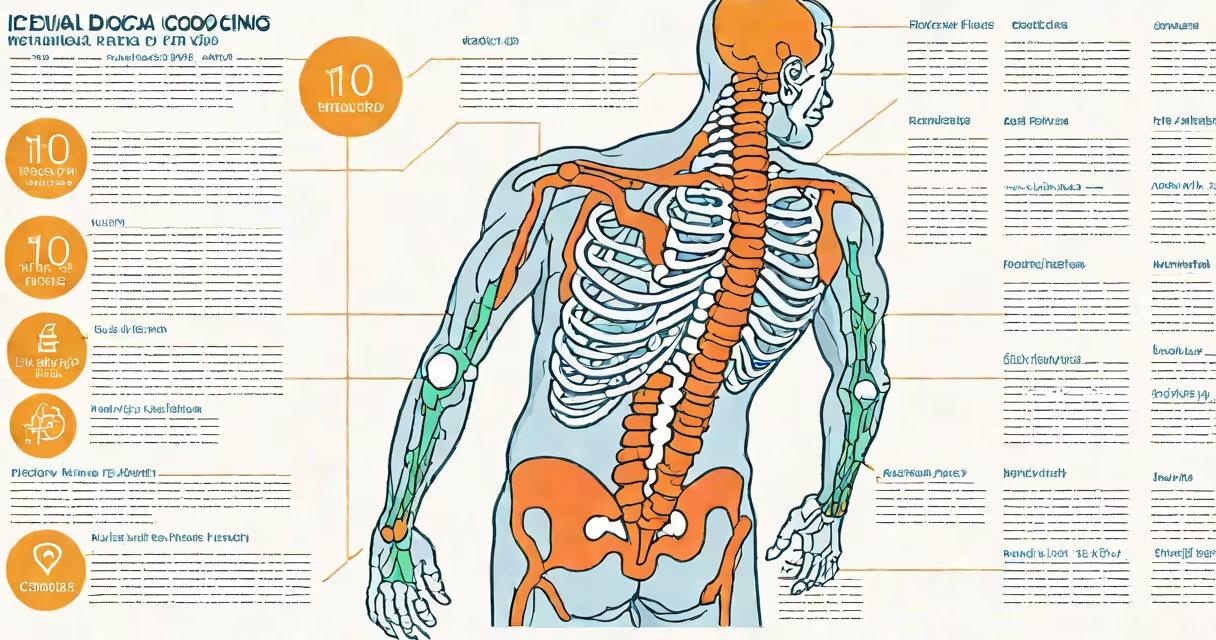
The r10 icd 10 code classifies unspecified back pain, used when a provider documents back discomfort without specifying location, cause, or duration. It falls under the 'symptoms' category in the ICD-10-CM system, which standardizes disease and condition reporting globally.
Back pain is one of the most common reasons patients visit healthcare providers. The r10 code applies when no further detail exists-such as whether the pain is in the upper, lower, or lumbar spine-or when diagnostic tests have not yet confirmed a specific etiology. This code ensures consistent data collection across clinics, hospitals, and insurers.
According to the Centers for Disease Control and Prevention (CDC), back pain affects about 80% of adults at some point in their lives. The ICD-10-CM manual, maintained by the National Center for Health Statistics (NCHS), assigns r10 to cases where a clinician notes "back pain" but lacks specificity. This avoids over-coding while allowing accurate tracking of symptom prevalence.
When a patient reports pain in the back during a visit, the physician may document "back pain" without identifying a precise anatomical site or underlying pathology. In such cases, the coder selects r10 as the primary diagnosis code. This code supports billing, insurance claims processing, and public health surveillance.
For example, a 45-year-old office worker visits a clinic complaining of persistent lower back pain. The doctor performs a physical exam, orders no imaging, and diagnoses "non-specific back pain." The electronic health record (EHR) system prompts the coder to assign r10. This allows the claim to be processed without requiring a definitive diagnosis.
Using r10 does not imply poor documentation. It reflects clinical reality: many patients present with symptoms before a clear diagnosis emerges. The code acts as a placeholder until further testing or follow-up reveals a more specific condition-like herniated disc (m51.26), spinal stenosis (m48.06), or fibromyalgia (m79.6).
The r10 code is a parent category with several subcodes based on anatomical location and context. These subcodes allow greater precision when details are available.
| Code | Description | Use Case Example |
|---|---|---|
| r10.0 | Pain in neck | Neck pain after car accident; no fracture detected |
| r10.1 | Pain in thoracic region | Upper back pain following heavy lifting |
| r10.2 | Pain in lumbar region | Lower back pain lasting 3 days; no radicular symptoms |
| r10.3 | Pain in sacral region | Pain localized to tailbone area after fall |
| r10.9 | Unspecified back pain | Generalized back discomfort with no site specified |
Each subcode corresponds to a distinct anatomical zone. R10.2 (lumbar pain) is the most frequently assigned variant due to high incidence rates of lower back issues. Clinicians should select the most specific subcode available-even if the patient says "my back hurts"-to improve data accuracy and avoid claim denials.
A frequent error is using r10 when a more specific diagnosis exists. For instance, assigning r10 to a patient with sciatica (m54.16) or degenerative disc disease (m51.36) violates coding guidelines. The ICD-10-CM Official Guidelines state that codes should reflect the highest level of specificity known.
Another mistake is treating r10 as a standalone diagnosis. It is not a disease-it's a symptom descriptor. Using it without proper clinical context leads to inaccurate billing and potential audits. The American Academy of Professional Coders (AAPC) warns that coders must verify that the provider's documentation supports the selected code.
One non-obvious distinction: r10 does not include pain caused by trauma unless explicitly stated. A patient who fell and now has back pain should receive a code like w19.0xxa (accidental fall on same level) combined with r10.2 if no structural injury is confirmed. Relying solely on r10 ignores the mechanism of injury, which affects risk assessment and treatment planning.
In a primary care clinic, a 52-year-old woman presents with dull, bilateral lower back pain lasting five days. She denies fever, numbness, or weakness. Physical exam shows normal reflexes and range of motion. No imaging is ordered. The provider writes: "Patient reports low back pain, no red flags."
The coder reviews the note and confirms no further details exist. They select r10.2-pain in the lumbar region-as the principal diagnosis. This code is submitted with the patient's insurance claim. The payer processes the claim based on the documented symptom, not a presumed condition.
I've reviewed hundreds of claims where r10 was incorrectly applied. Once, a claim for a patient with chronic knee pain was coded with r10 because the provider wrote "I'm in pain" in the progress note. That led to a denial. Correcting the code to m25.551 (knee pain, left) resolved the issue. This illustrates how context matters-even with symptom-based codes.
For conditions involving both back and joint pain, coders must differentiate. Back pain with knee involvement requires separate codes. For example, a patient with r10.2 and m25.551 would be coded correctly. Using r10 alone misses the joint component and risks incomplete reimbursement.
When back pain coexists with other conditions, additional codes may apply. For example, a patient with diabetes and back pain needs both r10 and e11.9 (type 2 diabetes mellitus without complications). The combination ensures complete clinical picture representation.
Accurate use of r10 icd 10 ensures compliance, supports quality reporting, and enables better population health analysis. It is not a catch-all-its purpose is clarity, not convenience.