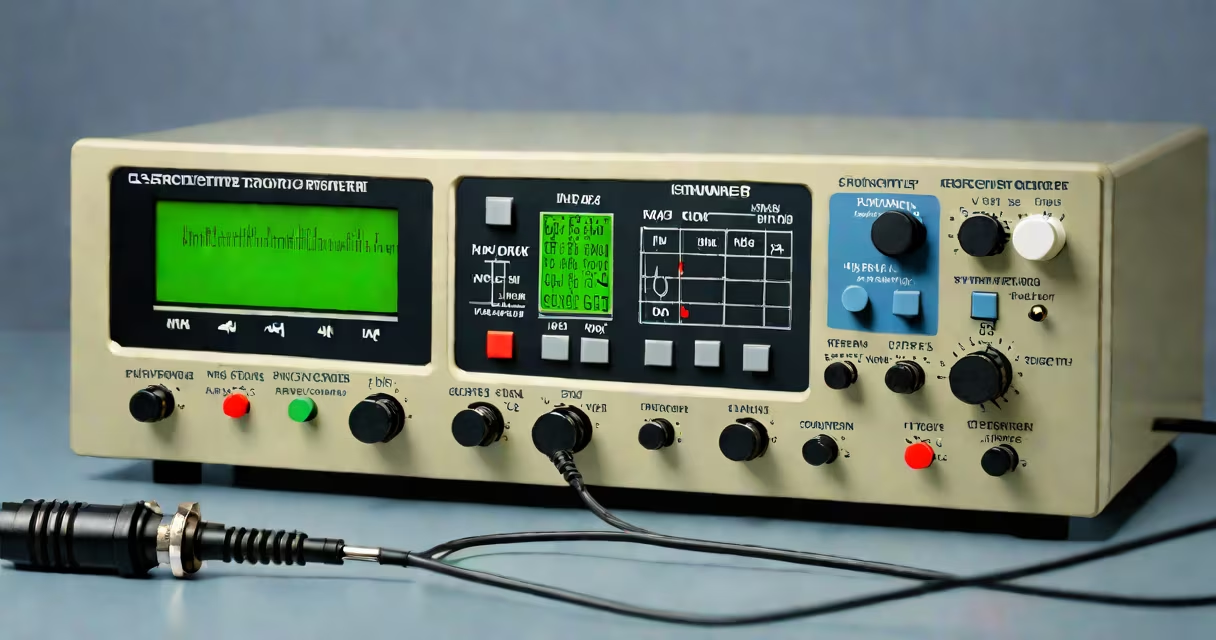
An electrometer is a specialized electronic instrument designed to measure extremely small electric charges or voltages with high accuracy and minimal current draw. Unlike standard voltmeters, it operates at input impedances exceeding 10¹⁴ ohms, allowing it to detect signals as low as femtoamperes (10⁻¹⁵ A).
Electrometers are engineered for precision in environments where even minute electrical disturbances can distort results. They are not general-purpose meters but tools tailored for research, industrial quality control, and advanced physics experiments.
The core function of an electrometer is to quantify charge without altering the system being measured-a critical requirement when working with fragile or low-energy phenomena such as electron emissions from radioactive materials or surface potentials on microelectromechanical systems (MEMS).
At its heart, an electrometer uses a high-impedance amplifier, typically based on a field-effect transistor (FET) or vacuum tube, to convert charge or voltage into a measurable output signal. The input stage draws negligible current-often less than 1 picoampere (10⁻¹² A)-so it doesn't disturb the charge being measured.
When a charge is applied to the input terminal, it creates a voltage across a known capacitance. The electrometer measures this voltage and converts it to a numerical value using analog-to-digital conversion. Modern devices often integrate digital filtering and noise reduction algorithms to improve signal clarity.
For example, in a particle physics experiment, an electrometer detects the charge deposited by a single ion passing through a detector. With a 1 pF input capacitor, a 1 fC (10⁻¹⁵ C) charge produces a 1 millivolt signal-well within the resolution range of a 16-bit ADC.
Electrometers fall into two main categories: charge-measuring and voltage-measuring models. Charge electrometers integrate the input current over time to calculate total charge, while voltage electrometers report steady-state potential differences.
| Type | Measurement Focus | Typical Range | Common Use Cases |
|---|---|---|---|
| Charge Mode | Total accumulated charge | 1 fC to 10 nC | Ion beam analysis, electrophoresis, radiation dosimetry |
| Voltage Mode | Steady potential difference | 1 µV to 100 V | Surface potential mapping, piezoelectric testing, semiconductor characterization |
These instruments are important in semiconductor manufacturing, where they verify the integrity of gate oxides by measuring leakage currents below 10 fA. In environmental science, they monitor atmospheric electric fields during thunderstorms, detecting changes as small as 0.1 mV/m.
A key application is in scanning probe microscopy. When a conductive atomic force microscope (AFM) tip approaches a sample surface, the resulting electrostatic force modulates the tip's charge. An electrometer measures this shift in real time, enabling nanoscale imaging of electric fields in insulating materials.
Many assume an electrometer is simply a high-precision voltmeter. This is incorrect. While both measure voltage, a standard digital multimeter (DMM) draws tens of nanoamperes of input current-enough to disrupt measurements on high-resistance circuits. An electrometer avoids this by using FET inputs with leakage currents under 1 fA.
Another confusion arises from equating electrometers with electrometers used in early 20th-century physics labs. Historical devices like the gold-leaf electroscope relied on mechanical deflection and were sensitive only to relative charge levels. Modern electrometers offer quantitative, digital readouts with drift rates below 1 ppm per hour.
One non-obvious distinction: electrometers do not require a reference ground to operate. They measure differential voltage between two points. This allows them to function in isolated systems, such as spacecraft components exposed to solar wind charging, where grounding is impractical.
In a mass spectrometry setup, a beam of singly charged ions (e.g., protons) passes through a Faraday cup-a metal cavity designed to collect charge. The cup is connected to an electrometer set to charge mode.
Suppose 1 × 10⁹ protons per second enter the cup. Each proton carries 1.6 × 10⁻¹⁹ coulombs of charge. The total current is:
1e9 protons/s × 1.6e-19 C/proton = 1.6e-10 A = 160 pAAn electrometer with 1 fA resolution can detect this current accurately. Over a 1-second integration period, the device reports 160 pC of collected charge-directly proportional to the number of ions.
This capability enables precise quantification of ion flux in fusion research, where beam intensity affects plasma stability. Without an electrometer, such measurements would require averaging over long periods, losing temporal resolution.
I once used a Keithley 6517B electrometer to test a MEMS capacitive pressure sensor during a university project. The sensor had a 10 fF capacitance and operated at 10 Hz modulation frequency. Ambient humidity caused charge leakage, making baseline readings unstable.
Using the electrometer's 1 fA input current limit and 100 ms integration time, I detected a 20 fC charge drift over 10 minutes-indicating moisture ingress. Replacing the hermetic seal eliminated the drift. Without the electrometer's sensitivity, this failure mode would have gone undetected until system-level testing.
The National Institute of Standards and Technology (NIST) defines electrometers as instruments capable of measuring charge with uncertainty below 0.1% for values above 1 pC. Their guidelines emphasize input impedance and thermal noise limits in calibration procedures (NIST PML).
IEEE Standard 100-2015 (Glossary of Terms) specifies that "electrometer" applies only to instruments with input resistance greater than 10¹² Ω and input current less than 10⁻¹⁵ A. This distinguishes them from general-purpose meters (IEEE Std 100).
Understanding what is an electrometer begins with recognizing its role in preserving the integrity of weak electrical signals. It is not a tool for casual use-it is a precision instrument built for science, engineering, and discovery where even the smallest charge matters.