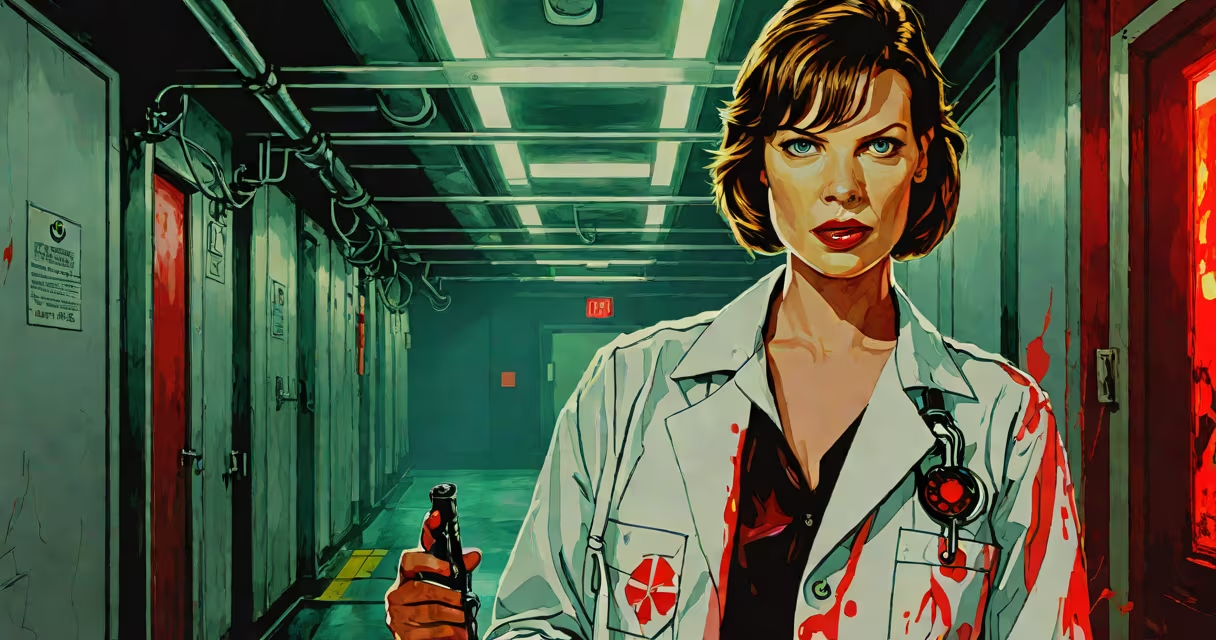
Resident Evil the movie is a 2002 science fiction horror film directed by Paul W.S. Anderson and based on the Capcom video game series of the same name. It stars Milla Jovovich as Alice, a genetically enhanced operative who survives a viral outbreak in a secret underground facility. The film blends elements of action, survival horror, and dystopian sci-fi, establishing a cinematic universe that expanded across five sequels.
The story begins inside the Hive, a research facility beneath the fictional town of Raccoon City. A bioweapon known as the T-virus mutates humans and animals into aggressive zombies. Alice, a test subject with enhanced strength and reflexes, escapes the facility while battling infected scientists, security forces, and monstrous creatures. Her mission shifts from survival to uncovering the truth behind her creation and stopping the virus's spread.
Resident Evil the movie was produced by Constantin Film and Dimension Films. It grossed $106 million worldwide on a $20 million budget, proving that video game adaptations could succeed at the box office. The film's success led to four direct sequels, all directed by Anderson and featuring Jovovich in the lead role. It remains the most commercially successful entry in the franchise.
The film follows a classic survival horror arc: isolation, escalating threat, and escape. The narrative unfolds in real time within the Hive, using tight corridors, flickering lights, and sudden creature attacks to build tension. Unlike traditional horror films, Resident Evil the movie integrates high-octane action sequences, including gunfights, hand-to-hand combat, and vehicle chases.
It combines two genres: survival horror and military sci-fi. Survival horror emphasizes fear, limited resources, and environmental puzzles. Military sci-fi focuses on advanced technology, government conspiracies, and elite operatives. The film merges both by placing Alice in a hostile environment where she must use weapons, stealth, and strategy to survive.
A key structural element is the use of flashbacks to reveal Alice's backstory. These scenes show her training at Umbrella Corporation's facility, where she was selected for genetic experimentation. The contrast between her past as a test subject and her present as a warrior creates emotional stakes beyond mere survival.
Resident Evil the movie relies on practical effects, prosthetics, and CGI for its creatures. The design of the infected-zombies with elongated limbs, exposed bones, and distorted faces-draws from classic horror tropes while incorporating biomechanical details inspired by the games. The Nemesis, a towering, heavily armed enemy, appears in later sequels but is absent in the original film.
Visual style centers on cold, sterile environments contrasted with blood-soaked chaos. The Hive's interior features white walls, fluorescent lighting, and industrial machinery-all designed to feel clinical and oppressive. When the virus spreads, the setting deteriorates: lights fail, doors jam, and walls bleed black fluid.
Sound design plays a important role. The score, composed by John Frizzell, uses low drones, sudden stabs of percussion, and electronic textures to mirror Alice's heartbeat during tense moments. Footsteps echo in empty hallways. Distant screams and mechanical groans signal approaching threats.
The film spawned a five-film series, each with distinct tones and production values. The original film established the core identity: action-heavy, character-driven, and grounded in the game's lore. Subsequent entries leaned further into spectacle, with larger set pieces and more elaborate fight choreography.
| Film | Release Year | Director | Focus |
|---|---|---|---|
| Resident Evil the movie | 2002 | Paul W.S. Anderson | Action-horror, origin story |
| Resident Evil: Apocalypse | 2004 | Anderson | Urban warfare, city-wide outbreak |
| Resident Evil: Extinction | 2007 | Anderson | Post-apocalyptic desert, convoy survival |
| Resident Evil: Afterlife | 2010 | Anderson | Underground bunker, virtual reality |
| Resident Evil: Retribution | 2012 | Anderson | High-tech fortress, AI-controlled enemies |
Each sequel introduced new settings and threats. While the original film focused on containment and escape, later entries explored global collapse, artificial intelligence, and alternate realities. The shift from grounded horror to apocalyptic action reflects changes in audience expectations and the influence of superhero cinema.
Resident Evil the movie helped define the modern video game adaptation. Before its release, such films were often dismissed as low-budget or derivative. This film proved that source material could be adapted with visual flair, consistent worldbuilding, and commercial viability.
It influenced later franchises like Tomb Raider (2018), Sonic the Hedgehog (2020), and The Last of Us (2023). Studios began investing in faithful yet cinematic interpretations of beloved games. According to Vulture, Resident Evil the movie "set the template for how video game films could balance fan service with mainstream appeal."
Despite mixed critical reception-Rotten Tomatoes gives it a 47% approval rating-the film gained a cult following. Fans praise its pacing, Jovovich's performance, and the integration of game mechanics into live-action storytelling. The scene where Alice disables a security system by hacking a terminal mirrors gameplay logic, making it feel authentic to fans.
Many assume Resident Evil the movie is a direct translation of the video game. It is not. The film adapts only the premise and core characters-not the plot, levels, or endings. The game's protagonist, Leon S. Kennedy, does not appear. The setting is altered from Raccoon City's police station to a secret research facility.
Another misconception is that the film is purely a horror movie. It contains horror elements, but its runtime (90 minutes) and structure prioritize action and exposition. The film's climax involves a high-speed chase through a collapsing facility, not a slow-burn confrontation with a final boss.
A lesser-known fact: the film's title was changed for international markets. In Japan, it was released as *Biohazard*-the original Japanese name for the game series. This reflects the cultural roots of the property and underscores that the franchise originated in Japan, not Hollywood.
I watched Resident Evil the movie in a theater during its opening weekend in 2002. The crowd reacted with surprise at the intensity of the opening sequence-a silent hallway filled with dead bodies, then sudden movement. When Alice first fires a shotgun, the sound echoed through the auditorium. I remember the collective gasp when a zombie lunged from a ventilation shaft.
Later, I compared the film to the original game. The game's level design emphasized exploration and resource management. The film replaced those mechanics with cinematic pacing. For example, in the game, players must find keys to enable doors. In the film, Alice simply kicks open a door. The change prioritizes narrative momentum over player agency.
Resident Evil the movie is a hybrid genre film that reimagines a video game's world for the screen. It combines survival horror tension with explosive action, creating a unique blend that appealed to both gamers and general audiences. Its legacy lives on in the franchise's continued expansion and in the way studios approach game-based storytelling.