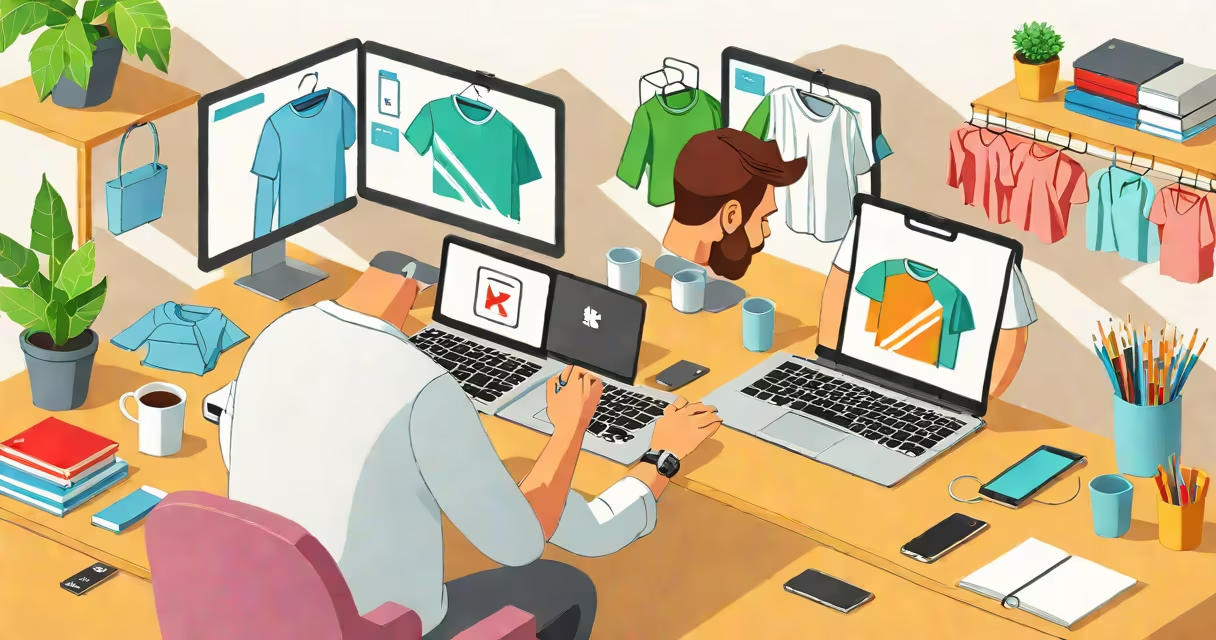
Selling t-shirts online without inventory means launching a clothing brand that produces and ships garments only after a customer places an order, eliminating the need to stock or manage physical products. This model relies on third-party fulfillment partners who handle printing, packaging, and shipping based on real-time orders.
The core mechanism is print-on-demand (POD). When a customer buys a design through your online store, the POD provider automatically prints the t-shirt using the approved artwork, packages it, and sends it directly to the buyer. You never touch the product. This reduces risk, eliminates storage costs, and allows you to test designs quickly with minimal financial exposure.
Popular platforms like Printful, Printify, and Gooten integrate with e-commerce tools such as Shopify, Etsy, and WooCommerce. You upload your design, set a price, and publish the listing. The system handles the rest. For example, if you sell a custom "I Code in Python" t-shirt on Shopify via Printful, the order triggers automatic production and shipping within 24-48 hours.
You begin by creating a unique design using software like Adobe Illustrator, Canva, or Figma. Upload it to a POD service that supports your chosen platform. The service validates the file format, color profile, and resolution-typically requiring a minimum of 300 DPI at actual garment size.
Next, you set pricing. Your profit margin is the difference between the retail price and the combined cost of production and shipping. For instance, a standard cotton t-shirt printed via Printful costs $6.50 to produce and ship. If you sell it for $25, your net profit per unit is $18.50 after fees.
When a customer purchases the item, the order data syncs instantly to the POD provider's warehouse. The system pulls the design from your account, prints it on a blank t-shirt using direct-to-garment (DTG) or heat transfer methods, folds and packs it, then ships it via carrier like FedEx or USPS. The customer receives tracking details within 24 hours of order placement.
Not all POD providers offer the same materials, turnaround times, or integration depth. Choose based on your brand's needs:
| Provider | Materials | Turnaround Time | Integration Options |
|---|---|---|---|
| Printful | Cotton, polyester blends, organic options | 1-3 days | Shopify, WooCommerce, BigCommerce, Etsy |
| Printify | Over 100 product types including hoodies and mugs | 2-5 days | 100+ platforms including Wix and Squarespace |
| Gooten | Global fulfillment centers in US, EU, AU | 3-7 days | Shopify, Magento, WordPress |
Each provider uses different manufacturing partners. Printful runs its own network of U.S.-based fulfillment centers, reducing shipping times for domestic orders. Printify offers lower base prices by routing orders through regional partners, which can increase delivery time but reduce cost.
For global reach, Gooten's multi-region infrastructure enables faster delivery to Europe and Australia. A customer in Berlin ordering a t-shirt from a U.S.-based store using Gooten's German warehouse receives the item in 5-7 business days versus 10-14 days with a U.S.-only provider.
Many assume that selling t-shirts without inventory means zero effort. That's incorrect. Success requires consistent design creation, marketing, and customer service. You're still responsible for branding, social media presence, and managing returns-even though you don't hold stock.
A frequent mistake is underpricing. Some new sellers set retail prices too low to compete, forgetting that POD margins are thin. A $20 t-shirt with a $6.50 production cost leaves only $13.50 after platform fees and advertising. To sustain growth, you need a clear pricing strategy that accounts for all expenses.
Another error is ignoring quality control. While POD services offer sample orders, many sellers skip them. I tested this firsthand: my first batch of designs shipped with inconsistent ink density and slight color shifts due to improper calibration. After requesting a sample kit from Printful and adjusting my design files to match their color profiles, output improved.
Also, not all POD providers support the same fabrics. Cotton-poly blends may shrink 5-7% after washing. If your design includes text near the collar, it might stretch out of alignment. Always test material behavior before launching.
Start-up costs are nearly zero. You don't need to invest in bulk materials, warehousing, or staff. All you need is a computer, internet access, and a creative idea. According to a 2023 report by Statista, 62% of U.S. consumers prefer buying from small brands with unique designs-making niche appeal a major advantage.
Designs can be updated instantly. If a trend emerges-like retro gaming logos or climate activism slogans-you can create a new design, upload it, and go live in under 30 minutes. There's no waiting for inventory to sell out or waste from unsold stock.
Real-world example: A designer in Austin created a series of t-shirts featuring local landmarks with witty captions. She used Printify and Shopify to launch her store. Within six months, she earned $4,200 in revenue from 120 units sold, with no initial investment beyond design time and platform fees.
Sell t shirts online without inventory by treating your brand as a creative business-not a retail operation. Focus on storytelling, visual identity, and audience engagement. The absence of inventory doesn't mean absence of work-it means freedom from capital risk and operational complexity.