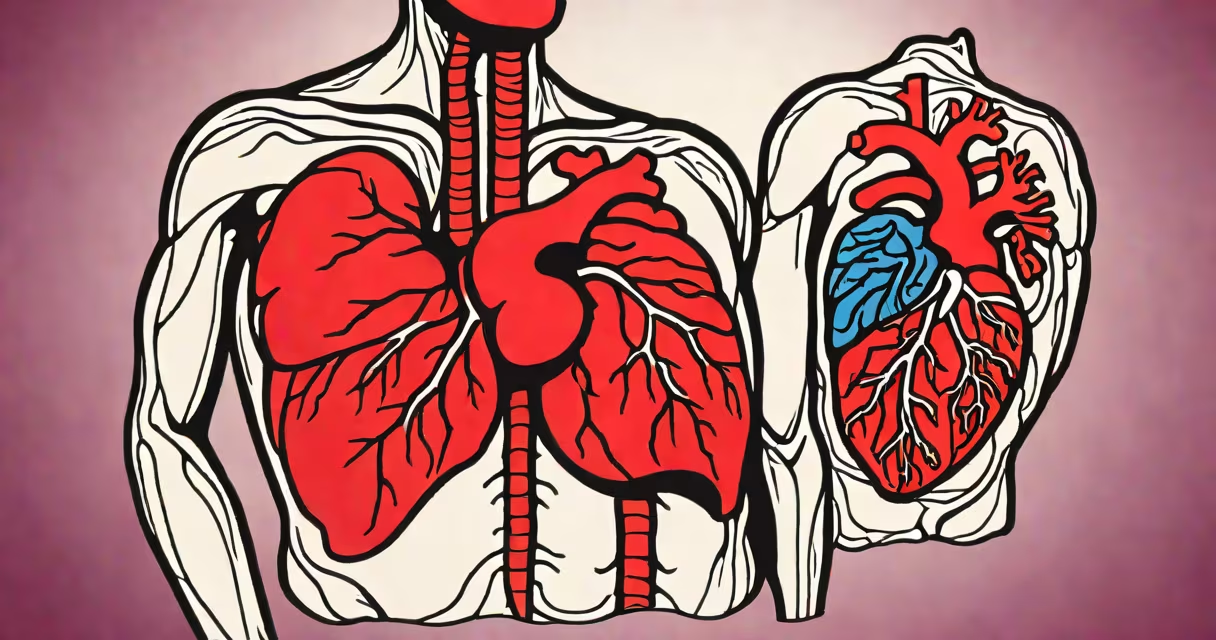
The heart is primarily located on the left side of the chest, nestled between the lungs and slightly offset toward the left. It sits behind the sternum and above the diaphragm, with about two-thirds of its mass on the left side of the body.
Human anatomy places the heart in the mediastinum-the central compartment of the thoracic cavity-where it rests within the pericardial sac. The apex of the heart points downward and to the left, typically resting near the fifth intercostal space along the midclavicular line. This positioning allows for efficient blood circulation through the pulmonary and systemic circuits.
According to the National Institutes of Health (NIH), the heart's leftward tilt results from asymmetrical development during embryogenesis. The left ventricle, responsible for pumping oxygenated blood to the body, is larger and thicker-walled than the right, contributing to the organ's leftward orientation. This structural asymmetry is normal and essential for proper function.
The heart lies in a protective space called the pericardial cavity, surrounded by serous fluid that reduces friction during contractions. Its position is stabilized by ligaments and the surrounding rib cage, which limits excessive movement during physical activity.
When lying down, the heart shifts slightly due to gravity, but remains anchored in the left hemithorax. During breathing, the diaphragm pushes upward, causing minor displacement. These movements are normal and do not alter the heart's fundamental alignment.
Auscultation-the act of listening to heart sounds using a stethoscope-relies on accurate knowledge of heart position. Clinicians place the stethoscope at specific points on the chest wall to detect valve function and abnormal murmurs. For example, the mitral valve sound is best heard at the fifth intercostal space, midclavicular line-directly over the heart's apex.
While most people have a typical left-sided heart, rare variations exist. These are usually detected incidentally during imaging or surgery.
| Type | Description | Prevalence | Impact |
|---|---|---|---|
| Levocardia | Heart positioned normally on the left side | ~99% | Standard anatomy |
| Dextrocardia | Heart located on the right side of the chest | ~1 in 10,000 births | Often asymptomatic; may indicate underlying congenital conditions |
| Isolated Dextrocardia | Heart on the right, but internal organs in normal positions | Rare | Can occur without other abnormalities |
Dextrocardia is often associated with situs inversus, a condition where all internal organs are mirrored. In such cases, the liver is on the left and the spleen on the right-a reversal of standard anatomy. However, many individuals with isolated dextrocardia live healthy lives without symptoms.
One non-obvious fact: the heart's electrical axis is not always aligned with its anatomical position. A 2021 study published in Journal of Electrocardiology found that 12% of healthy adults show a leftward electrical axis despite normal cardiac structure. This means ECG readings can suggest left-sided dominance even when the heart is symmetrically placed.
Many people assume the heart is centered or equally distributed between both sides. This misconception arises from cultural depictions-such as the red heart symbol-which represent emotion, not anatomy. The heart is not a symmetrical organ, nor is it centered in the chest.
Another confusion stems from the belief that the heart is always on the left because of emotional symbolism. But emotion and physiology are unrelated. The heart's leftward position evolved for mechanical efficiency, not symbolic meaning.
Some patients report feeling "heart pain" on the right side. This is often referred pain from the gallbladder, pancreas, or musculoskeletal strain. True cardiac pain-angina-typically manifests in the center or left side of the chest, radiating to the left arm or jaw.
In 2019, a 34-year-old woman presented with fatigue and shortness of breath. Initial exams showed a normal-sized heart on echocardiogram, but her electrocardiogram revealed an unusual pattern. Further imaging confirmed dextrocardia with situs solitus-meaning her internal organs were in normal positions, but her heart was on the right.
She had no symptoms related to the anomaly and required no treatment. The diagnosis was incidental. However, knowing which side the heart is located on helped prevent misdiagnosis. Had clinicians assumed a left-sided heart, they might have overlooked subtle signs of arrhythmia or ischemia.
This case highlights why understanding anatomical variation matters. Even when the heart is on the right, it functions normally-if properly assessed.
Knowing which side is your heart located helps in emergency response. When performing CPR, rescuers compress the lower half of the sternum, aiming for the center of the chest. This targets the heart regardless of its lateral position because the sternum is centrally located.
During surgery, surgeons rely on precise anatomical landmarks. For example, in coronary artery bypass grafting (CABG), the internal mammary artery is harvested from the left chest wall-because the heart's left side is the primary site of intervention.
For patients undergoing imaging, such as CT scans or MRIs, radiologists use the heart's position to assess chamber size, wall motion, and valve function. A displaced heart may mimic pathology if not interpreted correctly.
As a medical student, I once misidentified a patient's heart murmur because I assumed the apex beat was on the left. The patient had dextrocardia. After reviewing the scan, I realized the apex was on the right. Correcting my assumption prevented a false diagnosis.
The liver lies on the right side of the abdomen, beneath the diaphragm and above the stomach. It occupies the upper right quadrant of the abdominal cavity and extends partially into the left side. This arrangement contrasts with the heart's leftward bias.
The heart is located on the left side of the chest, with its apex pointing left and downward. This configuration supports efficient blood flow and is consistent across most humans. While rare variations exist-like dextrocardia-they don't necessarily affect function.
Knowing which side is your heart located prevents diagnostic errors and improves clinical accuracy. It's not just about anatomy-it's about interpreting signals correctly, whether in a doctor's office or during an emergency.
Understanding the heart's position is foundational to medicine, imaging, and personal health literacy. simply curious about your body, this knowledge offers clarity and context.