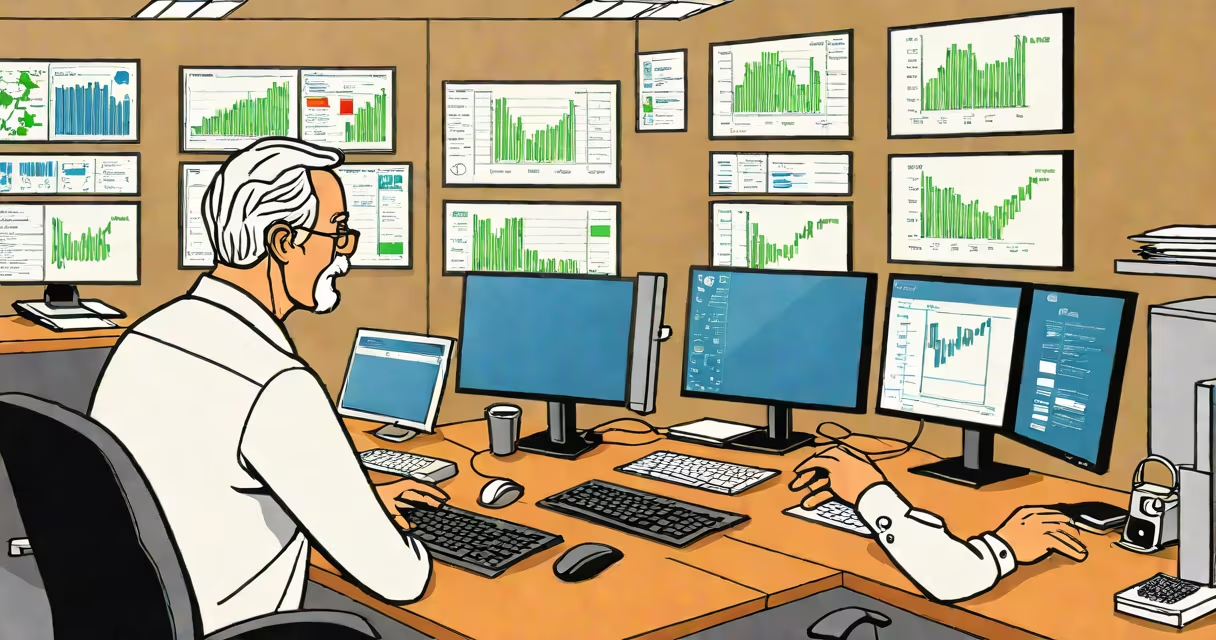
A senior IT manager directs the technical operations of an organization's information systems, leads engineering and support teams, and ensures technology strategies meet business objectives. They bridge technical execution with executive decision-making, typically managing budgets, staffing, and infrastructure across departments.
This role sits at the intersection of technology and business strategy. Senior IT managers define long-term roadmaps for software deployment, cybersecurity protocols, cloud migration, and system scalability. They report to CIOs or CTOs and often supervise multiple project managers, network engineers, and application developers.
According to the U.S. Bureau of Labor Statistics, computer and information systems managers-including senior IT roles-earned a median annual wage of $160,000 in 2023. The position requires advanced technical expertise, leadership experience, and formal education such as a bachelor's degree in computer science or information technology, often paired with certifications like PMP, CISSP, or AWS Certified Solutions Architect.
Senior IT managers operate by setting priorities across technical initiatives. They assess risks, allocate resources, and ensure compliance with regulations like HIPAA, GDPR, or SOX depending on industry. Their daily work includes reviewing incident reports, approving capital expenditures, and coordinating cross-functional projects.
They don't write code or configure routers directly-but they approve architectures, review vendor contracts, and oversee implementation timelines. When a company migrates to a new CRM platform, the senior IT manager approves the budget, selects the project lead, sets milestones, and monitors progress against KPIs like uptime, user adoption, and cost-per-user.
For example, at a mid-sized healthcare provider, a senior IT manager led a five-month transition from legacy patient records software to a cloud-based electronic health record (EHR) system. They coordinated with clinical staff, selected a third-party integrator, ensured HIPAA-compliant data handling, and reduced system downtime by 40% during rollout through phased testing.
Key duties fall into four domains: people, process, technology, and governance.
These responsibilities require constant trade-offs. For instance, choosing between investing in faster hardware versus upgrading to a newer software version involves balancing cost, risk, and business impact. A senior IT manager must weigh these decisions using data-not intuition.
While the core function remains consistent, specialization shapes day-to-day focus. The following table outlines common variants based on industry and scale.
| Type | Typical Industry | Focus Area | Key Metric |
|---|---|---|---|
| Enterprise IT Manager | Large corporations, finance, manufacturing | System integration, global deployments | System uptime (99.95%+) |
| Healthcare IT Manager | Hospitals, clinics, insurers | EHR systems, HIPAA compliance | Mean time to resolve critical incidents |
| Cloud Operations Manager | Tech startups, SaaS providers | Scalable infrastructure, DevOps pipelines | Deployment frequency (daily vs. monthly) |
| Security & Risk Manager | Banks, government agencies | Cybersecurity posture, breach response | Number of successful attacks prevented |
One non-obvious distinction: many organizations use "senior IT manager" interchangeably with "IT director." But the latter often has broader authority-managing multiple teams, representing IT in board meetings, and shaping organizational policy. A senior IT manager may report to an IT director, who then reports to the CIO.
People often confuse a senior IT manager with a systems administrator or a software developer. These roles differ sharply in scope and accountability. An admin configures servers; a developer writes code. A senior IT manager evaluates which tools to adopt, who to hire, and whether to build or buy solutions.
Another misconception is that senior IT managers only manage people. In reality, they make high-stakes technical decisions. For example, when a company faces a ransomware attack, the senior IT manager must decide whether to pay the ransom (rare), restore from backups (common), or engage law enforcement and forensic experts (increasingly standard).
Even within IT, the title varies by company size. In small firms, a single person may wear multiple hats-handling both network administration and project coordination. In those cases, the "senior IT manager" may be a hybrid role with limited direct reports. In contrast, at Fortune 500 companies, the role is highly specialized, with dedicated sub-teams for infrastructure, applications, and security.
In 2022, a regional bank with 12 branches began replacing a 20-year-old core banking system. The senior IT manager led the effort, assembling a team of six project managers, three database architects, and eight external consultants.
They ran a pilot in two branches, monitored transaction latency, and collected feedback from tellers. After identifying bottlenecks in the authentication layer, they revised the API design and added load-balancing features. The full rollout took 11 months and involved 14 major testing cycles.
The result: transaction processing speed improved by 65%, error rates dropped from 1.2% to 0.3%, and customer wait times decreased by 40%. The project was completed under budget due to better vendor negotiation and resource scheduling-both key responsibilities of the senior IT manager.
I once worked alongside a senior IT manager during a merger between two regional retailers. The challenge was unifying two separate inventory systems. The manager didn't just assign tasks-he mapped data flows, identified duplicate product IDs, and negotiated a 30-day grace period with the vendor to avoid service disruption. His ability to align technical constraints with business deadlines kept the integration on track.
A senior IT manager does not handle day-to-day troubleshooting. That falls to junior technicians. Nor do they set individual coding standards unless they're leading a custom software team. Their influence lies in defining the boundaries of success: what systems must achieve, how quickly, and at what cost.
They also aren't responsible for hiring non-technical staff. HR handles recruitment for marketing, sales, or accounting roles. The senior IT manager focuses exclusively on technology-related positions-from help desk agents to cybersecurity analysts.
Most candidates hold a bachelor's degree in computer science, information systems, or engineering. Many pursue an MBA or certification in project management (PMP), information security (CISSP), or cloud architecture (AWS or Azure).
Experience matters. The typical path includes five to seven years as a project manager or IT supervisor. Some advance through technical tracks-starting as a network engineer, then moving into leadership after demonstrating consistent results.
According to LinkedIn's 2023 Workplace Learning Report, 72% of senior IT managers had completed at least one formal leadership development program. These programs cover conflict resolution, stakeholder communication, and strategic planning-skills essential for influencing executives and going through organizational politics.
Leadership in IT isn't about knowing every tool-it's about knowing when to trust your team, when to intervene, and when to step back. A senior IT manager's success is measured not by how much they do themselves, but by how well their team performs under pressure.
Organizations rely on senior IT managers to maintain continuity during crises, enable innovation, and protect assets. Their role is central to digital transformation efforts across industries-from supply chain logistics to patient care. Without them, even the most advanced technology cannot deliver value.
Understanding the senior IT manager role clarifies how technology becomes a strategic asset rather than a cost center. It's not just about keeping systems running-it's about making them work for the business.