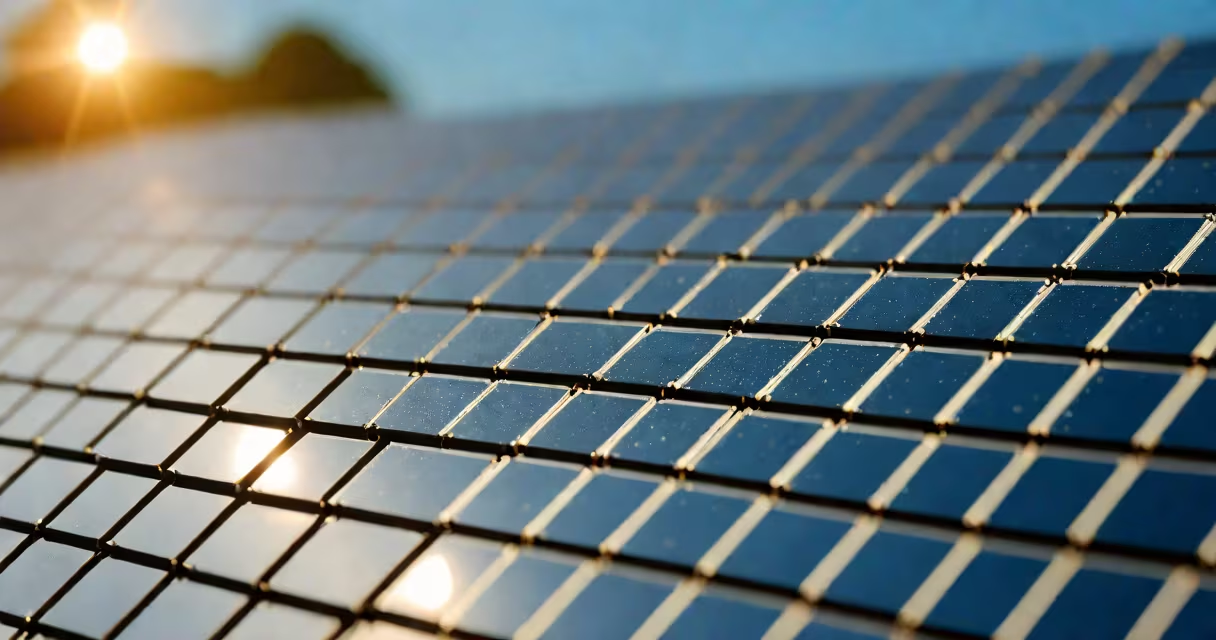
Solar PV cells are semiconductor devices that convert sunlight directly into electrical current through the photovoltaic effect. They form the core component of solar panels used in residential, commercial, and utility-scale installations.
Each cell is typically made from layers of silicon doped with impurities to create a p-n junction. When photons from sunlight strike the cell, they dislodge electrons, generating a flow of direct current (DC) electricity. A single cell produces about 0.5 volts under standard test conditions.
Multiple cells are connected in series and parallel within a module to increase voltage and current output. A typical solar panel contains 60 to 72 cells, producing between 300 and 450 watts of DC power under ideal sunlight.
When sunlight hits a solar PV cell, photons transfer energy to electrons in the semiconductor material. This energy excites electrons, freeing them from their atomic bonds. The electric field created by the p-n junction directs these free electrons toward the metal contacts on the surface, creating a usable electric current.
The process begins when sunlight-specifically photons in the visible and near-infrared spectrum-strikes the cell's surface. Silicon absorbs most of this light efficiently, especially wavelengths between 400 and 1100 nanometers. Light outside this range either passes through or reflects off the surface.
For example, a 300-watt solar panel installed in Phoenix, Arizona, receives approximately 6.5 peak sun hours per day. Under these conditions, it generates roughly 1.95 kilowatt-hours (kWh) of electricity daily. Over a year, this amounts to about 710 kWh-enough to offset a significant portion of a household's energy use.
Three main types dominate the market: monocrystalline, polycrystalline, and thin-film. Each differs in efficiency, cost, and manufacturing process.
| Type | Efficiency Range | Cost per Watt | Use Case |
|---|---|---|---|
| Monocrystalline | 18-23% | $0.45-$0.60 | Residential rooftops, space-constrained areas |
| Polycrystalline | 15-18% | $0.35-$0.45 | Commercial buildings, large ground-mount systems |
| Thin-film (CdTe, CIGS) | 10-13% | $0.25-$0.35 | Large-scale solar farms, curved surfaces |
Monocrystalline cells are cut from a single crystal of silicon, giving them a uniform dark color and higher efficiency. Polycrystalline cells are cast from molten silicon poured into molds, resulting in a fragmented, blue-tinged appearance and slightly lower efficiency.
Thin-film cells use layers of photovoltaic material deposited on glass, plastic, or metal substrates. They are lighter and more flexible than wafer-based cells but degrade faster over time. Cadmium telluride (CdTe) cells, used in First Solar's modules, achieve around 13% efficiency and are common in utility projects.
Solar PV cells are deployed in grid-tied, off-grid, and hybrid energy systems. Grid-tied systems connect to the local power network, feeding excess electricity back during peak production. Off-grid systems rely on batteries and charge controllers to store energy for nighttime or cloudy days.
A 5-kilowatt system using 20 monocrystalline solar PV cells (each rated at 250 watts) can generate about 20 kWh per day in a sunny region. This meets the average daily consumption of a U.S. household, which uses about 29 kWh per day according to the U.S. Energy Information Administration (EIA).
These cells are also used in remote applications such as water pumping in rural India, powering streetlights in urban Africa, and providing emergency power in disaster zones. NASA uses high-efficiency triple-junction GaAs cells in satellites due to their resilience under extreme radiation and temperature swings.
Many assume solar PV cells work only in direct sunlight. In reality, they generate electricity on cloudy days-just at reduced output. On a heavily overcast day, a cell may produce 10-25% of its rated capacity depending on cloud thickness and duration.
Another myth is that solar PV cells degrade rapidly. According to the National Renewable Energy Laboratory (NREL), most silicon-based cells lose less than 0.5% of their output per year. After 25 years, a well-maintained panel still operates at 80-85% of original capacity.
Some confuse solar PV cells with solar thermal collectors. While both harvest solar energy, PV cells convert light to electricity. Solar thermal systems use mirrors or lenses to concentrate heat for water heating or steam generation. A solar thermal plant in California's Mojave Desert uses parabolic troughs to reach temperatures above 400°C, driving turbines to produce electricity-distinct from the solid-state process in solar PV cells.
I once installed a 4-kW solar PV system on a small barn in Vermont. During winter, snow accumulation reduced output by up to 40% on clear days. But after clearing the panels manually, output returned to 90% of normal. This confirmed that even in cold climates, solar PV cells remain effective when kept clean and unobstructed.
Cell efficiency is measured under Standard Test Conditions (STC): 1,000 W/m² irradiance, 25°C cell temperature, and air mass 1.5 spectrum. Actual performance varies with weather, tilt angle, shading, and temperature.
For example, a cell operating at 70°C (common in summer afternoons) can see efficiency drop by 10-15% compared to STC. This is because higher temperatures reduce the voltage output of the semiconductor. Cooling techniques, such as passive airflow or liquid cooling in concentrated PV systems, help mitigate this loss.
Manufacturers rate panels based on STC, but real-world performance is better described by Performance Ratio (PR), which compares actual energy output to theoretical maximum. A PR of 80% is considered good for rooftop systems in temperate climates.
When selecting solar PV cells, consider not just efficiency but degradation rate, warranty length, and manufacturer reputation. Tier-1 manufacturers like LG, Canadian Solar, and SunPower offer 25-year product and performance warranties, backed by third-party testing from organizations like UL and IEC.