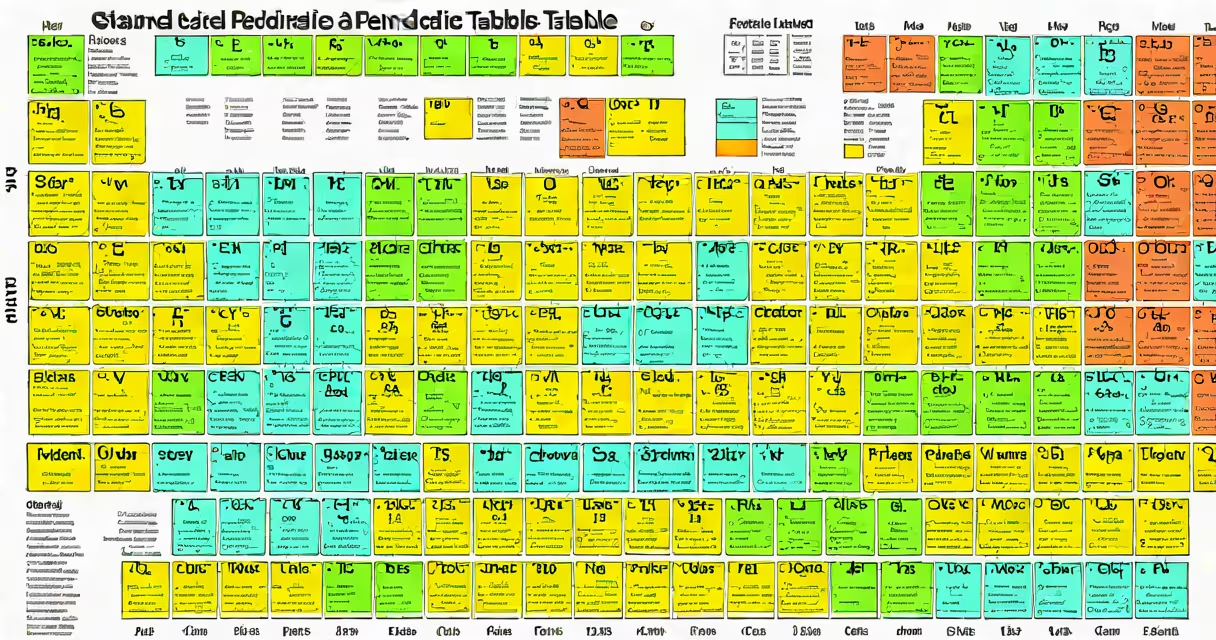
The standard periodic table arranges all known chemical elements in order of increasing atomic number, grouping them by recurring physical and chemical properties. It displays 118 confirmed elements, organized into rows (periods) and columns (groups), revealing patterns in reactivity, electronegativity, and atomic size.
Elements are ordered left to right and top to bottom based on their atomic number-the number of protons in the nucleus. This sequence helps elements with similar electron configurations appear in vertical groups. For example, Group 1 contains alkali metals like lithium (atomic number 3), sodium (11), and potassium (19), all of which react vigorously with water and form +1 ions.
The table's structure reflects the periodic law: when elements are arranged by atomic number, their properties recur periodically. This allows chemists to predict behavior. Fluorine (F, atomic number 9) and chlorine (Cl, 17) both belong to Group 17 (halogens), sharing high electronegativity and forming -1 ions. Their placement predicts similar reactivity despite differing atomic masses.
Each element occupies a cell showing its symbol, atomic number, and average atomic mass. The layout divides elements into metals, metalloids, and nonmetals. Metals dominate the left and center, including transition metals like iron (Fe) and copper (Cu). Metalloids such as silicon (Si) and arsenic (As) lie along a diagonal boundary. Nonmetals occupy the upper right, including oxygen (O), nitrogen (N), and noble gases like neon (Ne).
Periods represent energy levels. Period 1 holds only hydrogen (H) and helium (He), with electrons filling the first shell. Period 2 includes lithium through neon, with electrons occupying the second shell. As shells fill, electron configuration determines group membership. Elements in the same group have identical valence electron counts, leading to similar bonding patterns.
For example, carbon (C, atomic number 6) has four valence electrons and forms four covalent bonds. So does silicon (Si, 14), though less readily. This similarity explains why both form tetrahedral compounds like methane (CH₄) and silane (SiH₄), even though silicon is less reactive.
The standard periodic table uses a consistent format developed by Dmitri Mendeleev in 1869 and refined since. Modern versions include the f-block (lanthanides and actinides) placed below the main body to save space. These elements have electrons filling inner f-orbitals and exhibit complex oxidation states.
Elements are categorized by block based on the subshell being filled:
| Block | Electron Subshell | Examples | Group Range |
|---|---|---|---|
| s-block | ns¹⁻² | Lithium, calcium | 1-2 |
| p-block | np¹⁻⁶ | Oxygen, bromine, argon | 13-18 |
| d-block | (n−1)d¹⁻¹⁰ | Iron, nickel, zinc | 3-12 |
| f-block | (n−2)f¹⁻¹⁴ | Cerium, uranium | Not assigned to groups |
Each block corresponds to a specific orbital type. s-block elements tend to lose electrons easily, forming cations. p-block elements often gain or share electrons, forming anions or covalent bonds. d-block elements display variable oxidation states and catalytic activity-iron in hemoglobin, for instance, binds oxygen reversibly due to its ability to switch between Fe²⁺ and Fe³⁺.
Many assume the periodic table is static. It is not. New elements are synthesized and added. Nihonium (Nh, 113), moscovium (Mc, 115), tennessine (Ts, 117), and oganesson (Og, 118) were officially recognized by the International Union of Pure and Applied Chemistry (IUPAC) between 2015 and 2016. They exist only briefly in particle accelerators and decay rapidly.
Another misconception: the table shows all elements in nature. Only about 94 occur naturally; the rest are synthetic. Technetium (Tc, 43) and promethium (Pm, 61) are exceptions-both are man-made and do not occur in stable form in Earth's crust. Their absence from natural sources was predicted by Mendeleev, who left gaps for undiscovered elements.
A lesser-known fact: the periodic table's layout is not arbitrary. The spacing between periods reflects electron shell capacities. Period 1 holds 2 elements (2 electrons max). Period 2 and 3 hold 8 each (s and p orbitals). Period 4 and 5 include d-block elements, expanding capacity to 18. Period 6 adds f-block, holding 32 elements. This pattern aligns with quantum mechanical principles governing electron arrangement.
Chemists use the standard periodic table daily. In drug development, researchers analyze element trends to design molecules with desired solubility, stability, and binding affinity. For example, replacing a carbon atom with a fluorine atom in a pharmaceutical compound can increase metabolic stability-fluorine's small size and high electronegativity minimize breakdown by liver enzymes.
In materials science, the table guides alloy selection. Titanium (Ti, 22) is used in aerospace because it combines strength with low density. Adding vanadium (V, 23) improves hardness. Chromium (Cr, 24) enhances corrosion resistance. These choices stem from understanding how elements behave in combination-predicted by their positions.
I once tested a prototype battery using lithium-ion chemistry. The cathode material contained cobalt (Co, 27), which stabilizes the crystal lattice during charge cycles. When we replaced cobalt with manganese (Mn, 25), performance dropped. Manganese's lower oxidation state limited charge transfer. The periodic table explained why-cobalt sits higher in the d-block, allowing greater redox flexibility.
For educational purposes, the standard periodic table remains the most accurate reference. It's published by IUPAC and updated regularly. The latest version (2023) includes revised atomic weights for 11 elements, reflecting improved measurement precision. For example, the atomic weight of gallium (Ga) was updated from 69.723 to 69.723(1), indicating tighter uncertainty bounds.
Some confuse the standard table with the "long form" or "extended" version, which separates the f-block and places it below. The long form avoids crowding but doesn't change the underlying logic. Both follow the same rules of electron configuration and periodicity.
Also distinct is the concept of "T" in the periodic table-often misinterpreted as a missing element. There is no element with symbol T. The letter T appears in names like "tetravalent" or "transition metals," but never as a symbol. The closest is technetium (Tc), whose symbol begins with T but is not "T."
The standard periodic table is not just a chart-it's a predictive tool grounded in quantum mechanics and experimental observation. Its structure enables scientists to anticipate unknown behaviors, design new materials, and understand life's building blocks. From DNA's phosphorus (P, 15) to nuclear reactors' plutonium (Pu, 94), the table connects atomic structure to real-world function.
Understanding the standard periodic table means grasping how nature organizes matter. It's not a list-it's a map of elemental relationships, validated over 150 years of research. Every cell represents a discovery, a prediction, and a pattern waiting to be applied.