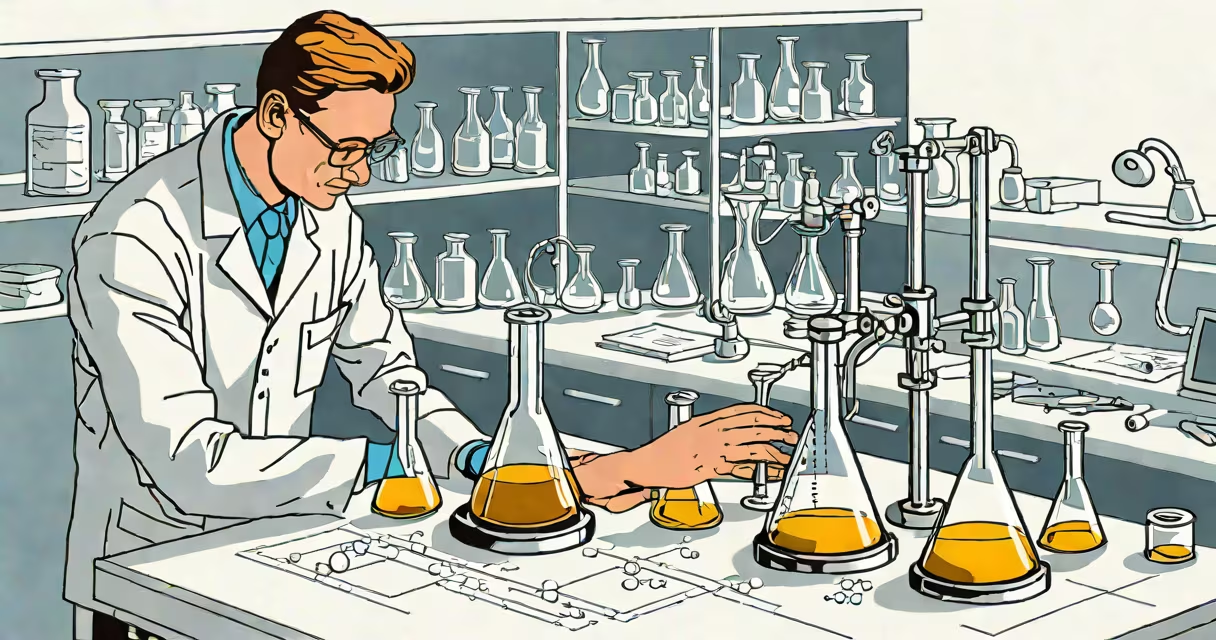
Standard solution chemistry involves preparing and using solutions with precisely known concentrations to measure unknown substances in analytical procedures such as titrations. These solutions serve as reference points in quantitative chemical analysis.
Standard solutions are essential in labs performing acid-base, redox, and complexometric titrations. They allow chemists to calculate the concentration of an analyte by measuring how much standard solution reacts with it. The accuracy of the result depends entirely on the precision of the standard solution's concentration.
The preparation process begins with a primary standard-a highly pure, stable compound with a known molar mass. Common examples include potassium hydrogen phthalate (KHP) for acid-base titrations and sodium oxalate for redox reactions. These materials are dried, weighed accurately, and dissolved in a solvent-usually water-to create a solution of exact molarity.
When a chemist performs a titration, they slowly add a standard solution from a burette to a solution containing the unknown substance. The endpoint-the point at which the reaction completes-is detected using an indicator or instrument like a pH meter or spectrophotometer. The volume of standard solution used determines the amount of analyte present.
For example, suppose you're analyzing vinegar for acetic acid content. You'd titrate a 25.0 mL sample of vinegar with a 0.100 M NaOH standard solution. If 22.4 mL of NaOH is required to reach the endpoint, the moles of NaOH used are:
0.0224 L × 0.100 mol/L = 0.00224 mol NaOHSince NaOH reacts with acetic acid in a 1:1 ratio, the vinegar contains 0.00224 mol of acetic acid. Dividing by the volume gives a concentration of 0.0896 M. This calculation relies entirely on the known concentration of the standard solution.
Without a standard solution, such calculations would lack reproducibility. A 1% error in the standard's concentration leads to a 1% error in the reported analyte concentration-critical in pharmaceuticals, environmental testing, and food safety.
Standard solutions fall into two categories: primary and secondary. Primary standards are high-purity solids with low hygroscopicity and high stability. Secondary standards are solutions prepared from primary standards but may degrade over time and require periodic re-standardization.
| Type | Examples | Stability & Use Case |
|---|---|---|
| Primary Standard | KHP, sodium carbonate, potassium dichromate | High purity (>99.9%), stable, used to prepare initial standard solutions |
| Secondary Standard | NaOH, KMnO₄, EDTA | Often unstable; must be standardized against a primary standard before use |
NaOH, for instance, absorbs moisture and CO₂ from air. A freshly prepared NaOH solution cannot be assumed to have the stated concentration. Chemists always standardize it using KHP before use in titrations. This step ensures traceability and reliability.
According to the National Institute of Standards and Technology (NIST), primary standards must meet strict criteria: high purity, stability, and well-defined stoichiometry. NIST provides certified reference materials (CRMs) for common primary standards, ensuring consistency across labs worldwide.
Many assume that any solution labeled "standard" is automatically accurate. That's incorrect. A solution only qualifies as a standard if its concentration is verified through calibration and documented uncertainty. A solution prepared by diluting a commercial reagent without verification is not a standard solution-it's a working solution.
Another frequent mistake is assuming that standard solutions remain stable indefinitely. Even properly stored, many standard solutions degrade over time due to evaporation, microbial growth, or reaction with container walls. For example, iodine solutions decompose in light; they must be kept in amber glass bottles and stored in darkness.
A non-obvious fact: the temperature at which a standard solution is prepared affects its molarity. Volume changes with temperature, so a solution prepared at 25°C has a different concentration if used at 15°C. Modern labs correct for this using temperature coefficients or perform calibrations at the actual operating temperature.
Standard solution chemistry underpins quality control in pharmaceutical manufacturing. Drug potency assays rely on titrations with standard solutions to confirm active ingredient levels. The U.S. Pharmacopeia (USP) mandates the use of validated standard solutions in all official methods.
In environmental science, standard solutions detect pollutants like nitrates in drinking water. The EPA requires laboratories to use NIST-traceable standards to ensure compliance with regulatory limits. Without them, results would lack legal defensibility.
I once observed a student in a university lab mislabel a 0.1 M HCl solution as "standard" without verifying it. During a titration, the results were off by 12%. After recalibration using a primary standard, the data aligned with expected values. This incident highlighted that the term "standard" is not a label-it's a certification.
Standard solution chemistry is not limited to academic settings. In clinical labs, standard solutions calibrate instruments measuring glucose, cholesterol, and electrolytes. Even in brewing, standard solutions verify alcohol content and acidity levels during fermentation.
Standard solution chemistry differs from general solution preparation. A general solution may be approximate-used for cleaning or preliminary tests. A standard solution must have a known, traceable concentration with documented uncertainty.
It also differs from buffer solutions. Buffers resist pH change and maintain a constant environment, while standard solutions provide quantifiable reactivity. A phosphate buffer maintains pH 7.4; a 0.1 M NaOH standard measures acid content.
Finally, standard solution chemistry is not interchangeable with calibration. Calibration uses standard solutions to adjust instruments, but the standard itself remains the reference. You calibrate a pH probe using a standard buffer-but the buffer is the standard, not the act of calibration.
Understanding standard solution chemistry is fundamental to accurate measurement in science. It forms the basis of quantitative analysis across disciplines-from drug development to climate monitoring. When you see a lab report citing a "0.1000 M standard," know that behind it lies rigorous preparation, validation, and traceability.