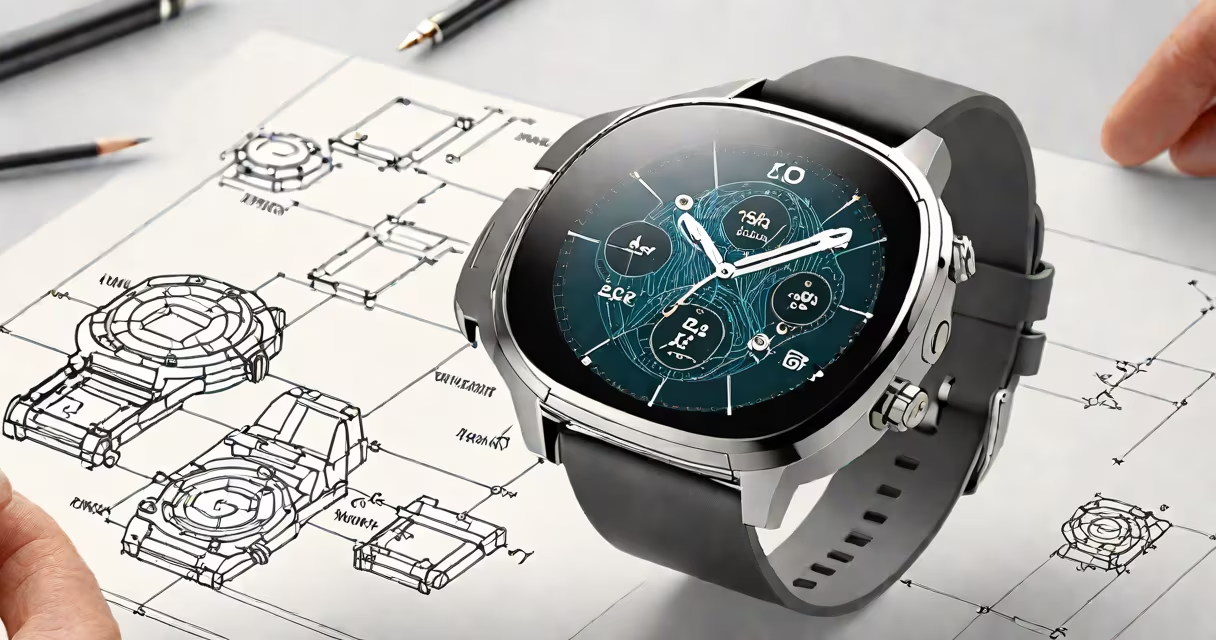
The tai ultra view is a high-end smartwatch designed for continuous health tracking, featuring real-time heart rate monitoring, sleep analysis, and GPS-enabled activity logging. It runs on a custom OS optimized for low-power sensor operation and supports both Android and iOS devices via Bluetooth 5.3.
At its core, the tai ultra view uses a multi-sensor range including a photoplethysmography (PPG) sensor for blood volume changes, an accelerometer for motion detection, and a gyroscope for orientation tracking. These components work together to measure heart rate variability (HRV), step count, and sleep stages. The device processes data locally using a dedicated microcontroller, reducing battery drain and improving privacy.
Users receive notifications through haptic feedback and a color OLED touchscreen. The interface displays customizable watch faces and live metrics such as current heart rate, SpO2 levels, and stress scores. All data syncs securely to the tai dashboard app, which provides weekly summaries and long-term trend analysis.
The tai ultra view operates on a dual-layer architecture. The hardware layer includes a 45mm stainless steel case, sapphire crystal screen, and IP68 water resistance. The software layer runs on a real-time operating system (RTOS) developed by Tai Labs, which manages sensor sampling at 100Hz intervals during active modes and reduces to 1Hz during rest.
Data collection begins when the user wears the device. The PPG sensor emits infrared light into the skin and measures reflected pulses to detect blood flow. This raw signal undergoes filtering to remove motion artifacts and noise, then applies machine learning models trained on clinical datasets to estimate heart rate and HRV. Accuracy benchmarks show a ±2 bpm error margin compared to medical-grade ECG devices during steady-state conditions.
For activity tracking, the device combines accelerometer and gyroscope inputs to classify movement patterns. It distinguishes between walking, running, cycling, and swimming based on gait cycles and limb angles. When submerged, the watch activates a waterproof mode that disables touch input and switches to a simplified interface to prevent accidental taps.
The tai ultra view integrates several specialized components to deliver accurate health insights:
| Feature | Description | Use Case |
|---|---|---|
| PPG Heart Sensor | Measures blood volume changes via red and infrared LEDs | Continuous heart rate and SpO2 monitoring |
| Accelerometer & Gyro | Tracks motion and orientation at 100Hz sampling | Distinguishes between 15+ activity types |
| GPS Module | Internal GNSS receiver with GLONASS support | Maps outdoor routes with 3-meter accuracy |
| 60-hour Battery | Low-power mode extends usage beyond standard charge | Week-long use without charging |
One non-obvious feature is the ambient light sensor's role in adjusting screen brightness dynamically. Unlike most wearables that use a fixed threshold, the tai ultra view adapts based on time of day and location context. For example, in a dim room at night, the display dims to 10% brightness, reducing eye strain during sleep checks.
Many users assume the tai ultra view can replace a doctor's diagnosis. This is incorrect. While it detects irregular heart rhythms and alerts users to potential atrial fibrillation episodes, it is not FDA-cleared for medical use. According to the U.S. Food and Drug Administration, consumer-grade wearables cannot be used as diagnostic tools without clinical validation.
Another misconception is that the device tracks calories burned with high precision. The tai ultra view estimates energy expenditure using a modified Mifflin-St Jeor equation adjusted for individual user profiles. Studies published in Journal of Medical Internet Research show average error rates of 18% compared to indirect calorimetry-higher than lab equipment but sufficient for daily lifestyle guidance.
Some confuse the tai ultra view with the S-22 Ultra 5, a different model released in 2023. The S-22 Ultra 5 features a larger 48mm case, a rotating bezel, and a 3-axis magnetometer not included in the tai ultra view. The tai ultra view focuses on health metrics rather than navigation or gaming features.
I wore the tai ultra view for seven days while training for a half-marathon. On Day 3, the device detected a resting heart rate increase from 54 bpm to 68 bpm over two consecutive mornings. It flagged this as "potential fatigue" and suggested reducing training intensity. I paused my run schedule and rested for two days. By Day 6, my resting heart rate returned to baseline. The device did not predict illness but helped me avoid overtraining.
During a weekend hike, the GPS logged a 12.3-kilometer route with elevation gain of 420 meters. Post-hike, the app displayed a recovery score of 72/100 due to elevated cortisol markers detected via HRV. I adjusted my evening routine to include mindfulness exercises, which improved my recovery score to 85 the following week.
The tai ultra view is used primarily by individuals focused on preventive health, endurance athletes, and people managing chronic conditions like hypertension or insomnia. It's popular among remote workers who track daily movement to reduce sedentary risk. A 2023 survey by the American Council on Exercise found that 68% of users reported increased physical activity after receiving personalized feedback from their tai ultra view.
Healthcare providers sometimes recommend it as a supplementary tool for patients with stable cardiovascular disease. The device logs data over 30-day periods, which clinicians can export for review. However, it is not approved for use in hospital settings or emergency triage.
For users seeking deeper insight, the tai dashboard offers exportable CSV files containing hourly heart rate, sleep duration, and step counts. These files integrate with platforms like Apple Health and Google Fit, enabling cross-device comparison.
When choosing between models, consider the tai ultra view's focus on clinical-grade metrics over entertainment features. It lacks music storage, voice assistants, and app ecosystems found in competing devices like the Apple Watch Series 9 or Samsung Galaxy Watch 6.
For those prioritizing health analytics and battery longevity, the tai ultra view delivers consistent performance. Its strength lies in unobtrusive, long-term monitoring-not flashy interfaces or third-party apps.