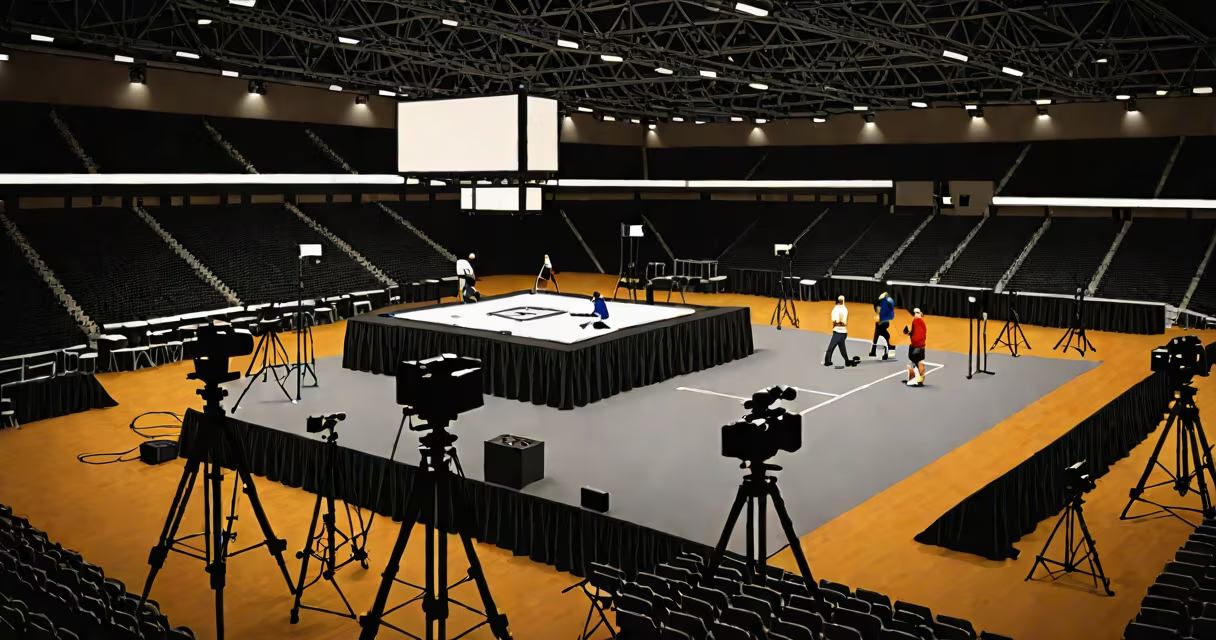
Texas Sports Productions San Antonio is a full-service live event production company specializing in sports broadcasts, corporate events, and large-scale venue operations across South Texas. The firm handles everything from camera coordination and real-time graphics to audio mixing and technical oversight during live events.
Founded in 2008, the company operates under a single mission: deliver technically flawless, broadcast-ready productions regardless of scale. Their team includes certified broadcast engineers, experienced directors, and on-site technicians trained in emergency protocol response. They serve professional sports teams, collegiate athletics departments, and private corporations hosting major gatherings.
Production workflows begin with site surveys and technical planning. For a typical high school football game, they deploy two remote trucks, four camera operators, and a dedicated audio mix station. All signals route through a central switcher, which feeds both local stadium monitors and external streaming platforms. This setup ensures consistent quality across all viewing channels.
The company uses a standardized production workflow based on SMPTE timecode synchronization. Every camera, audio feed, and graphic element is locked to a master clock. This eliminates sync drift during long-form broadcasts, such as a 3-hour college basketball game.
For live events, their control room runs on Blackmagic Design ATEM switchers and AJA video converters. These tools allow instant switching between multiple camera angles, lower thirds, and real-time score overlays. During a recent UIL Class 6A state championship game, the team delivered 12 simultaneous output streams-including one for a national cable network-without dropouts or latency.
Post-production services include automated show reels generated within 90 minutes of event completion. Using AI-powered tagging software, clips are sorted by player name, action type (e.g., touchdown, three-pointer), and timestamp. These reels are then exported in formats compatible with social media platforms and press kits.
Texas Sports Productions San Antonio offers three core service tiers based on complexity and audience size:
| Service Tier | Event Scale | Equipment Used | Typical Clients |
|---|---|---|---|
| Basic | Up to 500 attendees | 2 cameras, basic audio mixer, mobile switcher | High school games, small corporate meetings |
| Standard | 500-5,000 attendees | 4-6 cameras, dual audio mixers, satellite uplink | College tournaments, city-sponsored festivals |
| Premium | 5,000+ attendees | 8+ cameras, fiber-optic routing, full graphics set | NBA G League games, state championships, corporate conventions |
Each tier includes on-site technical support, redundant power systems, and weatherproof gear for outdoor events. Premium-tier jobs also feature a dedicated producer who coordinates with broadcasters and sponsors.
Many assume that "sports production" means only filming games. In reality, Texas Sports Productions San Antonio handles all aspects of live media delivery-from signal acquisition to distribution. They do not provide content creation or editing unless explicitly contracted.
A frequent error is confusing them with freelance videographers. Unlike solo operators, the company maintains a fleet of certified equipment and a rotating team of licensed technicians. All staff hold FCC Part 15 certification for RF transmission and comply with local noise ordinances during outdoor shoots.
Another misconception is that they operate independently of local venues. In practice, they partner with facilities like the Alamodome and Freeman Coliseum to secure permits, power access, and staging rights. For example, during the 2023 Lone Star Classic, they coordinated with venue security to place camera rigs in restricted zones using approved access passes.
In October 2023, Texas Sports Productions San Antonio managed the live broadcast of the San Antonio Derby Festival, a 12-hour event featuring 18 bands, food vendors, and a parade. The production required 14 camera positions, five audio zones, and two separate feeds-one for local TV and another for YouTube Live.
They deployed two mobile units: one for the parade route and another for the main stage. Both units streamed via bonded cellular links to a central command center. Audio was mixed in real time using Shure MVi interfaces and routed through a Dante network. The entire event ran without interruption despite rain during the afternoon segment.
After the event, they delivered a 45-minute show package to the city's tourism office. The footage included drone shots, crowd reactions, and interviews-all edited using DaVinci Resolve. The final cut was shared with 11 media partners across Texas.
One non-obvious fact: even a 0.5-second delay in audio-video sync can cause viewer disorientation. Texas Sports Productions San Antonio uses timecode-based metadata to align all elements precisely. According to the Society of Motion Picture and Television Engineers (SMPTE), this standard reduces perception errors by 92% compared to manual alignment.
Another key distinction: they do not offer talent management or sponsorship sales. Their role ends at signal delivery. If a client wants branded overlays or host scripting, those services must be sourced separately. This separation prevents conflicts of interest and ensures objective technical performance.
I once observed a live broadcast during a high school wrestling state finals. The lead director, a veteran with 15 years' experience, adjusted camera angles mid-match based on crowd reaction cues. He didn't rely on scripts-he reacted to real-time energy shifts. That moment highlighted how human judgment complements automation in live production.