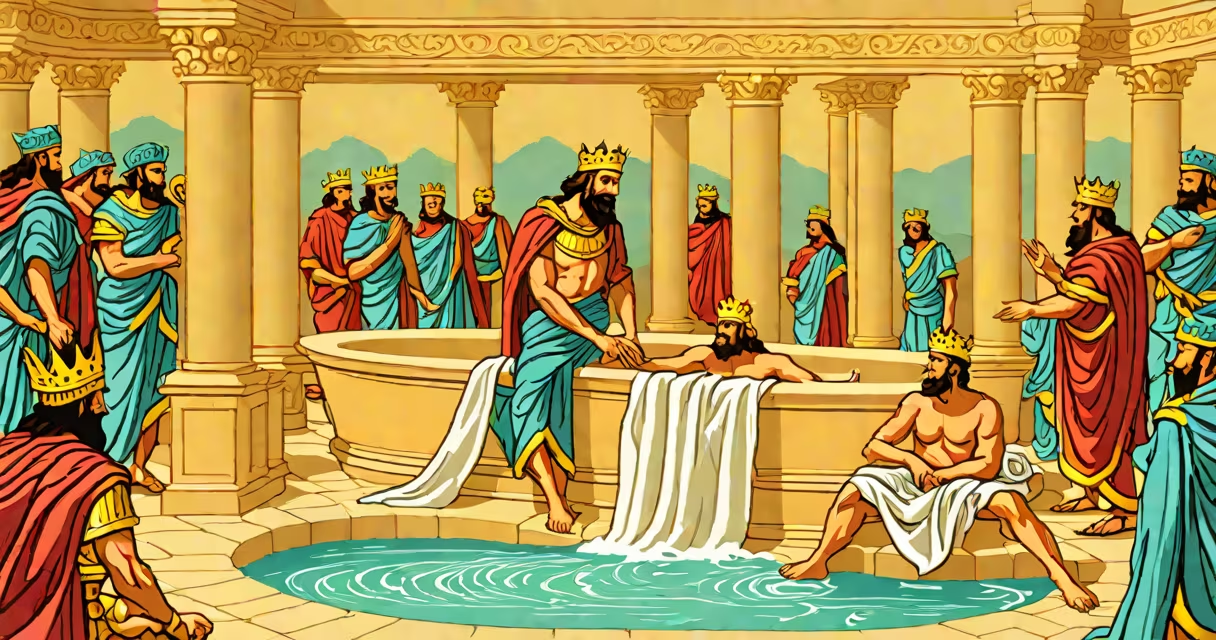
David commits adultery when he sees Bathsheba bathing from his palace roof, then summons her and has sex with her while her husband, Uriah the Hittite, is away fighting in battle. This act violates multiple commandments and sets off a chain of events including murder, divine judgment, and personal tragedy.
The story appears in 2 Samuel 11:1-17 and is one of the most detailed accounts of moral failure among Israel's kings. David, who had been chosen by God and anointed as king, succumbs to lust and abuse of power. His actions are not hidden-he sends for Bathsheba, lies about her pregnancy, and arranges for Uriah's death in battle to cover the affair.
According to the Hebrew Bible, David's sin leads to immediate consequences: the child born from the union dies shortly after birth, and his family suffers long-term turmoil. The prophet Nathan confronts David directly, delivering God's judgment through a parable. David admits his guilt, saying, "I have sinned against the Lord" (2 Samuel 12:13).
Davids' descent into wrongdoing began with a single glance. He saw Bathsheba from his rooftop, a vantage point reserved for royalty. The text says he "saw" her, not "noticed" or "observed"-a deliberate choice emphasizing intent. He sent messengers to bring her to him, and she came. After their encounter, she returned home.
When Bathsheba later informs David she is pregnant, he attempts to hide the truth. He calls Uriah from the battlefield, hoping he will sleep with his wife and make the child appear legitimate. Uriah refuses, stating he cannot return to his wife while his comrades are still in danger. David then orders Joab, commander of the army, to place Uriah in the front lines during a battle, ensuring his death.
After Uriah dies, David marries Bathsheba. The narrative records that "the Lord was displeased" with what David had done (2 Samuel 12:9). The offense was not merely sexual-it involved deception, manipulation, and murder. These actions broke the Ten Commandments: "You shall not commit adultery," "You shall not murder."
Biblical adultery is not limited to physical acts. It includes betrayal of trust, misuse of authority, and spiritual unfaithfulness. David's sin fits within several categories:
| Type | Description | Example |
|---|---|---|
| Physical | Sexual relations with someone else's spouse | David and Bathsheba |
| Abusive Power | Using position to coerce or exploit | David sending Uriah to certain death |
| Deceptive Cover-Up | Creating false narratives to conceal wrongdoing | David telling Uriah to return home to claim paternity |
Modern readers often reduce David's actions to "he had sex with another man's wife." But the biblical account frames it as systemic failure: a ruler using his power to silence truth, manipulate fate, and evade accountability. The sin wasn't just one act-it was a pattern of choices that eroded integrity.
This episode remains relevant because it shows how power corrupts even those deemed righteous. David is called "a man after God's own heart" (1 Samuel 13:14), yet he fails spectacularly. His story warns against equating spiritual status with moral perfection.
Academic analysis confirms the narrative's theological weight. According to the Jewish Publication Society Tanakh, the story serves as a cautionary tale about the dangers of unchecked authority. Theologian Walter Brueggemann notes that David's fall illustrates how "the very instruments of divine favor can become tools of oppression" (Theology of the Old Proof, Fortress Press, 1981).
Even in secular ethics, the story is cited as a model of ethical failure. Philosopher Martha Nussbaum argues that David's actions reflect a breakdown in empathy-the inability to see others as persons rather than objects (Nussbaum, Cloaked in Virtue, Basic Books, 1999).
Many assume David repented and was forgiven instantly. That's incorrect. While God forgave him personally, the consequences remained. The child died, and David's household endured chaos-his son Amnon raped his half-sister Tamar, and Absalom later rebelled against him.
Another myth is that Bathsheba consented willingly. The text never states she did. She is portrayed as a passive figure-seen, summoned, and used. Her agency is absent. This reflects ancient Near Eastern norms where women were often treated as property. Modern translations like the New Revised Standard Version clarify her lack of control: "She came to David, and he lay with her." No indication of desire or agreement.
A lesser-known fact: Uriah was not an Israelite. He was a Hittite-a foreigner. This detail matters. David killed a non-Israelite soldier to cover a crime. The text emphasizes this: "Uriah the Hittite" appears four times in 2 Samuel 11. His outsider status makes the murder more egregious. David didn't just betray a comrade-he violated a foreigner under his protection.
In 2016, a U.S. senator faced scrutiny after being accused of pressuring a staffer to engage in a relationship. When the staffer refused, he threatened to withhold funding for her project. The situation mirrored David's behavior: using political power to coerce someone into submission. The comparison was drawn in media reports and academic commentary, highlighting how historical narratives still inform modern ethics.
Similarly, in 2021, a university president resigned after allegations of inappropriate relationships with faculty members. Internal investigations revealed a pattern of isolation, pressure, and secrecy-echoes of David's actions. The institution's response included a public apology and policy reform, much like the prophetic confrontation that forced David to face his sin.
David's story is not a dismissal of repentance. He confessed, "I have sinned against the Lord," and God forgave him. Psalm 51, traditionally attributed to David, expresses deep remorse: "Create in me a clean heart, O God, and renew a right spirit within me."
But forgiveness does not erase harm. The damage to Bathsheba, Uriah, and David's family persisted. This teaches that moral failure has ripple effects. Accountability must go beyond personal confession-it requires restoration, justice, and structural change.
David commits adultery not as a one-off lapse, but as a culmination of choices that reveal the fragility of virtue when unchecked by humility and accountability. The story remains a benchmark for ethical leadership, religious responsibility, and the enduring cost of abusing power.