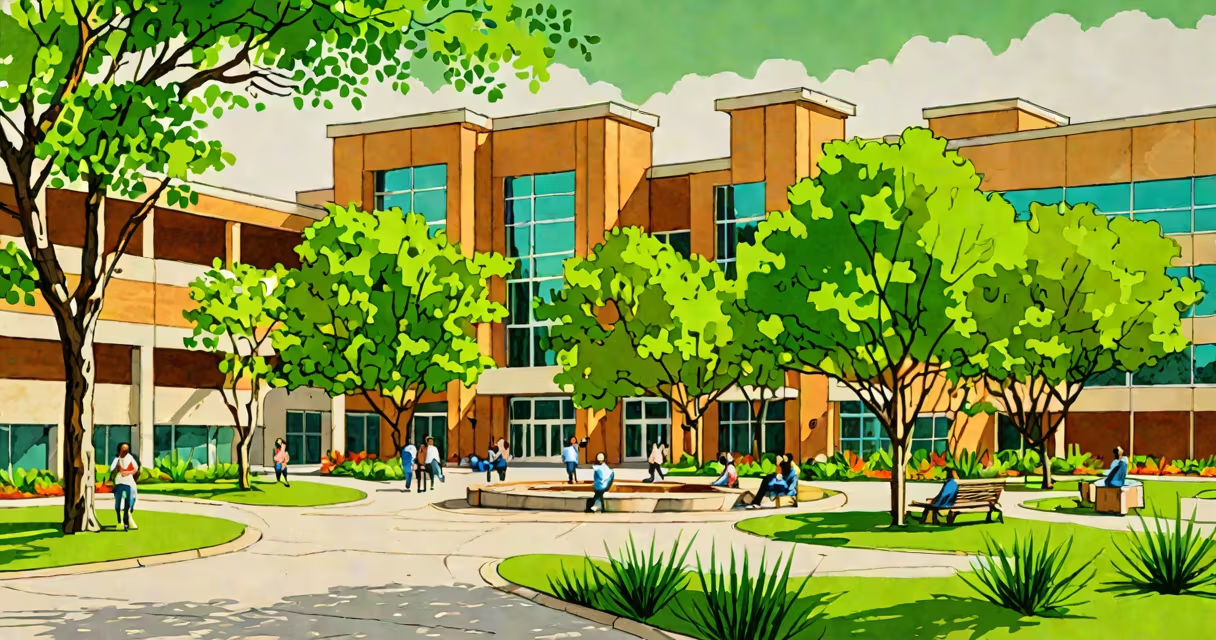
The University of Texas Rio Grande Valley (UTRGV) is a public research university established in 2015 through the consolidation of the University of Texas-Pan American and the University of Texas-Brownsville. It serves the Rio Grande Valley region of South Texas with campuses in Edinburg and Brownsville, offering bachelor's, master's, and doctoral degrees across multiple disciplines.
UTRGV was formed under Texas House Bill 1601, which authorized the merger of two institutions with distinct histories. UTB began in 1927 as a junior college and expanded into a four-year university, while UTPA, founded in 1927 as Pan American College, grew into a major regional institution. Their integration created a single university system with dual campuses, aiming to strengthen access to higher education in a region with high Hispanic enrollment and significant socioeconomic challenges.
As a Tier One research university, UTRGV conducts federally funded research in areas such as cancer biology, environmental sustainability, and health disparities. It holds full accreditation from the Higher Learning Commission and is classified among the top 100 public universities in the nation for social mobility by the U.S. News & World Report.
UTRGV operates under a centralized governance model with shared leadership between its Edinburg and Brownsville campuses. Each campus maintains independent academic departments, administrative offices, and student services, but they follow unified academic policies and degree requirements. Students may transfer between campuses with minimal disruption to their program progression.
The university offers 140+ academic programs across five colleges: the College of Business and Entrepreneurship, the College of Science and Engineering, the College of Liberal and Fine Arts, the School of Medicine, and the Graduate School. Programs span fields including nursing, computer science, civil engineering, and Spanish language and literature. The School of Medicine, launched in 2016, is the only medical school in the Rio Grande Valley and trains physicians for underserved communities.
For example, the B.S. in Biomedical Sciences requires 120 credit hours, including 30 credits in core science courses (biology, chemistry, physics), 12 credits in math and statistics, and 18 credits in clinical and research practicums. Students complete a capstone project involving community health outreach in collaboration with local clinics. Graduates often pursue medical school or careers in public health.
UTRGV is classified as an R2 institution by the Carnegie Classification of Institutions of Higher Education, indicating "high research activity." This status reflects its annual research expenditures exceeding $30 million, primarily from federal grants via the National Institutes of Health (NIH) and the National Science Foundation (NSF).
| Classification | Description | Examples |
|---|---|---|
| R2: High Research Activity | Conducts substantial research with external funding and advanced degree programs | UTRGV, University of Houston, Texas State University |
| Hispanic-Serving Institution (HSI) | Enrolls at least 25% Hispanic students and meets federal criteria for HSI designation | UTRGV, California State University, Los Angeles |
| Emerging Research University | Designation by the Texas Legislature for institutions advancing toward Tier One status | UTRGV, University of North Texas, Texas Tech University |
UTRGV is designated a Hispanic-Serving Institution (HSI) by the U.S. Department of Education. This classification qualifies it for federal grants focused on improving educational outcomes for Latino students. In 2022, UTRGV received $12.3 million in HSI grant funding to expand STEM pathways and increase retention rates in engineering and computer science programs.
UTRGV is often mistaken for a branch campus of the University of Texas System, but it is a separate entity within the UT System. While it shares branding and administrative oversight with other UT institutions, it operates independently under its own board of regents and state legislative authority. Its mission emphasizes regional impact, not national prestige rankings.
A common error is assuming that UTRGV only offers associate degrees or vocational training. In reality, it confers doctoral degrees in fields such as biomedical sciences and educational leadership. The Ph.D. in Biomedical Sciences, launched in 2018, is one of only three such programs in Texas outside the Austin and Houston metropolitan areas.
Another misconception is that UTRGV lacks academic rigor due to its focus on accessibility. Data from the Texas Higher Education Coordinating Board shows that UTRGV's four-year graduation rate for full-time undergraduates was 52% in 2021-higher than the statewide average of 48%. Retention rates for first-generation students improved from 61% in 2016 to 73% in 2022, according to institutional reports.
UTRGV plays a central role in workforce development for the Rio Grande Valley. The university partners with local industries, including healthcare providers and manufacturing firms, to align curricula with labor market demands. For example, the UTRGV Center for Innovation in Healthcare Education trains 150 nursing students annually, many of whom secure jobs at Valley Baptist Medical Center and other regional hospitals.
In 2020, UTRGV researchers led a study on air quality in Brownsville, using sensors deployed across neighborhoods near industrial zones. The findings, published in Environmental Health Perspectives, identified elevated levels of particulate matter linked to respiratory conditions in children. The results prompted city officials to revise zoning regulations and fund community health initiatives.
I visited the UTRGV Health Sciences Campus in Edinburg in 2023 during a faculty tour. The simulation lab, equipped with mannequins that mimic real patient responses, demonstrated how medical students practice emergency procedures in controlled environments. One group simulated a cardiac arrest scenario using a patient with a history of diabetes and hypertension-conditions prevalent in the region. The realism of the training environment underscored how UTRGV prepares clinicians for local health challenges.
UTRGV continues to grow its research footprint. In 2023, it secured a $4.7 million NIH grant to study genetic markers associated with Type 2 diabetes in Mexican-American populations-a demographic disproportionately affected by the disease. The project involves collaboration with the University of Texas Health Science Center at San Antonio and local clinics in Cameron County.
For students seeking a public university with strong regional ties, research opportunities, and a commitment to equity, the university of texas rio grande valley provides a structured path to academic and professional advancement. Its dual-campus model supports geographic diversity, while its focus on health, science, and community engagement ensures tangible outcomes beyond the classroom.
Understanding the university of texas rio grande valley reveals more than institutional structure-it highlights how higher education can serve as a catalyst for economic and social progress in underserved regions. With its roots in both legacy institutions and forward-looking policy, UTRGV exemplifies how public universities adapt to meet evolving societal needs.