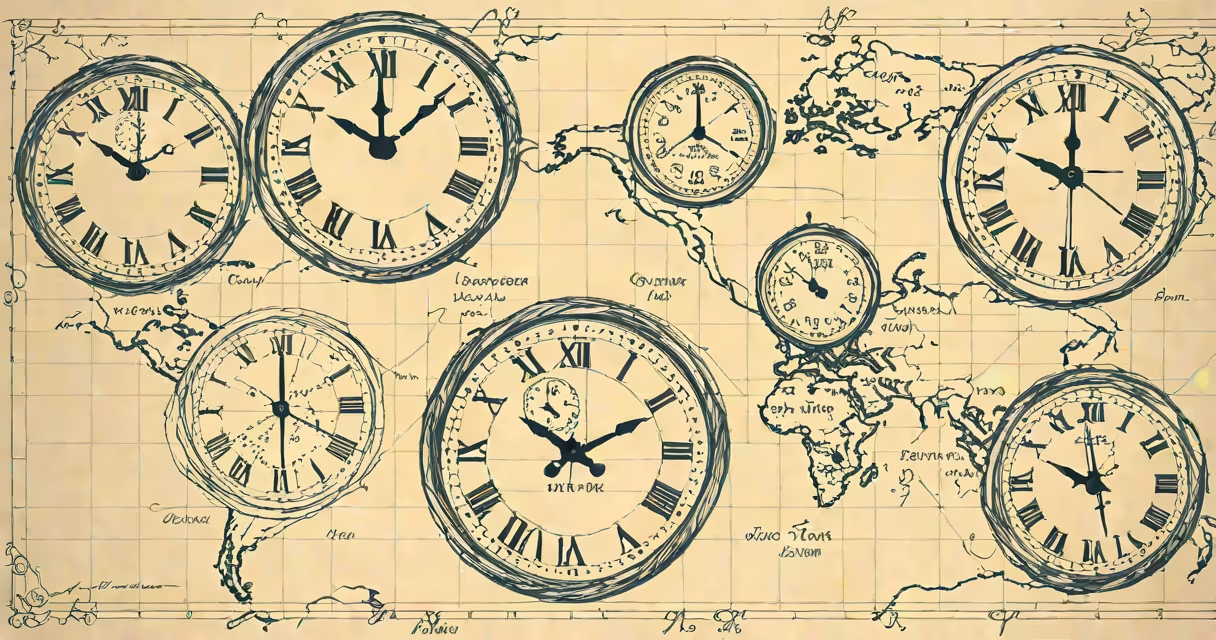
Time zone differences refer to the variation in local time between geographic locations due to Earth's rotation and standardized regional timekeeping. These differences arise because the planet is divided into 24 longitudinal segments, each representing one hour of time. When it's noon in London, it's 7 AM in New York and 8 PM in Tokyo.
Each time zone follows a specific UTC offset-the number of hours and minutes difference from Coordinated Universal Time (UTC), the global reference point. For example, New York operates on UTC−5 during standard time and UTC−4 during daylight saving time. Tokyo uses UTC+9 year-round. The system allows synchronized coordination across continents, though it creates challenges in communication, travel, and business operations.
Time zone differences are not always whole hours. Some regions use half-hour or quarter-hour offsets. India uses UTC+5:30, Nepal uses UTC+5:45, and Afghanistan uses UTC+4:30. These irregularities stem from political decisions, geographical convenience, and historical precedent rather than strict longitude alignment.
The Earth rotates 360 degrees in 24 hours, meaning each 15-degree segment of longitude corresponds to one hour of time. This forms the basis of the 24 primary time zones. However, actual boundaries often deviate from these lines due to national borders, economic integration, and administrative convenience.
For example, China spans five theoretical time zones but uses a single time zone-China Standard Time (CST), which is UTC+8-across the entire country. This decision was made in 1949 to promote national unity, despite the vast geographic span from Xinjiang in the west to Shanghai in the east. As a result, sunrise times in western China can be as late as 10 AM in winter, creating practical challenges for residents.
Daylight saving time (DST) further complicates the picture. About 70 countries observe DST, advancing clocks forward by one hour in spring and setting them back in autumn. The United States observes DST in most states, shifting between Eastern Standard Time (EST, UTC−5) and Eastern Daylight Time (EDT, UTC−4). This creates seasonal shifts in time zone differences, especially for cross-border meetings.
Time zones fall into three broad categories based on their relationship to UTC:
| Zone Type | Offset Example | Region Example | Notes |
|---|---|---|---|
| Standard (whole hours) | UTC+1 to UTC+12 | Paris (UTC+1), Sydney (UTC+10) | Most common; aligned with major cities. |
| Half-hour offsets | UTC+5:30, UTC+6:30 | India (UTC+5:30), Bangladesh (UTC+6:00) | India's offset is unique among large nations. |
| Quarter-hour offsets | UTC+5:45, UTC+4:30 | Nepal (UTC+5:45), Afghanistan (UTC+4:30) | Nepal's offset is the only one with a 45-minute difference. |
Some areas also have unusual arrangements. The Chatham Islands in New Zealand use UTC+12:45, making them the farthest ahead of UTC. The Republic of Kiribati includes islands in both the Western and Eastern Hemispheres, with some using UTC+14-the furthest ahead of UTC. This results in dates being different even within the same country.
A notable example of confusion arises during international events. During the 2022 FIFA World Cup, matches in Qatar began at 15:00 local time. That meant kickoff at 3:00 PM in Doha, but 11:00 PM in London (UTC+1), 6:00 AM in Los Angeles (UTC−7), and 10:00 PM in Seoul (UTC+9). Fans in different regions had to adjust sleep schedules, work hours, and social plans accordingly.
Many assume time zone differences are purely mathematical and follow strict longitude lines. In reality, political and cultural factors heavily influence boundaries. For example, Russia spans 11 time zones but uses only nine official ones, with some regions changing their clocks annually based on government policy.
Another misconception is that daylight saving time applies globally. Only about 40% of countries observe it. Most of South America, Africa, and Southeast Asia do not. In 2023, the European Parliament voted to end mandatory daylight saving changes, but implementation remains pending in many member states.
A lesser-known fact: some regions use time zones that are not based on UTC. For example, Iran uses Iran Standard Time (IRST), which is UTC+3:30. This offset is not divisible by 15 degrees, reflecting historical adoption of a local solar time standard before UTC became universal.
Managing time zone differences requires awareness and planning. Scheduling tools like Google Calendar automatically detect time zones based on user location and display events in local time. When you set a meeting for 9:00 AM in Berlin, the system shows 3:00 AM in San Francisco and 5:00 PM in Tokyo.
I once coordinated a virtual team meeting across four time zones-New York (UTC−5), London (UTC+0), Dubai (UTC+4), and Sydney (UTC+10). I used a shared online tool to convert all times to UTC first, then checked each participant's local time. The meeting was scheduled at 10:00 AM in New York, which was 3:00 PM in London, 7:00 PM in Dubai, and 1:00 AM the next day in Sydney. I sent out a calendar invite with all times labeled. No one missed the call.
For travelers, apps like World Time Buddy or Time Zone Converter provide instant comparisons. They show overlapping hours, helping plan calls or arrivals. Business professionals rely on these tools to avoid sending emails at 2:00 AM local time in a partner's country.
Understanding time zone differences improves global collaboration. A study by the Harvard Business Review found that teams with clear time zone awareness reported 23% fewer scheduling conflicts and higher engagement in remote work settings. Accurate time tracking prevents missed deadlines and ensures accountability across regions.
Time zone differences are not just logistical hurdles-they reflect how societies organize time. From the 1884 International Meridian Conference that established UTC to modern digital calendars, the system continues to evolve. Recognizing the role of geography, politics, and human behavior in shaping time zones leads to better coordination in an interconnected world.
Time zone differences remain essential for global synchronization. Whether managing a multinational project or planning a video call with family abroad, knowing how time zones interact reduces errors and builds trust. Use reliable tools, verify offsets, and always confirm local times before committing to a schedule.