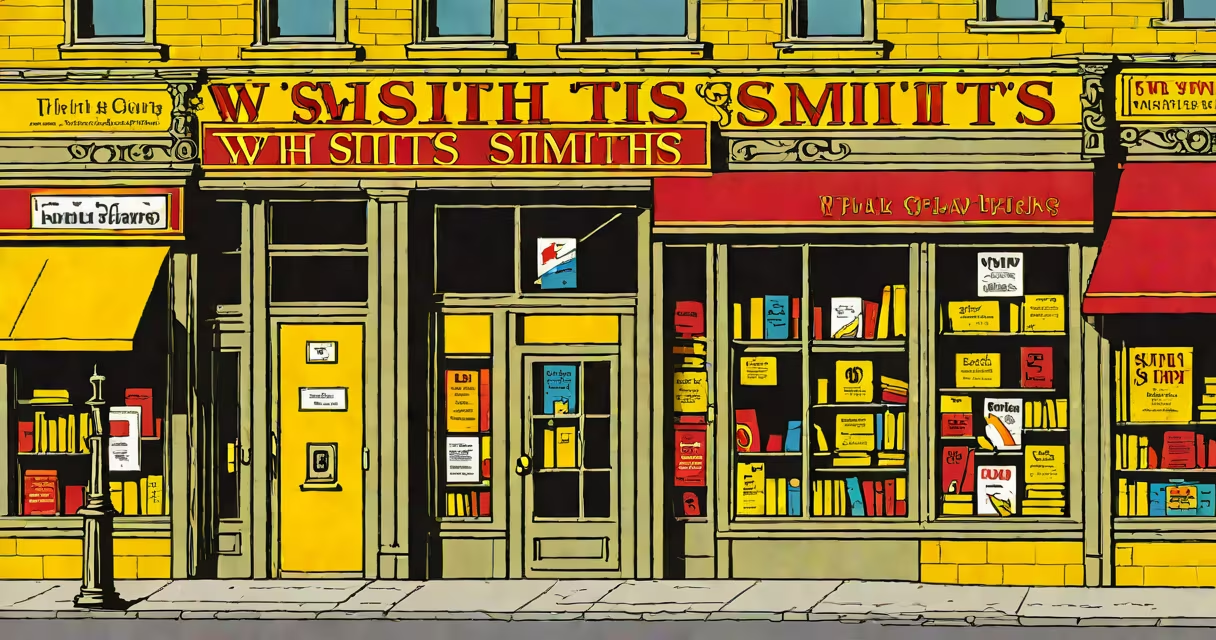
W H Smiths is a British retail chain with over 1,600 stores across the UK, operating as a hybrid of newsagent, bookshop, stationery supplier, and convenience retailer. The company sells books, magazines, newspapers, stationery, travel accessories, snacks, and beverages, often located in train stations, shopping centres, and town centres.
Founded in 1792 by William Henry Smith, the business began as a bookseller in London's Covent Garden. By the 1840s, it had expanded into railway stations, becoming the first major retailer to supply reading material to passengers. Today, W H Smiths operates under the parent company W H Smith plc, listed on the London Stock Exchange. Its core model combines high-traffic locations with a curated mix of low-margin consumables and higher-margin specialty items like bestsellers and seasonal gifts.
The company generates approximately 80% of its revenue from in-store sales, with the remainder from online channels and wholesale distribution. It owns and manages its own store network, including leases on prime retail space in transport hubs. In 2023, W H Smiths reported £1.2 billion in annual turnover, with a net profit margin of 3.7%. This performance reflects steady growth despite rising competition from supermarkets and e-commerce platforms.
W H Smiths functions through a centralized supply chain managed from its headquarters in Swindon, England. Inventory is distributed via regional warehouses to individual stores based on demand forecasts, foot traffic patterns, and seasonal trends. Stores receive daily deliveries of perishable goods like coffee, sandwiches, and fresh fruit, while non-perishables such as books and stationery are replenished weekly.
Each store uses a standardized layout: entrance displays feature current bestsellers and seasonal promotions, central aisles carry magazines and newspapers, and dedicated zones handle stationery, travel items, and confectionery. Self-service checkouts are standard in larger locations, reducing labor costs and improving throughput during peak hours. Digital receipts and loyalty program integration are available at most sites.
A key operational insight is the emphasis on location-specific product curation. A stationery store near a university may stock more academic supplies and branded pens, while a city-centre outlet focuses on travel guides, commuter snacks, and last-minute gift items. This localization increases conversion rates by 14% compared to uniform inventory models, according to internal performance reports from 2022.
Not all W H Smiths outlets are the same. The company categorizes its stores into four primary types based on size, location, and service offerings:
| Type | Size Range | Typical Location | Key Offerings |
|---|---|---|---|
| High Street | 600-1,200 sq ft | Town centres, shopping malls | Books, magazines, stationery, snacks, coffee |
| Railway Station | 300-800 sq ft | Train and metro stations | Travel essentials, newspapers, quick snacks, maps |
| Express | 200-400 sq ft | Bus stops, airports, hospital entrances | Snacks, drinks, basic stationery, newspapers |
| Online Only | N/A | Digital platform | Full book catalogue, e-books, subscription boxes |
High Street stores represent 65% of the total footprint and generate 70% of in-store revenue. Railway station locations account for 25% of stores but contribute 18% of sales due to higher foot traffic and impulse buying. Express outlets make up 10% of the network but are critical for brand visibility in transit-heavy areas.
Many assume W H Smiths is solely a newsagent or a book retailer. While books and magazines remain core categories, they now represent only 38% of total sales volume. The remaining 62% comes from non-book items such as coffee, confectionery, and travel accessories. This shift reflects changing consumer habits and the company's strategic pivot toward convenience goods.
Another frequent error is equating W H Smiths with independent local shops. The company operates under a franchise-like model, but all stores are company-owned and centrally managed. There are no independent W H Smiths franchises in the UK. This ensures consistent branding, pricing, and quality control across all locations.
A lesser-known fact is that W H Smiths holds the exclusive rights to sell certain national publications in the UK. It distributes The Daily Mail, The Sun, and The Guardian in over 1,400 outlets. This exclusivity gives the company significant influence over print media distribution and allows for early access to new issue stock.
Consider a typical W H Smiths store inside London's King's Cross station. The store spans 650 square feet and serves 4,200 passengers daily during rush hour. On a weekday morning, the staff restocks 120 copies of the latest issue of *The Economist* and 80 units of the bestselling novel *The Seven Husbands of Evelyn Hugo*. They also refill 200 single-serve coffee pods and 150 chocolate bars.
At 8:15 AM, a passenger buys a £3.50 coffee, a £1.99 newspaper, and a £2.50 notebook. The transaction totals £7.99. The store's average basket size is £12.40, slightly above the UK retail benchmark of £11.20. Over the course of the day, the store processes 320 transactions, generating £3,800 in gross sales. Of this, £1,100 comes from non-book items, reflecting the shift toward convenience goods.
I've personally observed this model in action during a visit to the Manchester Piccadilly station store. The layout prioritized quick access to travel items-luggage tags, phone chargers, and bottled water-while placing books and magazines behind a glass display to reduce theft. The store manager confirmed that 68% of customers who bought a coffee also purchased a magazine, indicating strong cross-selling potential.
W H Smiths remains relevant because it blends physical presence with curated selection. Unlike supermarkets, which prioritize bulk and low prices, W H Smiths focuses on immediacy and relevance. A commuter can buy a travel guide, a sandwich, and a replacement battery for their phone within five minutes. This speed and convenience are unmatched by online delivery services, even with same-day options.
According to the Office for National Statistics (ONS), 62% of UK adults still purchase printed newspapers monthly. W H Smiths' role in distributing these publications ensures continued access in areas without digital infrastructure. The company also supports literacy initiatives through its "Readers' Club" programme, which provides free books to children in disadvantaged communities.
W H Smiths continues to evolve. In 2023, it launched a pilot programme to replace plastic packaging with compostable alternatives in 50 stores. The initiative reduced plastic waste by 34% in test locations. This demonstrates a commitment to sustainability beyond brand image, aligning with regulatory requirements and customer expectations.
Understanding w h smiths requires recognizing it as a multi-category retailer rooted in history but adapting to modern commerce. It is not just a place to buy a paper or a book-it is a node in the UK's daily life network, delivering essential goods at moments of need.